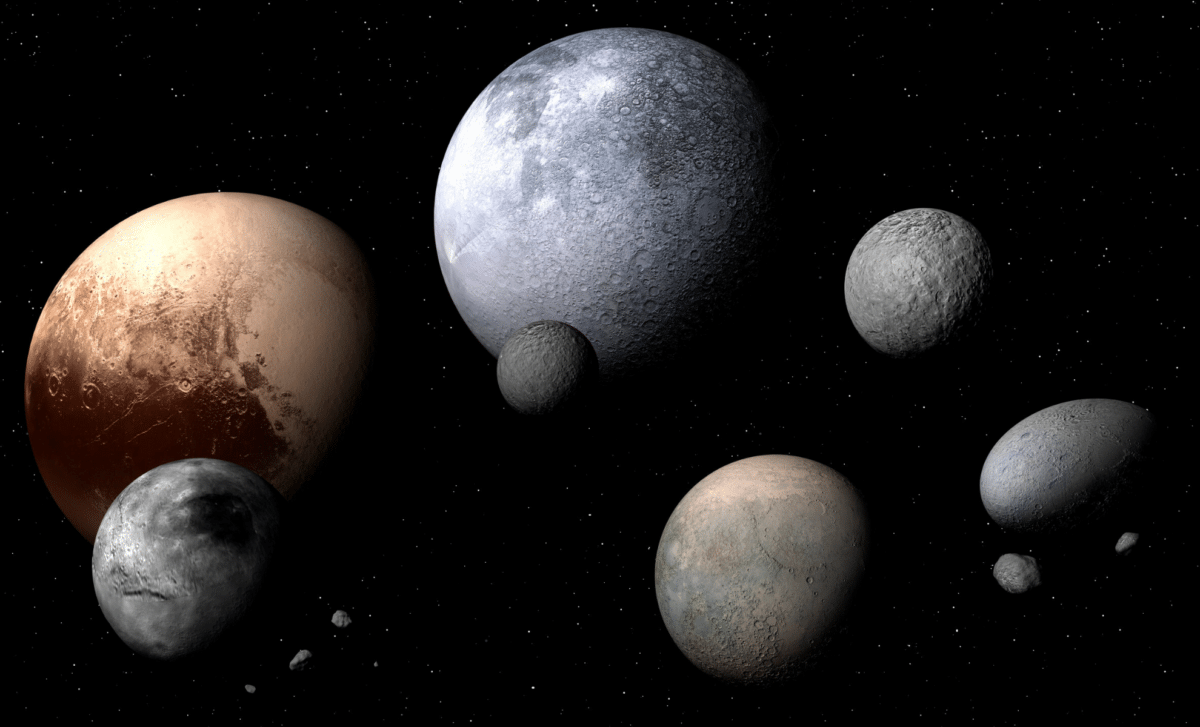
In 2025, astronomers uncovered more than 100 new moons orbiting planets in our solar system, an exciting discovery that could help unlock the mysteries of planetary formation. As reported by New Scientist, these findings, which include a new moon around Uranus and hundreds around Saturn, signal a deeper understanding of the processes that shape our solar system. These revelations offer a glimpse into the complexities of moon formation and the many more discoveries that may await.
The Surprising Discovery of Over 100 Moons
Astronomers have made a groundbreaking discovery in our solar system, uncovering more than 100 moons previously unknown to science. This collection of new moons is set to expand our understanding of how celestial bodies evolve and interact. According to New Scientist, the most notable findings include 128 moons around Saturn, pushing its total number of known moons to a staggering 274. These discoveries were made possible through cutting-edge techniques, including stacking multiple long-exposure images from the Canada-France-Hawaii Telescope, which allowed scientists to detect even the faintest objects in the vastness of space.
This monumental task of cataloging moons is not just a matter of adding more objects to a list, but a crucial step in piecing together the puzzle of planetary formation. As the lead researcher Edward Ashton noted,
“Everybody always likes to find new moons and everybody always likes to think about what they’re going to call them. It’s an exciting moment. It’s a bit of a legacy.”
With Saturn’s moons so numerous, the practice of naming them has evolved, with many moons now only referred to by numbers instead of the traditional mythological names.
The sheer scale of moons around Saturn highlights the complexity of this gas giant and its satellites. The discovery of new moons provides valuable insights into the mechanisms that shape planetary systems, allowing scientists to refine their models of planetary evolution.
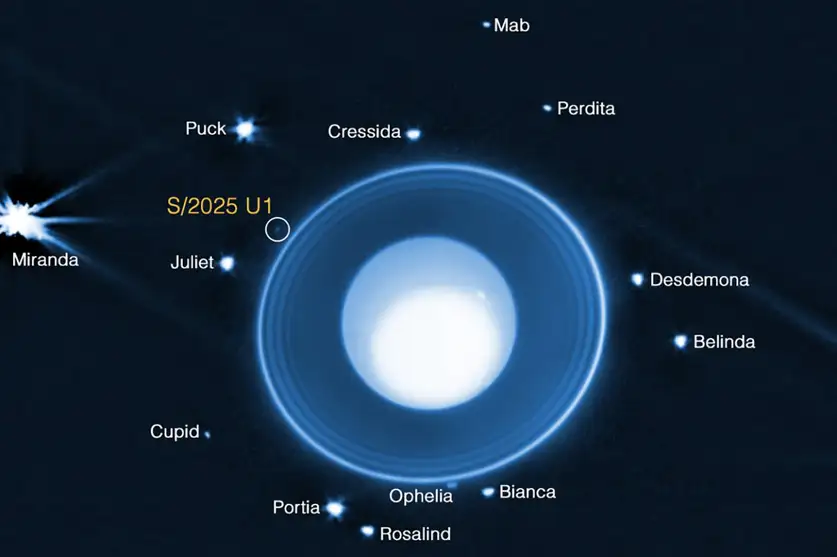 Uranus’s new moon, S/2025 U1, was spotted using the James Webb Space Telescope
NASA/ESA/CSA/STScI/M. El Moutamid (SwRI)/M. Hedman (University of Idaho)
New Moon of Uranus: A Mysterious Discovery
One of the more intriguing discoveries was the detection of a new moon orbiting Uranus, officially named S/2025 U1. Found using the James Webb Space Telescope, this moon is a small and dim object that was difficult to spot using conventional methods. Despite its faintness, its discovery adds to the growing catalog of moons orbiting Uranus, now totaling 29.
The process behind finding this moon is a testament to the advances in technology and the persistence of astronomers. The Webb Telescope, which captures long-exposure infrared images, has enabled scientists to peer deeper into space than ever before. While still unnamed, S/2025 U1 may eventually follow the naming conventions of other moons of Uranus, many of which are named after characters from Shakespeare’s plays, such as Titania and Oberon. This tradition dates back to the discovery of Uranus’s first moons in 1787.
Nigel Mason, a researcher from the University of Kent, points out the significance of these discoveries in understanding planetary systems. He reflects on the number of moons that still remain to be discovered, especially those around Neptune and Uranus. Mason states,
“Why are there so many? What is it that triggered [planets] to make 40, 50, 60 of such varying shapes and sizes? That’s why they’re exciting. It’s not just stamp collecting. It really is ‘wow’.”
The Fascinating Role of Moons in Planetary Evolution
Moons are not just fascinating for their sheer numbers; they also play a crucial role in understanding planetary formation. The discovery of new moons adds more pieces to the puzzle of how planets and their satellite systems come to be. The varying sizes and shapes of moons around Saturn, Uranus, and other planets raise important questions about the processes that lead to their creation.
As Mason emphasizes, studying the diversity of moons is more than an exercise in cataloging.
“Really surprisingly, the whole planet-formation process is not as well understood as we think.”
The discovery of moons with such varied characteristics helps to challenge and refine the existing models of how moons are formed, whether through capture, collision, or other processes.
Moreover, moons are important for understanding the history of their parent planets. The interaction between moons and their planets can reveal insights into the dynamic processes that govern celestial bodies, including the effects of gravitational interactions and tidal forces. Each moon adds a layer to our understanding of the complex nature of planetary systems.