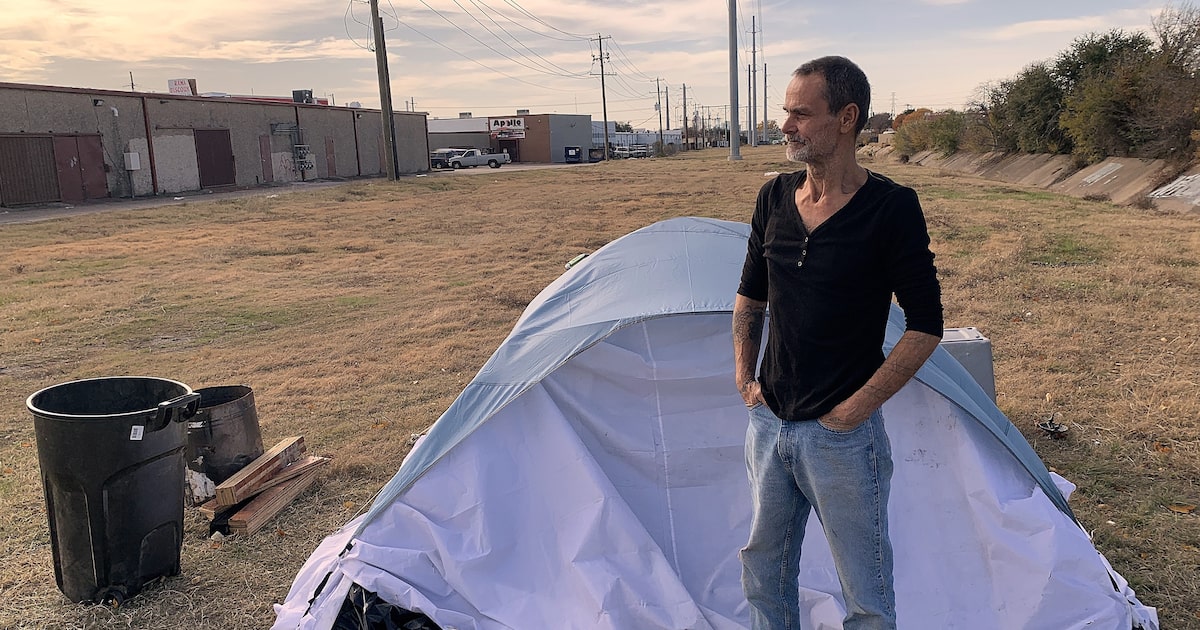

Doug Courtney lives in the blue tent pitched beneath the power lines on Harry Hines Boulevard a few yards north of Walnut Hill Lane. Just below his perch are the storm-drain tunnels, where people live until the waters rise high enough to wash away their belongings. Courtney has lived in the easement along Harry Hines and in the tunnels below for seven years. That’s when he lost his job and his woman and everything else.
“Situations bring you out here — or they will put you here,” he said last week. He was dressed in an old black pullover, faded jeans and well-worn work boots, and puffing on a cigar stub. The grass beneath a small barrel near his tent was scorched. Cars raced by. Planes flying into and out of Dallas Love Field sometimes made it hard to hear.
“In the Good Book it always says, until you pass that test, she’ll keep making you repeat it until you pass it,” Courtney said over the din. “Or you’re set out here for a reason — maybe to tell a story, to tell somebody else’s story or make them take a leap of faith.”
I’ve visited Courtney several times in recent weeks when waiting for — or, more often, looking for — the man named Charlie Brown, whom Container Store co-founder, environmentalist and civic leader Garrett Boone hired to clean the creeks spewing trash into the Elm Fork of the Trinity River. Brown disappeared again several days ago, last seen at the Stewpot, where he was supposed to pick up a new ID for a meeting with a disability caseworker to which he didn’t show yet again.
Boone, who found Brown in those tunnels more than two years ago, hasn’t heard from him in days. Courtney hasn’t seen him, either. Because that’s just what happens. People come and go in the city you drive over, away from. Everyone knows everything about everybody down here. But eventually they drift away to become just another name, another ill-fated anecdote.
Opinion
Like Tall Lucky, who folks down there say drowned in the floodwaters that tore through the tunnels before Christmas last year. Or Dorian, who, so the story goes, passed out face-first into a fire along Shady Trail — or maybe he was set on fire, hard to say. Or Mike, who lost his leg to frostbite.
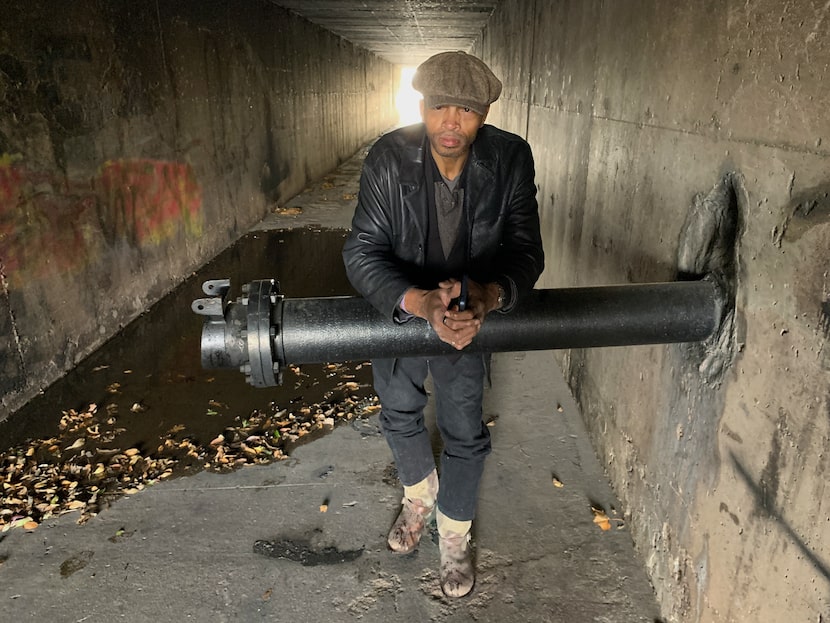
Charlie Brown lived in Tunnel Six for five years. He said he often clung to this pipe during flash floods, and kept his belongings chained to the pipe so they wouldn’t wash away.
Robert Wilonsky
Doug and Charlie spent five years as neighbors in these tunnels, alongside a man who calls himself Lucky Brown, who still lives down there with his girlfriend, who goes by Chocolate.
Charlie Brown got housing in a North Dallas apartment he has long complained keeps getting broken into. Courtney and Lucky and Chocolate have told me on several occasions they’ve been waiting on promised places for a long, long time.
“For probably a year or two,” Courtney said last week; Lucky, too.
In recent weeks I’ve heard that a lot from folks along the tunnels and in the increasingly crowded field behind the Shell station off Walnut Hill and North Stemmons Freeway. Last week I finally found Leanna Brosh, the woman with whom Charlie sometimes stays, cleaning up around her green tent along the fence line. She left for a few days and returned to find someone had set fire to some of her belongings left in the dead grass.
Brosh’s left leg was wrapped in white gauze; she said she was disabled, with a stack of documents from Parkland Hospital to prove it. She was disheveled and frustrated, complaining that she, too, was awaiting a roof promised but never delivered.
“I’ve seen a few of my friends get places,” she said, ticking off a handful of names. “But it’s never my turn.”
Because, to put it plainly, there’s no money.
Housing Forward, the agency tasked by the city with finding roofs for the unsheltered, had to beg— beg — the City Council for $10 million in American Rescue Plan Act funds a couple of weeks ago. And it’s still a fraction of what’s needed: Housing Forward has asked Dallas County to kick in an additional $10 million, and it hopes to raise another $8 million from private donors.
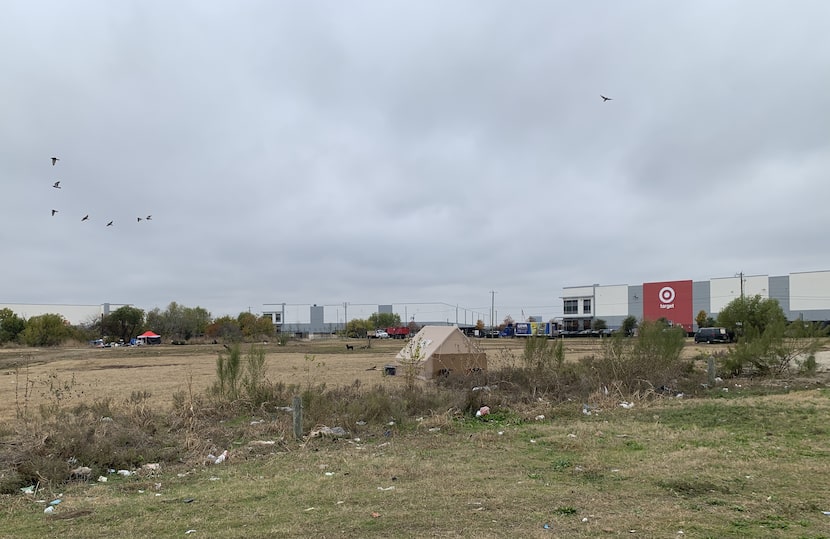
In the field off Walnut Hill Lane and N. Stemmons Freeway — a field owned by the Million Dollar Saloon, according to the Dallas Central Appraisal District — new tents appear to be popping up every day.
Robert Wilonsky
“And that money is going toward housing people out of the shelters,” said Housing Forward’s board chair Peter Brodsky, “so there’s always a place to bring people in from the street to the shelters.”
Except there’s often no room at the shelters, either: Daniel Roby, chief executive officer of the Austin Street Center, said Monday that for every one person the shelters accept, they have to turn away two or three more.
“There just aren’t beds available,” Roby said. “So those people are going to be on the streets until we find a way to get them off the streets, and it costs money.”
Money that keeps running out. Money that Housing Forward keeps having to beg for. Money that the Trump administration no longer wants to use for long-term housing programs, which threatens to send some 170,000 people back to the streets.
“We don’t want people just waiting around,” said Housing Forward President and CEO Sarah Kahn. “We want them to be self-sufficient. They want to be self-sufficient. It’s a misconception that they’re resistant to services. They want a viable pathway off the streets. But the one barrier we haven’t been able to bust is a sustainable source of revenue that feeds that rehousing machine every year. It’s tough.”
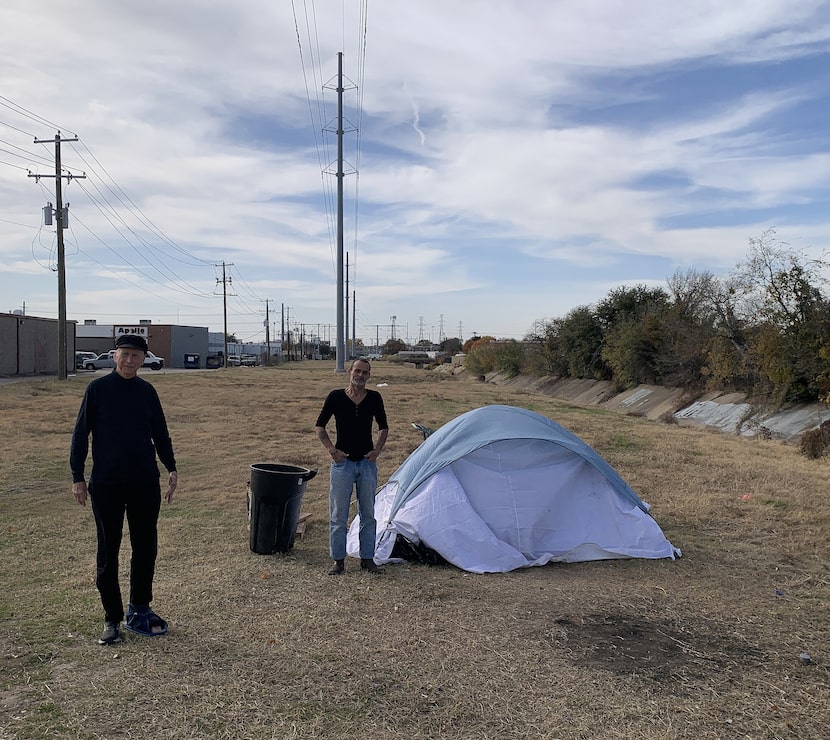
Garrett Boone, at left, has hired Doug Courtney, at right, to care for the creeks in Charlie Brown’s prolonged and unexplained absence.
Robert Wilonsky
And it gets tougher every day. There are already more than 3,000 unsheltered in Dallas County. And, according to Housing Forward, some 700 more people fall into homelessness every month. And God knows how many Charlie Browns are out there, too, people who got a home but couldn’t quite escape the street, either. And they don’t have a Garrett Boone watching over them.
Maybe think about that the next time you drive past Doug’s tent on Harry Hines, where the 57-year-old from Ohio climbs into dumpsters for tossed-out bottles of coffee, aspirin, cold medicine, bread, Gatorade, beef sticks, Ramen noodles, whatever else he can find and share.
“I mean, it’s no different than living like the Indians,” Courtney said. “No different. The Indians would go out and hunt. They hunt for the whole tribe. Right? They eat with the whole tribe and all that. They sleep separately, but they eat together. So I mean, you got to look at life like that.”
We spoke for a while one afternoon last week when Boone pulled up, with a trash can and some cash. Doug’s going to be cleaning up the creek now that Charlie Brown has disappeared. Because you always know where Doug’s going to be: in his blue tent on Harry Hines.
As Boone and Courtney visited, I saw Lucky Brown emerge from the tunnel in which he’s lived for eight years. The pianist and singer was taking his bike for a ride through the canals. I stopped him and asked how he got here.
“Music, legal trouble and a bad marriage,” he said. I said that sounded like a song lyric.
“And a good one! But even in my darkest hour, I’m glad I’m still here.” At which point he turned and rode away.