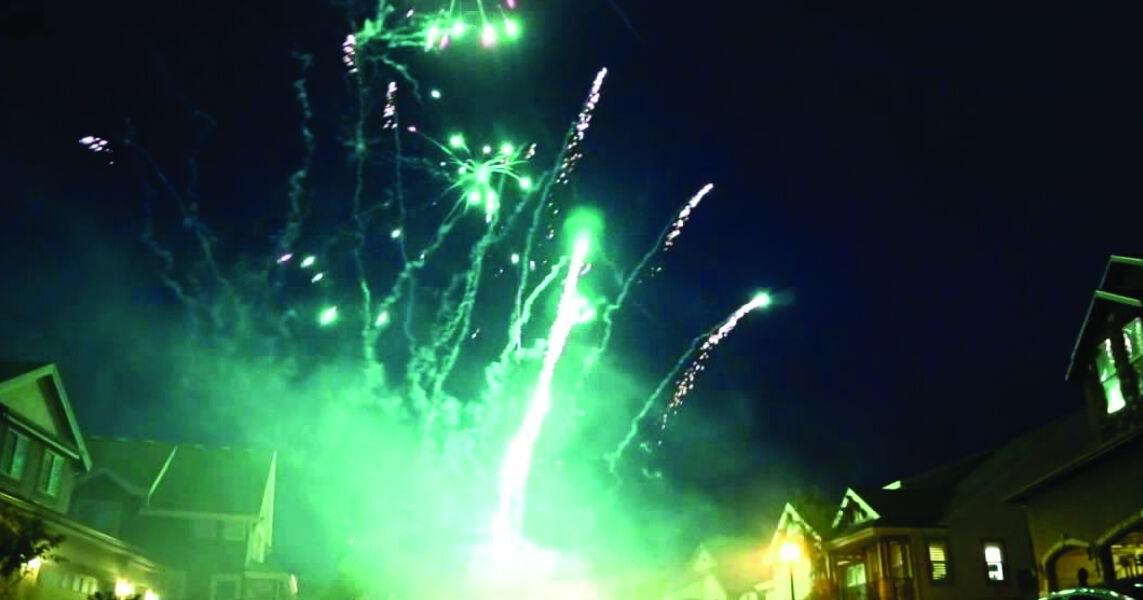
In a little noticed report to City Council early this month, Phoenix administration said that a coordinated crackdown on illegal fireworks, paired with an aggressive public education campaign, has significantly reduced emergency calls and safety risks during major holidays.
And with the period for legal fireworks use about to begin on Friday, Dec. 26, the report also underscored a major health concern driving that crackdown.
City leaders said illegal fireworks are no longer just a nuisance or fire hazard—they also are posing a growing public health threat tied to some of the worst air quality readings in the country.
Phoenix Fire Code regulations and state law, fireworks may be used by residents between Dec. 26 and Jan. 4 between 8 a.m. and 11 p.m. The exception is Dec. 31, when they can be used until 1 a.m. Jan. 1.
Permissable fireworks include sparklers, smoke devices, spinners and fountains. Prohibited are rockets and aerial fireworks and “anything that rises and explodes in the air,” according to city restrictions.
The memo to Council’s Public Safety and Justice Subcommittee detailed how fireworks smoke contributed to extreme pollution levels during recent holidays, including Jan. 1, 2025.
Air monitors that day in west Phoenix recorded the highest 24-hour fine particulate matter concentration in the United States and the third highest worldwide, according to regional air quality officials.
City officials say fireworks – especially illegal aerial devices – produce dense plumes of fine particulate matter known as PM-2.5, which can penetrate deep into the lungs and bloodstream.
These particles are particularly dangerous for children, older adults and residents with asthma, heart disease or other respiratory conditions.
“Fireworks smoke is not just temporary haze,” the report said. “It contributes to measurable health risks across the community.”
According to a January 2025 air quality briefing by the Maricopa Association of Governments (MAG), pollution levels spiked dramatically during New Year’s celebrations, overwhelming regional air monitors.
It reported that West Phoenix was not the only area in the city or the Valley with particularly high pollution concentrations on New Year’s Day 2025.
Other monitors in the region that registered dangerous levels of PM-2.5 included:
South Phoenix – 210.3, 23X higher than the standard.
Durango Complex – 167.4, 19X higher than the standard.
Mesa – 137.1, 15X higher than the standard.
“During the winter months, the Phoenix Metro area experiences a weather phenomenon known as inversion, where a warm layer of air traps a cooler, denser layer near the ground, preventing the atmosphere from mixing and allowing pollutants to accumulate,” the MAG report states.
“This inversion traps the dangerous particulates from consumer fireworks near the ground and in the air we breathe.”
Phoenix now integrates air quality considerations into its fireworks enforcement strategy for the first time.
While previous efforts focused primarily on fire prevention and noise complaints, the city’s Fireworks Safety Task Force is now coordinating with regional partners to address pollution impacts as well.
The council report detailed the work of the city’s Fireworks Safety Task Force, a multi-department group created last year in response to a surge in fireworks-related complaints and emergency calls around the Fourth of July and New Year’s holidays.
The group includes representatives from the city manager’s, communications, prosecutor’s and law departments, along with Phoenix police, fire, neighborhood services, and parks and recreation.
Over the past year, the task force implemented new enforcement and education strategies aimed at curbing the sale and use of illegal fireworks within city limits.
According to the report, Fire Prevention staff partnered with fireworks distributors to expand inspections at retail locations, conducting over 300 point-of-sale checks at stores and temporary tents selling consumer fireworks.
Of those, 123 locations were newly identified and “would not have been inspected” under previous protocols, according to the report.
City inspectors also conducted post-holiday checks to ensure fireworks were removed from shelves once legally allowed sales periods ended.
Police efforts focused on neighborhoods with historically high volumes of fireworks complaints.
In the days leading up to July 4, Phoenix Police Department Community Action Officers conducted data-driven outreach, visiting residents to explain fireworks laws, safety risks and reporting procedures.
From July 3 through the morning of July 5, each police precinct deployed a dedicated two-officer unit focused solely on fireworks enforcement.
“Dispatch-supported operations with a specialized radio code for fireworks, improving coordination and response efficiency,” the report states.
“All patrol officers received an employee notification system message containing a training video, enforcement guidance, and a legal bulletin developed in collaboration with the City Prosecutor’s Office.
“These combined efforts resulted in significant reductions in both fireworks-related calls and incidents of celebratory gunfire.”
City officials say the combined approach of education and enforcement has produced measurable results.
The Phoenix Fire Department reported a 49% reduction in fireworks-related calls over the past two years, while police saw declines in fireworks complaints and celebratory gunfire incidents during the July holiday period.
The city also rolled out an expanded public awareness campaign titled “Celebrate Safely.”
The multimedia effort ran from June 12 through July 6 and emphasized the use of legal, ground-based fireworks only, proper disposal of spent fireworks, maintaining safe distances, attending professional displays instead of using consumer fireworks, reporting illegal activity, and protecting pets from noise-related trauma.
Messages were distributed through social media, billboards and citywide communications channels, with support from partners including the Arizona Burn Foundation and the Humane Society.
According to city analytics, the campaign generated over 636,000 social media impressions and nearly 14,000 engagements across 81 posts.
“Zencity analysis revealed that public sentiment toward the messaging was generally positive, providing recommendations for future improvements. A media event and distribution of printed materials, both in English and Spanish, further extended outreach,” the report states.
Looking ahead to next week, the task force is increasing coordination and planning.
Interdepartmental meetings that began in October are scheduled to move to a weekly cadence in December, focusing on staffing, enforcement priorities, and messaging related to both fireworks and celebratory gunfire.
The city is also reassessing its operational plans based on lessons learned from July 4, expanding regional collaboration with the Maricopa Association of Governments and other partners, and increasing public education around fireworks safety and Shannon’s Law, according to the report.
Shannon’s Law makes shooting a gun into the air a felony. It was passed in 2000, the year after a 14-year-old Phoenix girl who was killed by a stray bullet fired into the air during a celebration.
The report also said city officials will be “exploring the development of proposed City Code updates to further enhance public safety.”
However, efforts by Phoenix and any Arizona municipality to control fireworks use is limited by state law, as the Legislature passed a law over six years ago that forbids cities and towns from banning their use altogether.