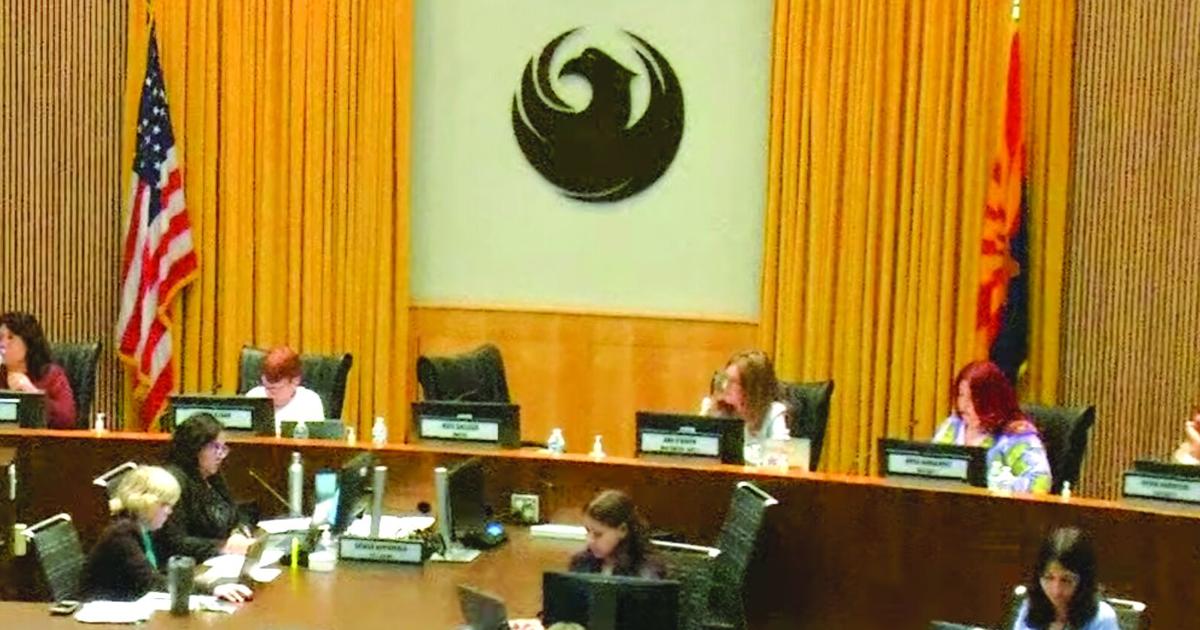
A heated debate over Phoenix residents’ rights to enjoy city parks without used syringes versus the assertion that homeless people need medical treatment in them played out for hours before City Council Dec. 17.
And in the end after over four hours of speeches, Council approved the ordinance – but delayed its implementation for 90 days so it could be clarified with the input of healthcare professionals and advocates who work with unsheltered people.
And that could mean Council would be voting again in March on an entirely different ordinance with possible exemptions and other conditions.
The measure would prohibit “any person, group or organization to invite, promote, advertise, sponsor, organize, or conduct an event or activity designed to provide medical treatment to the public in a park, unless such event or activity is sponsored by or otherwise authorized by the city by approval through established city processes.”
It also prohibited “any person, group or organization to invite, promote, advertise, sponsor, organize or conduct the sale or exchange of syringes and needles or organize or conduct a needle exchange or a needle exchange program.”
That prohibition included giving away a “harm reduction kit,” which it defined as “any collection of paraphernalia used to save the life or protect” people from the consequences of drug use, particularly syringes, alcohol wipes and testing kits.
The ordinance had been in the making for months and came in response to what numerous council members said last week were barrages of complaints by parents about discarded syringes.
At one point Councilwoman Kesha Hodge-Washington asked city Parks Department Director Cynthia Aguilar if she kept mentioning discarded needles in parks “because we’ve had multiple incidents where our employees have been exposed or pricked by needles, and then those employees have had to undergo medical testing to ensure that they have not been infected with something.”
Aguilar replied, “Unfortunately, we do every year, experience circumstances where parks employees undergo the situation or experience the situation you described.”
While no instances of residents experiencing the same issue were mentioned, testimony several months ago before a council subcommittee indicated there have been numerous instances where users and employees have found bloody bandages and other medical paraphernalia scattered around ramadas or in trash cans.
Looming over the entire debate, moreover, is Proposition 312, which allows property owners to claim a refund of their property tax payments if a city, county or town fails to curb homeless encampments, persistent panhandling or related nuisances.
The debate became so intense between some council members and ordinance opponents who jammed council chambers that at one point, City Attorney Julie Kriegh interrupted an angry Councilman Jim Waring buy stating:
“Every person has the right to speak without fear of retaliation or being interrupted. If you are disruptive in the audience or at the podium, you may be asked to leave the meeting.”
Waring was particularly upset with a speaker who claimed reports of problems related to medical treatment in parks were unsubstantiated.
He cited one woman who said such conduct was “wrecking her neighborhood.”
Waring harkened to Council’s 2006 passage of a law forbidding smoking in public places because it was “wrecking it for everybody else.
“So now voters have spent billions on our parks and our libraries, and they feel like they can’t use them,” Waring said. “There’s gonna be pushback. It’s here now. …People are tired of it.”
Councilman Kevin Robinson said that while he understood the need for compassion for people with no homes who needed medical care, he also was concerned about the city’s liability if a park user contracted a disease through contact with medical waste allowed in parks.
Scores of opponents of the measure decried the ordinance, with some criticizing the fact that city staff did not confer with medical professionals involved in the park programs in creating the rule.
“You cannot respond effectively to homelessness, extreme heat or public health emergencies while simultaneously restricting overdose prevention services in the very spaces people are forced to be (where) these policies are in direct conflict,” said Dominic Orso, who said he has in the past managed the city’s naloxone distribution program that reverses overdoses in many cases if administered in a timely manner.
“This ordinance does not prevent drug use – it prevents intervention,” Orso said. “It does not improve safety. It creates gaps where people fall through and sometimes die. I want to remind the Council of something fundamental. The people most affected by those by this ordinance are also your constituents.
“You do not get to pick and choose which constituents deserve care protection or public health services, people who are unhoused, people who use drugs, people in crisis, every single one of them is a Phoenician. Our parks do not divide people into worthy and unworthy.”
In the end, Councilwoman Laura Pastore initially moved to delay implementation of the ordinance for 90 days so that city staff could confer with medical professionals and groups that help street people.
After some debate as to whether the ordinance would take effect if staff did not come back to council with changes.
During that discussion, Pastore and colleagues Betty Guardado and Anna Hernandez expressed reservations about curtailing medical treatment for homeless people in parks and that the state Legislature was partly to blame.
They also expressed concern about an adverse impact on emergency calls for the city Fire Department and whether those calls would significantly increase if the park programs were not in operation.
“I have absolutely zero idea what the impact for the Fire Department,” Hernandez complained the ordinance could result in “increased calls that could very likely result in increased or delayed, longer call response call times to meet all of our residents.”
Hernandez then apologized to the audience, stating:
“I want to apologize to the professionals in the room, to the medical students in the room, to the residents that spend hours of their day to come to use your voice to advocate with evidence-based solutions and advice on how this city should be crafting policy.
“I’m truly sorry that the opinion and the facts that you as professionals in these fields and the providers do – health care, access to our most vulnerable residents – seem to not matter tonight.”
She said the process was being handled in a backwards fashion without adequate study and preparation.
“I have to take a vote on some on an empty piece of paper with zero guarantees that we will save lives as the fifth largest city in the United States,” Hernandez said. “It is shameful that our answer to an overwhelming need for access to care is to lean towards criminalization and restrictions in our public parks.
“Nothing in this ordinance will make our parks safer. Nothing in this ordinance will make our communities across Phoenix safer… Instead, what we are saying is that as the leaders of this city, we are okay with pushing our most vulnerable residents further into the shadows, further into neglect and further into despair.”