In a remarkable discovery, researchers have unearthed 10 new species of fossilized spiders from the Mesozoic era, including one whose eyes still reflect light, 110 million years after its death. This rare find, published in the Journal of Systematic Palaeontology, discovered by researchers from the Korea Polar Research Institute and the University of Kansas, have expanded our understanding of ancient eight-legged creature. While many of these species are similar to those known today, the preservation of their eyes presents an extraordinary insight into the evolutionary adaptations of these creatures.
A Window Into the Past: The Jinju Formation’s Fossils
The Jinju Formation in South Korea, which dates back to the Mesozoic era, has long been known as a rich source of fossils, but the preservation of soft-bodied creatures has been a rare occurrence. Unlike bones or hard exoskeletons, the delicate bodies of spiders are difficult to preserve.
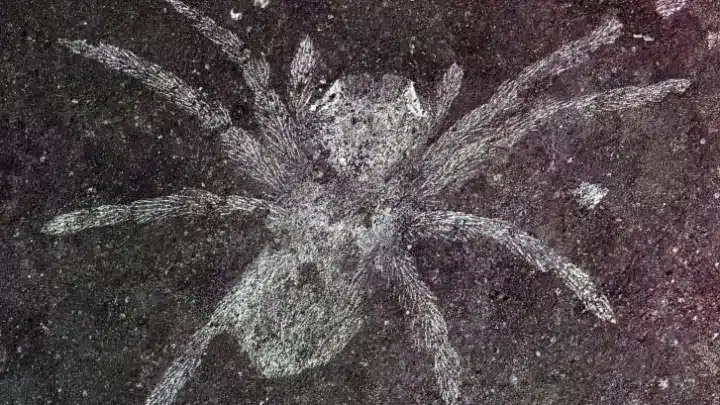 Fossilized spider from the Cretaceous period, showing exceptional detail preserved in rock. Credit: Paul Selden
However, researchers from the Korea Polar Research Institute and the University of Kansas discovered 10 new species of creepy-crawlers preserved in shale, a rare condition that allowed for the detailed preservation of their soft bodies. According to Paul Selden, a geologist at the University of Kansas, this discovery is exciting because it opens a new window into the Cretaceous period’s spider diversity.
“Because these spiders were preserved in strange slivery flecks on dark rock, what was immediately obvious was their rather large eyes brightly marked with crescentic features,” he explained in a statement.
Fossilized Spiders with Eyes That Still Reflect Light
What sets this discovery apart is the preservation of a tapetum in the eyes of two of the newly discovered spiders. The tapetum is a reflective layer found in the eyes of many nocturnal animals, like cats, which helps them see in low light, and this was the first time a tapetum had been identified in fossilized spiders.
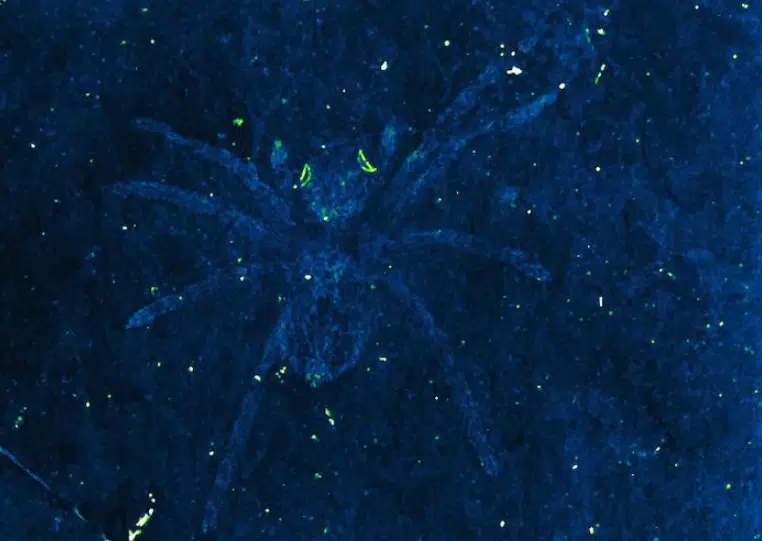 Two of the Korean fossils revealed reflective eyes. Credit: Paul Selden
The preservation of these reflective eye structures suggests that these spiders, like some modern-day species, may have been nocturnal hunters. As Selden explains:
“I realized this must have been the tapetum — that’s a reflective structure in an inverted eye where light comes in and is reverted back into retina cells,” he added, “It’s nice to have exceptionally well-preserved features of internal anatomy like eye structure. It’s really not often you get something like that preserved in a fossil.”
Expanding the Cretaceous Web: A New Era in Arachnid Discovery
According to the research, published in the Journal of Systematic Palaeontology, the eight-legged creatures from this era are rarely preserved in fossil records, making this find particularly important for paleontologists. By identifying 10 new species, the researchers have greatly expanded the known diversity of funnel-web spiders from this time. Selden notes that these creatures, particularly those with the tapetum, likely occupied ecological niches similar to those of modern-day jumping arachnids.
“This is an extinct family of spiders that were clearly very common in the Cretaceous and were occupying niches now occupied by jumping spiders that didn’t evolve until later,” he explained.“But these spiders were doing things differently. Their eye structure is different from jumping spiders.”
The next step for researchers is to revisit amber-preserved spiders, more common than rock fossils, to investigate whether they too have a tapetum lucidum layer in their eyes.
“Amber fossils are beautiful, they look wonderful, but they preserve things in a different way,” Selden stated. “Now, we want to go back and look at the amber fossils and see if we can find the tapetum, which stares out at you from rock fossils but isn’t so obvious in amber ones because the mode of preservation is so different.”