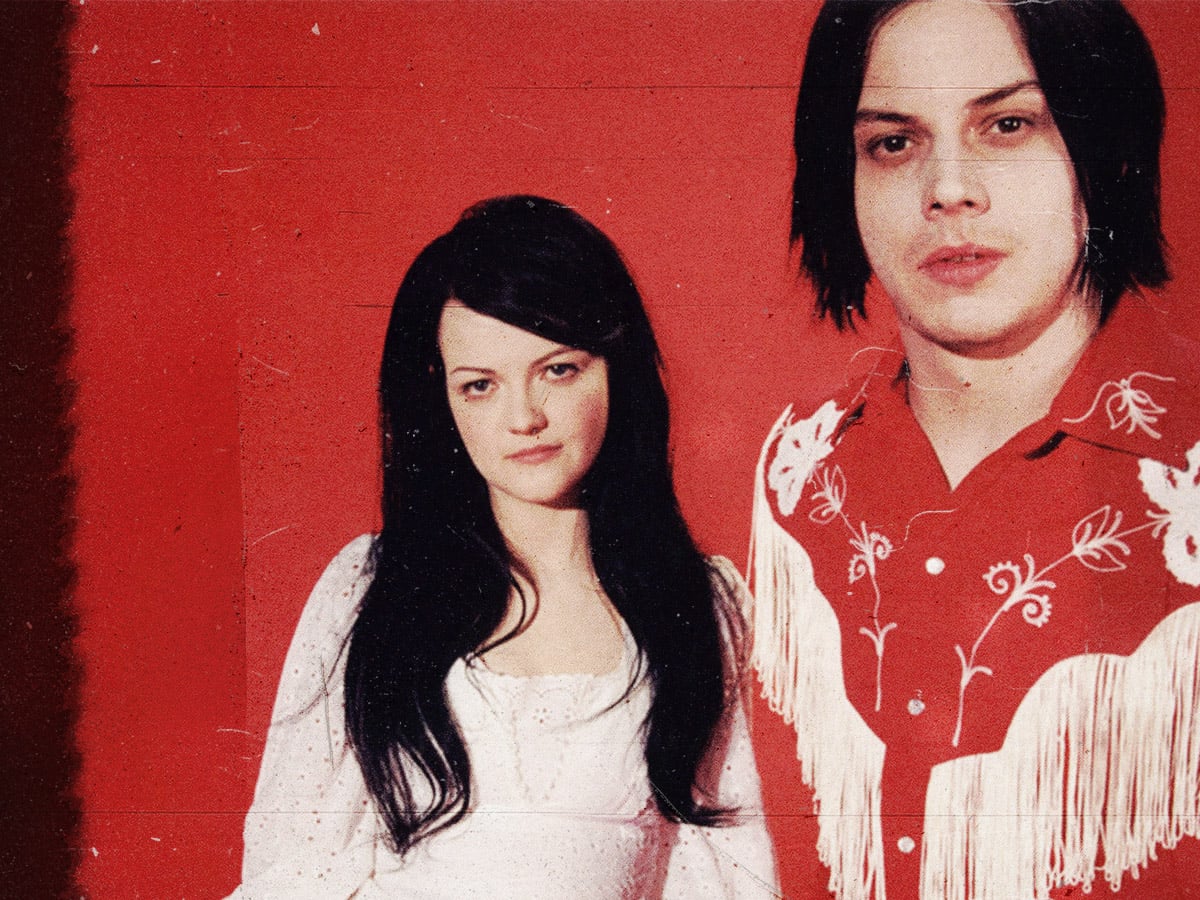
(Credits: Far Out / The White Stripes / Third Man Records)
Sun 28 December 2025 6:00, UK
Looking back on their emergence, it’s quite perplexing to think that a band like The White Stripes were able to become wildly successful at the turn of the millennium with a sound so raw and drenched in influence from long-gone styles.
Of course, there can obviously be revivals of forgotten scenes and musical movements at any point in history, and garage rock did seem to have a prominent comeback in the early 2000s, but what the Detroit duo of Jack and Meg White were offering was considerably bluesier compared to what acts like The Hives, and to a lesser extent, The Strokes were delivering at the time.
Their third album, White Blood Cells, was the record that helped propel them further into the mainstream, and was definitely a little more polished than their first two records, but it still possessed a minimalist approach to a certain degree, which was something that they built up over the course of the early releases. Rarely ever adding more than just guitar, vocals and drums, the band took simplicity to another level, and yet audiences were enthralled by their approach.
As much as they were clearly a formidable group, it was not likely that something so heavily influenced by blues from the 1950s and earlier could make its way into the lower end of the charts, let alone onto television.
However, they did manage to do that while promoting the release of De Stijl, making their debut appearance on Backstage Pass in 2000, a show that focused primarily on the art and entertainment scene of their home city of Detroit.
De Stijl, much like their self-titled debut, was an album that was recorded with little in the way of additional personnel, with only a harmonica and violin being added to three songs, and had very few overdubs crowding the mix of the record. All recorded live from the comfort of Jack White’s living room, it’s a truly basic record, and yet it gets straight to the point with its mission.
The beauty of the songs comes through because of how easy it is to penetrate them and get to the core of what The White Stripes were attempting to achieve, and when you’ve got little else distracting the listener, you’re forced to focus on all of the imperfections rather than finer details.
During their appearance on Backstage Pass, they played two songs, closing the credits with a cover of Son House’s ‘Death Letter’ which was also a highlight from the record, but they also chose to perform their often-forgotten early classic ‘Apple Blossom’, and did so in typically captivating fashion without any embellishments to bolster their sound and make it potentially more accessible to a modern audience who would want to hear a fuller sound.
Incredibly raw, wholly naive, but sublime in all senses, this is a prime example of The White Stripes at their purest, and while later stuff is perhaps even better and more refined, you can’t really avoid being captivated by the rudimentary charm of their earliest material.
Related Topics