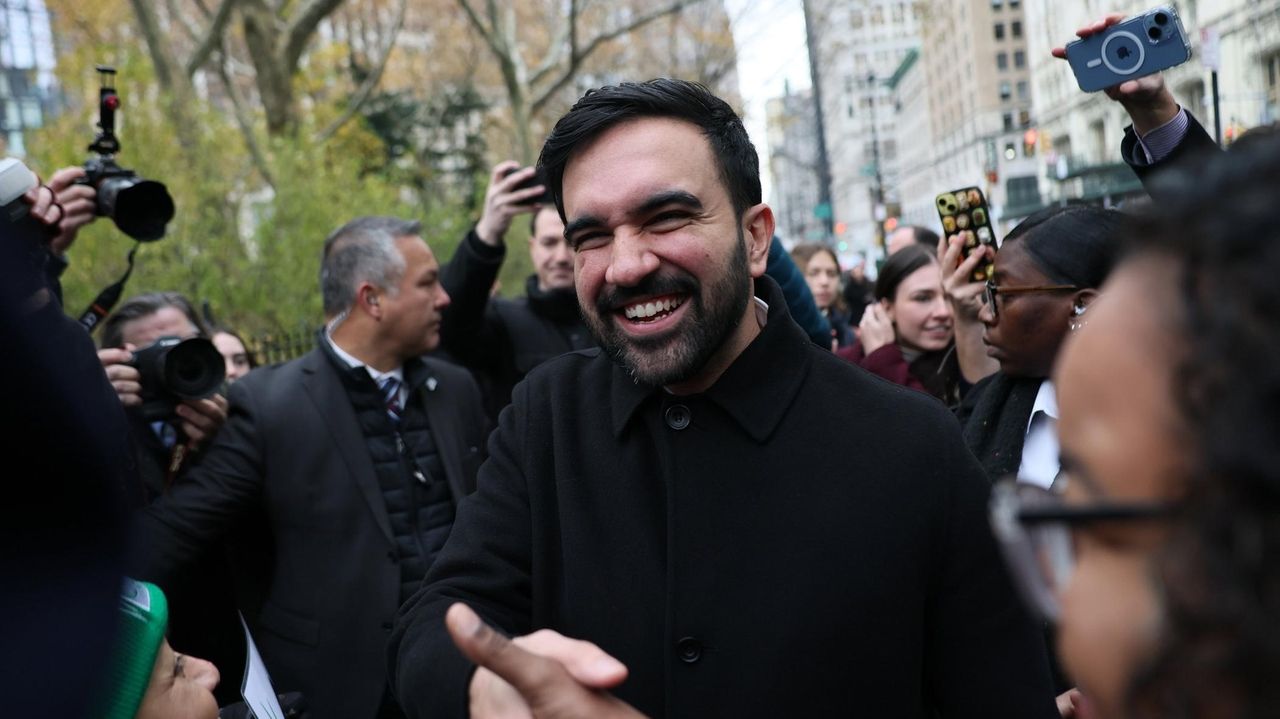
Before Zohran Mamdani became a household name earlier this year, before he twice toppled the Cuomo political dynasty, before he was mayor-elect of America’s most important city or even had launched a longshot bid for City Hall, he was a backbench legislator in 2021 joining a hunger strike outside City Hall.
“He was pretty weak. I think at times, maybe he had some Gatorade, or maybe some broth,” said Jabari Brisport, a state senator from Brooklyn who ran for office with Mamdani, who also has protested for other causes: against Israeli policies, for Palestinian rights, and against President Donald Trump’s border czar and for immigrants’ rights.
The issue catalyzing the hunger strike: indebted cabbies, sold on the supposedly solid investment of a medallion permitting a driver to pick up street hails, but who were plunged into crippling debt after the introduction of Uber and other apps.
After just over two weeks hunger-striking, the cabbies and their allies scored a major victory in getting the biggest owner of taxi loans to help restructure the debt, as well as the expansion of a relief program.
WHAT NEWSDAY FOUND
- Zohran Mamdani will be inaugurated mayor of New York City on Thursday, promising to focus on affordability — free childcare, fare-free buses, a rent freeze on regulated apartments and government-run grocery stores.
- His disciplined campaign, starting with barely 1% support in opinion polls, will segue into an administration with more than 300,000 employees and $115 billion budget.
- When Mamdani is sworn in, he’ll become the city’s first South Asian mayor and first Muslim mayor, and the first foreign-born mayor in five decades.
On Thursday, Mamdani will be inaugurated the 111th — or possibly the 112th, because of a just-detected record-keeping glitch by city historians — mayor of New York City. He’s promised to channel his past protesting and battling for left-leaning causes into a laser-focus on affordability — free childcare, fast and fare-free buses, a rent freeze on regulated apartments, government-run grocery stores — that helped catapult him to the mayoralty.
His disciplined campaign, starting with barely 1% support in opinion polls, will in days segue into an administration with more than 300,000 municipal employees and $118 billion budget.
“What you see is truly what you get, which is so not in the norm for post politicians,” said Bhairavi Desai, executive director of the New York Taxi Workers Alliance, with more than 28,000 members. “I think what motivates him is, he’s deeply caring. He is genuinely a good person who deeply cares about poor people and about those that are oppressed and on the margins of power.”
Mamdani is a democratic socialist — a sharp turn to the left from the incumbent, centrist and onetime Republican Eric Adams — and has spoken favorably, in the abstract, about a key plank of communism: “seizing the means of production.”
His unabashedly left-leaning politics has drawn criticism from centrists, some Democrats, and Republicans who question the wisdom of his proposals, including one to raise taxes on the rich and the biggest corporations.
“Mamdani is young, naïve and inexperienced. He’ll learn on the job, or he won’t. Socialists will share his success and the rest will suffer for his failure,” said the political consultant Ken Frydman, a onetime spokesman for Rudy Giuliani’s mayoral campaign.
Mamdani’s agenda faces headwinds: the state must greenlight most tax increases, Gov. Kathy Hochul is running for re-election in 2026 and has ruled out income tax hikes, Mayor Eric Adams is leaving his successor a $4.7 billion budget deficit, and the White House has choked off federal funding to cities, especially Blue ones.
Mamdani says expanding the social safety net and making the city affordable for the middle class is critical to keeping New York a city for more than just the rich. And, in rebutting skeptics, he has cited his own unlikely victory in quoting his hero Nelson Mandela: “It always seems impossible until it’s done.”
In January, he told Newsday that a key way to prevent New York City residents from moving out to suburbs like Long Island was to make childcare free, a plank of his ultimately successful campaign.
“If we are serious about making the city more affordable for families, or making it easier for people to raise families here, what we need to do is make childcare universal, taking twenty- to twenty-five thousand dollars a year off the backs of working parents,” he said.
His rise from Uganda
Mamdani is 34 years old and married to the artist Rama Duwaji.
Mamdani, born and raised in Kampala, Uganda, is part of the 38% of New York City’s population that, according to a report last month by the Center for Migration Studies, is foreign-born. He and his family — a filmmaker mother, Mira Nair, and academic father, Mahmood Mamdani — moved to America when he was 7, and was naturalized in 2018 as a U.S. citizen.
His mother’s films include “Mississippi Masala” and “The Namesake”; his father is a Columbia University professor, expert at decolonial studies and critic of Israel who, as does his mayor-elect son, calls for a secular state where all have equal rights, not a Jewish state.
Since Mamdani skyrocketed to popularity in the past nine months, his roots have been a source of pride — for Muslims, for South Asians, for immigrant Americans broadly, including on Long Island.
When Mamdani is sworn in Thursday, he’ll become the city’s first South Asian mayor, first Muslim mayor and the first foreign-born mayor in five decades. (Abe Beame, who took office in 1974, was born in London to Polish parents.)
Mamdani’s ascent has also been met with scorn, including initially from President Donald Trump, who channeled some voices on the right in musing over the summer that Mamdani might not be a legitimate citizen, and Trump threatened to arrest and deport him. (In November, the two men met and appear to have come to a rapprochement.)
The pronunciation of Mamdani’s name — or mispronunciation — throughout the election became a prism and Rorschach blot.
“The name is ‘Mamdani’: M-A-M-D-A-N-I. You should learn how to say it, because — we gotta get it right.” Mamdani scolded the opponent he would go on to defeat, Andrew Cuomo, who had repeatedly mispronounced Mamdani’s name.
In the U.S., Mamdani attended private school until scoring high enough on the ultra-competitive admission test to attend the prestigious Bronx High School of Science, where he co-founded its cricket team which went on to compete in the city’s Public Schools Athletic League.
That experience, his Assembly biography says, “though not ostensibly a political one, taught him how coming together with a few like-minded individuals can transform rhetoric into reality.”
It was at Bronx Science that Mamdani ran for one of his first political offices — which he did not win — for student vice president. It was “ultimately an unsuccessful run” and his opponent “whooped” him, he later said on a podcast in 2017.
Mamdani recalled that a social studies teacher told him that a rap-themed campaign video — he sometimes went by Mr. Cardamom — was to blame for the loss.
Among his campaign promises then: fresh juice for everyone, using locally sourced fruits, and credits for attending after-school games in lieu of gym.
He graduated in 2014 from Bowdoin College in Maine with a degree in Africana Studies with a minor in government and co-founded the school’s first chapter of Students for Justice in Palestine.
After Bowdoin, Mamdani flitted between various passions — rap, film, writing. He was also a foreclosure-prevention housing counselor to help poor homeowners avoid eviction, and he managed the ultimately unsuccessful state Senate candidacy of Ross Barkan, who ran as a Democrat, in a Brooklyn district far from solid blue in 2018.
“Since the district we were running in was held by a Republican — and the Democratic primary we had to compete in featured many registered Democrats who were effectively Republicans — Zohran had to try to sell progressive ideas to an electorate that could be, at times, hostile to them,” Barkan said. “He had to be in dialogue, constantly, with voters. Zohran and I knocked many hundreds of doors together and I do believe these kinds of conversations helped shape him. He understood that voters could be persuaded but also had to be met where they were.”
Two years later, Mamdani ran, and won, a state Assembly seat representing northwest Queens.
In the run-up to Mamdani’s mayoral campaign, and a few days after Trump’s victory in 2024, Mamdani filmed himself talking to Trump supporters in the Bronx and Queens, where he heard the concerns of working-class New Yorkers who had cast their ballots for Trump.
A year later, Mamdani recounted that experience — on Fordham Road in the Bronx and Hillside Avenue in Queens, near Trump’s childhood home, in Jamaica Estates — when meeting with Trump at the White House last month.
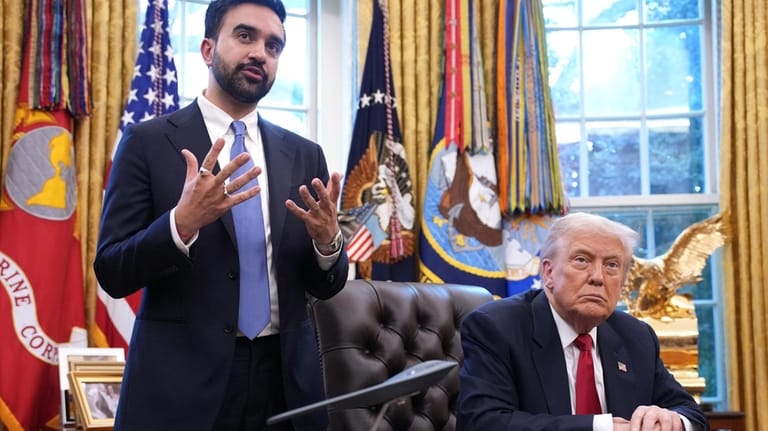
President Donald Trump meets with New York City Mayor-elect Zohran Mamdani in the Oval Office of the White House on November 21, 2025 in Washington, DC. Credit: Getty Images/Andrew Harnik
Still, Mamdani has always been, at heart, a leftist, with sympathy for the Palestinian cause, an advocate for a stronger social-safety net, changes to the criminal justice system, advocacy for tenants, Barkan said.
“I believed he developed his political views when he was much younger. His parents were very influential. I haven’t seen much change, truthfully, from 2018 until today. He was earnest then and earnest now,” Barkan said.
Back then, even earlier this year, few could have predicted that Mamdani would catapult to the New York City mayoralty, surmounting a dynastic ex-governor and politicians with decades more experience.
Even some of Mamdani’s closest allies — at first — didn’t believe it possible for him to win the mayoralty.
“It was totally a surprise. When he first told me he wanted to do that, I told him he couldn’t win, and it would be a waste of time and money to go for it,” Brisport said. “So, he proved me wrong.”
Matthew Chayes, a Newsday reporter since 2007, covers New York City.