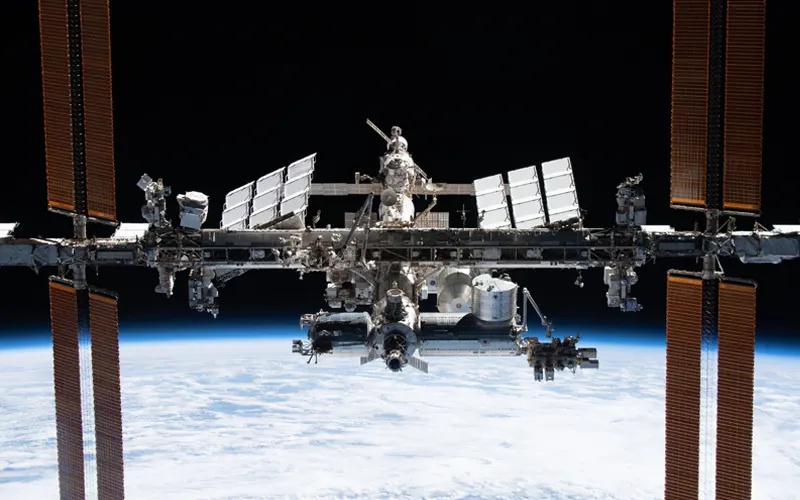
 Credit: NASA / ESA / T. Pesquet
The European Space Agency has cancelled a call for proposals to procure commercial cargo transportation services to the International Space Station (ISS). The services were intended to help the agency meet its obligations under the station’s Common System Operations Costs (CSOC) framework, which defines the shared responsibility of ISS partners to contribute to the station’s general upkeep, including crew and cargo transportation.
In the past, ESA met its CSOC obligations by transporting cargo to the ISS aboard the Automated Transfer Vehicle. More recently, the agency has agreed to supply European Service Modules for use aboard NASA’s Orion spacecraft to fulfil those commitments. To ensure a continued European presence aboard the station through to its planned decommissioning in 2030, the agency is once again preparing to commit some form of in-kind services.
On 3 October, ESA published a call for proposals under its CSOC Cargo Commercially Procured Offset (3CPO) initiative, seeking commercial transport services to the ISS to deliver between 4,900 and 5,000 kilograms of pressurised cargo to the orbiting laboratory. According to the call, the mission was intended to act as a “strategic offset’ to secure flight opportunities for ESA astronauts. It did, however, stipulate that the prospective procurement would only proceed if member states agreed to fund the initiative at the agency’s Ministerial Council meeting on 26 and 27 November 2025.
Following the late November meeting, ESA announced that member states had “agreed to implement short-term actions to guarantee European astronauts’ access to the International Space Station until its planned end of exploitation in 2030.” While this initially appeared to signal a favourable decision on the 3CPO initiative, the agency formally cancelled the call on 17 December, citing “the implementation of programmatic adjustments.” While the announcement did not provide any further details, some insight into the decision was offered during a press briefing following the 342nd ESA Council meeting, held on 17 and 18 December.
During the briefing, Director of Human and Robotic Exploration Daniel Neuenschwander was asked about a delay to ESA career astronaut Raphaël Liégeois’s flight to the ISS. While Liégeois had been expected to travel to the ISS in 2026, Neuenschwander could not confirm when the mission was now expected to take place.
“He will fly in a timeframe which will be clearly before the next Ministerial Council,” said Neuenschwander. The next ESA Ministerial Council meeting is expected to take place in late 2028, implying that Liégeois’s flight opportunity could be delayed by up to two years.
Neuenschwander explained that the delay was linked to ongoing discussions over the agency’s “transportation manifest,” noting that “there are two options at hand.” He did, however, add that decisions and funding commitments made during the 2025 Ministerial Council meeting in Bremen will fully cover the agency’s CSOC obligations for Liégeois’s flight.
Keep European Spaceflight Independent
Your donation will help European Spaceflight to continue digging into the stories others miss. Every euro keeps our reporting alive.