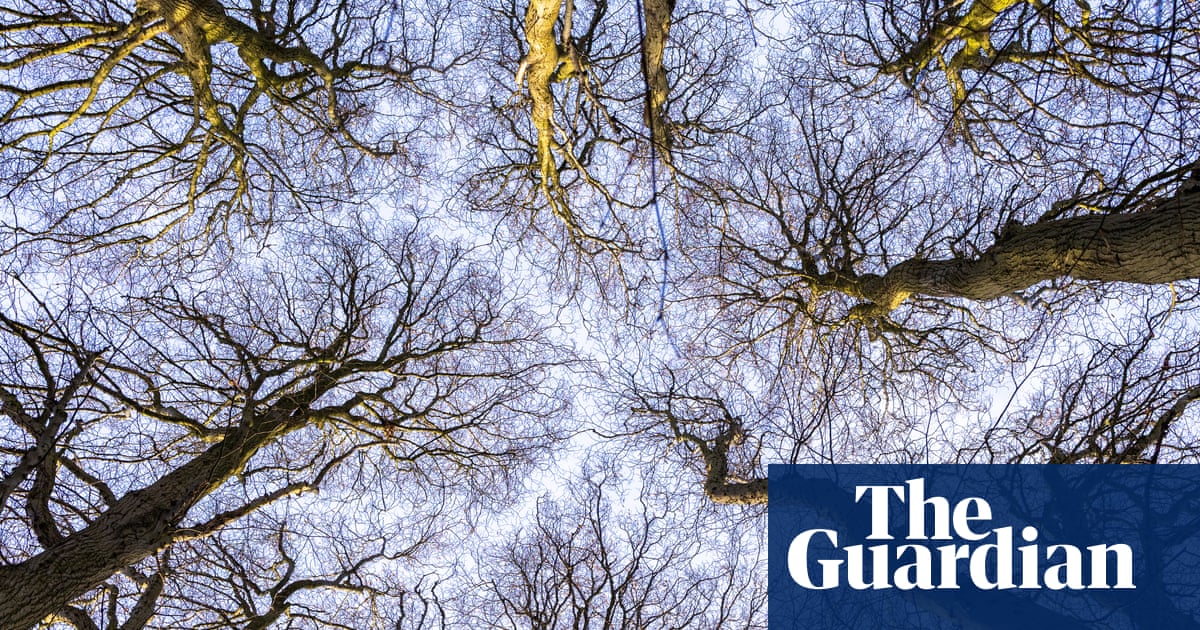
On a bright winter’s day, I stand at the centre of a ring of multi‑stemmed small-leaved limes. Their gnarled bases are furred with moss and feathered with sprays of epicormic growth. Lime trees are notoriously hard to age, but this one is probably more than 500 years old, shaped and reshaped by centuries of coppicing, now with a vast canopy stretching nearly 20 metres.
Looking up, I marvel at the intricate fractal lattice of branches and twigs of each tree. Every stem holds its own space, the crowns kept neatly apart from their neighbours – a quiet phenomenon known as crown shyness. This seems somehow appropriate, given how quiet the woodland is. It feels emptied, with only the rush of a chill wind numbing my bare fingertips, a peal of distant church bells, and a robin offering its muted winter song.
‘Their gnarled bases are furred with moss and feathered with sprays of epicormic growth.’ Photograph: Sarah Lambert
I close my eyes and try to imagine how differently Old Sulehay Forest might have sounded centuries ago: the chatter of woodsmen harvesting hazel, ash, oak and lime, voices and tools echoing between the trunks. John Clare hints at this lost soundscape in his poem May: “While wood men still on spring intrudes / And thins the shadow solitudes / Wi sharpend axes felling down / The oak trees budding into brown”.
The centuries-old technique of coppicing – cutting close to the ground every few years to encourage rapid growth – once bound people closely to these trees. Oak bark was used to tan leather, while fine-grained lime wood was prized for carving and turning.
Lime poles were also harvested for the strong fibres beneath the bark – bast – which could be twisted into rope and cordage. Stripped in early summer, the bark was submerged in water for months, then dried and stored, ready to be worked when needed. This ancient craft has recently been revived in a nearby lime wood.
Small-leaved lime seedlings. Photograph: Sarah Lambert
Pollen records show that, around 6,000 years ago, small-leaved lime was among Britain’s most abundant trees. Now it is largely confined to ancient woodland, and its seeds are rarely fertile without hot summers. Yet in recent years I’ve increasingly noticed carpets of lime seedlings in local woods – a small, hopeful sign that this charismatic tree may yet find new opportunities in a changing climate.
Under the Changing Skies: The Best of the Guardian’s Country Diary, 2018-2024 is published by Guardian Faber; order at guardianbookshop.com and get a 15% discount