A lot has changed since November: the ACC favorite, the Big Ten race, and our assessments of 2026 WNBA draft prospects.
In lieu of a full midseason Draft Board v2.0, we’re back with some quick midseason updates. There are a few reasons we’re taking this approach, chiefly, the fact that we entered the 2025-26 season with three or four years of observations on nearly all of these players and not much has changed in the first two months of the season. Therefore, a majority of the bullet points on our preseason board still ring true.
But, a few things have changed. Some players are in different roles, have played different competition, or haven’t made the improvements we were hoping for. Below are the WNBA prospects with the greatest rise or fall in their draft stock.
Note: 30 FV is a median outcome as a hardship-caliber player, 40 FV is a median outcome as an end-of-bench player, 45 FV is a starter on a mediocre WNBA team and 50 FV is a starter on a playoff team. 55 FV is a good starter on a title team, 60 FV is a perennial All-Star and 70 FV is a perennial All-WNBA player.
Order ‘Rare Gems’ and save 30%
Howard Megdal, founder and editor of The IX Basketball and The IX Sports, wrote this deeply reported book. “Rare Gems” follows four connected generations of women’s basketball pioneers, from Elvera “Peps” Neuman to Cheryl Reeve and from Lindsay Whalen to Sylvia Fowles and Paige Bueckers.
If you enjoy Megdal’s coverage of women’s basketball every Wednesday at The IX Sports, you will love “Rare Gems: How Four Generations of Women Paved the Way for the WNBA.” Click the link below to order and enter MEGDAL30 at checkout to save 30%!
Stock up
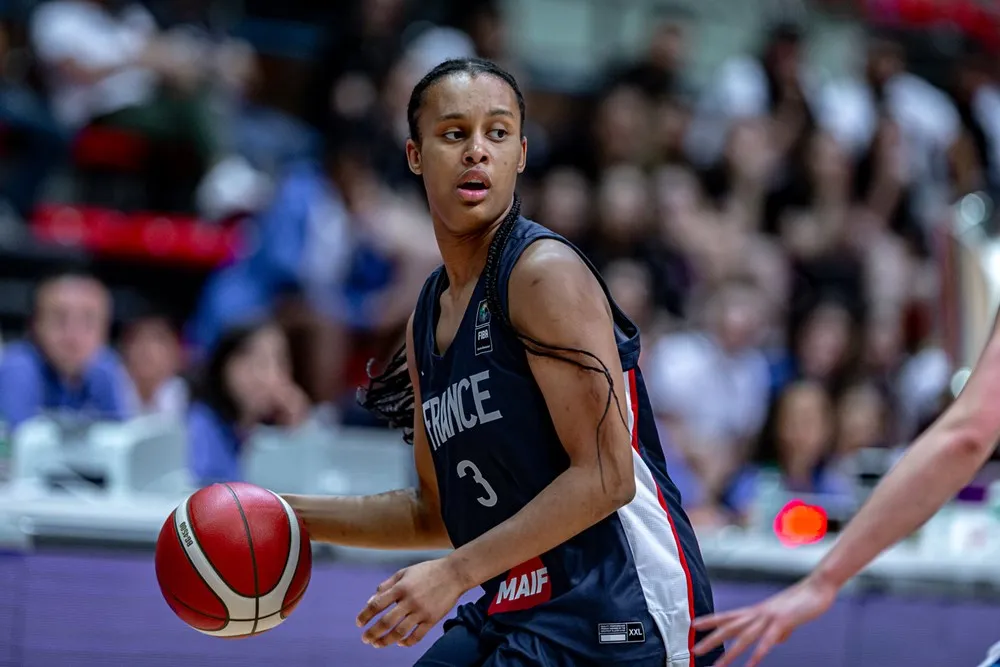
Nell Angloma, off-ball guard, BLMA (France)
Draft-and-stash (~30 FV) → 40 FV
Nell Angloma is putting together the most productive season by an international wing in the last decade, averaging 16.3 points on 63% shooting from two in the French league. At just 19, she already plays with veteran-like physicality, paired with an explosive first step and strong contact balance that make her extremely difficult to stop on drives (52% free-throw attempt rate, best in the class). Nearly every part of her game is solid, except her jumper, which remains her clear swing skill (13-for-49 from three). If her shot comes along, the upside on Angloma jumps significantly. If it doesn’t, will her drives be as impactful against WNBA talent if defenders can sag off? And does she fill enough gaps to still be impactful as a non-shooting wing? Still, she offers an enticing upside proposition for teams with strong confidence in their player development infrastructure.
Gabriela Jaquez, off-ball guard, UCLA
30 FV → 40 FV
Until this year, Gabriela Jaquez has lacked the accuracy from deep to make her a clear pro-level player. But with her 3-point attempt rate jumping almost 10 percentage points from last year, and her 3-point percentage going above 35% for the first time, her value as a prospect has also jumped. These improvements are critical for her position, as off-ball scorers at guard can only be prospects if they’re plus shooters. Jaquez’ considerable improvements at the free-throw line (unlike most players whose 3-point shooting suddenly spikes as seniors), paired with solid mechanics and quality footwork in her jumper, suggest that she may genuinely be a plus shooter at this point. The lack of on-ball creation and issues with ball screen navigation limit her upside, but a plus cutter and plus shooter with some size is always worth a good draft pick.
Raven Johnson, point guard, South Carolina
Watch list (~20 FV) → 30 FV
This is the second year in a row that Raven Johnson has made the midseason check-in article, although the end to her 2024-25 season dropped her even further than that article suggested. That’s probably an indictment of our inability to reach a stable evaluation for her, but that’s a topic for another day, and mostly an issue of overreaction. For now, Johnson remains who she’s been for a while: an elite point of attack defender with the wingspan and strength to scale up and guard the wing; enough of a shooter to command a closeout behind the arc, but not enough that she won’t shoot her team out of games; and a very steady presence with a controlling tempo on the ball. This season has been another all-around effort confirming those aspects of her game, and she’s been more aggressive getting downhill as well, which you’d hope a redshirt senior with her physical ability would be.
Azzi Fudd, off-ball guard, UConn
50 FV → 55 FV
Azzi Fudd has been the best senior in college basketball, now another year removed from her second torn ACL. As we all know, she’s arguably the greatest off-ball shooting prospect of all time, but she also continues to take steps on the defensive end. Fudd is a smart, disciplined player with remarkable core strength, anticipation and impact in the gaps and passing lanes (4.5% steal rate). The main questions center around her upside: Fudd doesn’t draw fouls at an average rate, doesn’t consistently create rim pressure, and rarely takes pull-up threes. Still, if her shooting translates to the sport’s highest level in the way it’s projected to, she could offer prime Allie Quigley-level offensive value, with better defense.
Want even more women’s sports in your inbox?
Subscribe now to The IX Sports and receive our daily women’s sports newsletter covering soccer, tennis, basketball, golf, hockey and gymnastics from our incredible team of writers. That includes Basketball Wednesday from founder and editor Howard Megdal.
Readers of The IX Basketball now save 50% on their subscription to The IX.
Stock down
Yarden Garzon, combo forward, Maryland
50 FV → 30 FV
Now at Maryland, Yarden Garzon remains an outstanding standstill shooter (38.6% on catch-and-shoot threes, per Synergy), but the issues outside of shooting have become more glaring. She doesn’t have the quickness to defend wings and isn’t strong enough to hold up at the four, leaving her caught between positions. While Garzon is a high-level passer, handle limitations and an inability to separate — even against mid-major talent — cap how much that skill can meaningfully impact an offense. For a player with Garzon’s archetype, the path for success is as a premier movement shooter, but her rigid perimeter movement raises questions about how likely that even is.
Laila Phelia, off-ball guard, Syracuse
40 FV → Non-Prospect
We once viewed Laila Phelia as a future lottery pick following an excellent two-way breakout in her sophomore season, but in the years since, the development simply hasn’t followed. She doesn’t read the floor well, is a poor rebounder, and remains an inconsistent finisher despite clear athletic tools (35.3% on half-court rim attempts, per Synergy). Phelia has also yet to make a pull-up three in her college career (0-for-20) and instead lives on a tough diet of mid-range jumpers. While she’s still draftable and worth a look in training camp, her profile as a 3-and-D wing is just too narrow for us to give her a 30 FV.
Iyana Martín, point guard, Avenida (Spain)
50 FV → Draft-and-stash (~30 FV)
Teenagers generally get fundamentally better every year, but that hasn’t been the case with Iyana Martín this season. After missing the opening of this LF Endesa season with an illness, she had a slow start that hasn’t gotten much better in the two months since, both on the stat sheet and on tape. Her shooting accuracy is the worst it’s been since she went pro, her turnovers are way up, and her 3-point attempt rate is way down. She still barely drives to her weak-handed side and doesn’t finish with that hand either, and her shot-creation has not improved. Her defense is still the worst of anyone on our draft board. Although her playmaking numbers would look significantly better if not for her teammates frequently blowing highlight passes, the overall package has plateaued enough that it makes little difference.
Ta’Niya Latson, combo guard, South Carolina
55 FV → 45 FV
Ta’Niya Latson got a bump in her FV grade upon transferring to South Carolina because of the work Dawn Staley and co. have done with just about every backcourt player who’s come through Columbia. While Latson has looked a bit better defensively in garnet and black, going from a 4-out spread pick-n-roll system at Florida State to an almost-two-post system with the Gamecocks has exposed a massive issue in her decision-making. She already often made decisions too late and attacked downhill without a good way out, regardless of whether she had a numbers disadvantage. But the added congestion of South Carolina’s offense has at best rendered her unable to create advantages with the ball in her hands. At worst, she has been running directly into double teams and burning time off the clock in the half-court. This portends even greater problems when she has to deal with the speed and timing of WNBA defenders collapsing the paint against her drives, and certainly points to an inability to play in more condensed lineups.

“Becoming Caitlin Clark” is out now!
Howard Megdal’s newest book is here! “Becoming Caitlin Clark: The Unknown Origin Story of a Modern Basketball Superstar” captures both the historic nature of Clark’s rise and the critical context over the previous century that helped make it possible, including interviews with Clark, Lisa Bluder (who also wrote the foreword), C. Vivian Stringer, Jan Jensen, Molly Kazmer and many others.