2025 gave us no lack of news to cover.
Some of the battles were familiar to San Diegans, such as the city’s struggle to get people out of homelessness. Others were new, such as the rapid influx of AI-powered bots used to for community college financial aid fraud.
But not all of it was bad. Two of this year’s top posts highlighted successful methods for how outreach workers are getting more people housed.
We asked our reporters to break down the top 10 posts of 2025, why they matter and what they’re looking forward to in the year ahead.
Editor’s note: Responses have been edited for length and clarity.
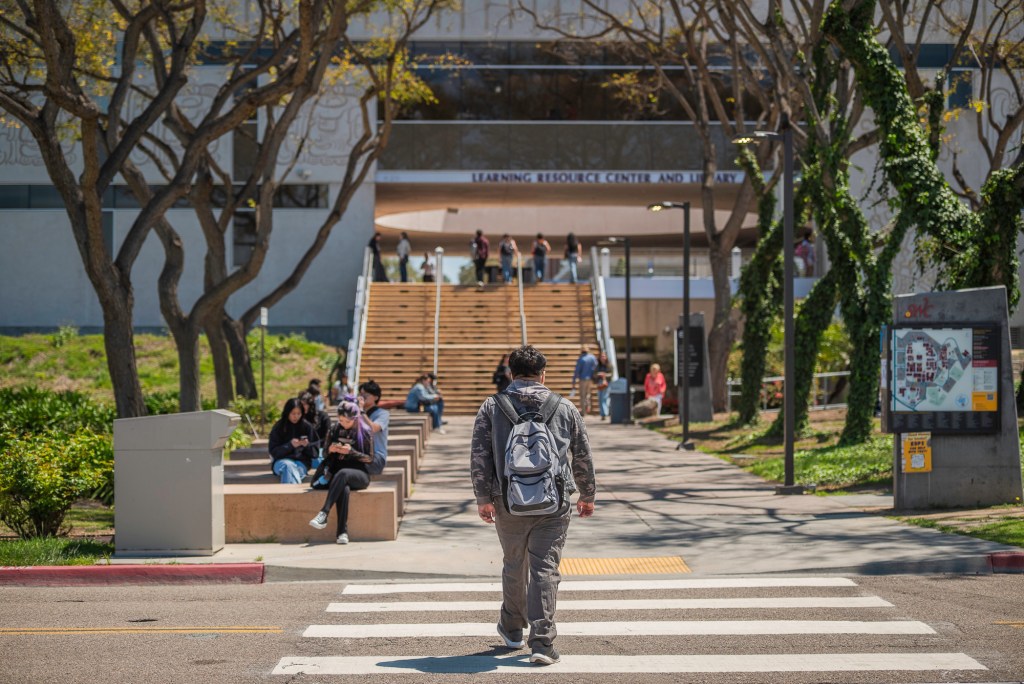 Community college students at Southwestern College in Chula Vista on April 9, 2025. / Photo by Vito di Stefano for Voice of San Diego
By Jakob McWhinney
What’s this story about? When the pandemic forced schools online, few systems embraced the shift more than community colleges. Their students are often older, working people, so having more opportunities to earn credits online was a welcome change.
But there was a catch.
As online classes became more prevalent, so did community college financial aid fraud. The scam is fairly simple. Fraudsters would use stolen identities to create a network of fake students, or bots. They use these bots to register for classes and attempt to stick around long enough to receive financial aid payouts for each of their fraudulent accounts. Community colleges are uniquely at risk because they don’t charge application fees.
The scam has been around for years, but the rise of online classes and AI platforms that allow fraudsters to easily create classwork to submit has supercharged the practice. As bots have flooded classes, community colleges have struggled to respond.
In 2024, fraudsters stole more than $10 million in aid. In that same year, one of every four California community college applicants was a fraudster. The bots have also crowded out real students trying to register for classes. For the piece I spoke with one Southwestern College professor who found that of 104 students registered in her online classes, only 19 were real people.
Where do you see this story going in 2026? As I reported in follow-up pieces, community college officials have had to rapidly evolve how they fight this fraud, because fraudsters themselves are rapidly evolving. As part of that fight, AI has become an increasingly important weapon in community colleges’ arsenals.
The tech-enabled arms race will likely only heat up, as fraudsters and watchdogs try to out-smart each other with new and more sophisticated AI strategies. For example, colleges have begun to require in-person appointments or video calls to verify identities, which has given rise to scammers using AI platforms to create fake videos.
The Trump administration will also likely continue to lean into the chaos. Officials this month touted their efforts to crack down on the scam, claiming they’d prevented fraudsters from absconding with more than $1 billion in financial aid.
Enrollment Decline Can’t Be Explained Away by Shift to Private Schools, Homeschooling
 Backpacks lay on the ground at Chet F. Harritt School in Santee on Feb. 28, 2025. / Ariana Drehsler for Voice of San Diego
By Jakob McWhinney
What’s this story about? Enrollment at San Diego County’s public schools has been dropping for years – and it doesn’t show any signs of stopping. Over the past decade, local schools have lost about 27,000 students. That’s an about 5 percent decline in enrollment countywide.
State officials think the declines will speed up in coming years. If their projections pan out, between 2014 and 2044 the county will lose about 115,000 students. That would mean the number of kids in local public schools would drop by the population of Del Mar, Solana Beach, Coronado, Lemon Grove and Poway combined.
For schools, the declines are frightening because they will lead to funding cuts, which will in turn lead to a whole lot of layoffs and closed schools. But what’s even more worrisome is why this is happening – declining birth rates and high costs chasing families elsewhere mean our region just has fewer kids.
And what happens to societies that shrink? Not great things!
Why did you pursue this story? This story started as a sort of fact check. One of the primary reactions I got to the first in a series of stories I wrote about this topic was that enrollment was declining because parents no longer trusted public schools and were opting to homeschool their children or send them to private schools. That’s just not true. The reason behind declining enrollment is much more simple – San Diego County has fewer kids.
An Experiment to Clear a Homeless Camp in North County Seems to Be Working
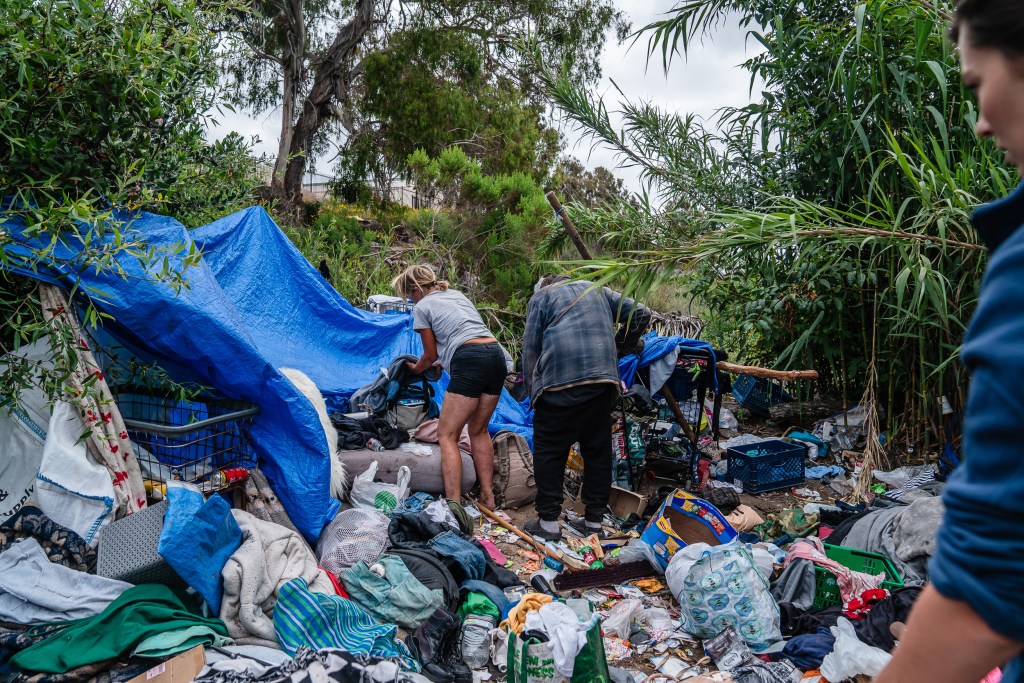 Tiffany and Stephen start taking some of their belongings from an encampment where they have been living on May 27, 2025 in Oceanside, Calif., as they get ready to move to an apartment. / Ariana Drehsler for Voice of San Diego
By Tigist Layne
What was this story about? For this story, I checked in on a joint effort by Oceanside and Carlsbad officials to move hundreds of unsheltered homeless people from encampments into stable and long-term housing. The two cities had received a state grant to move every person camped along state Route 78 and the Buena Vista Creek into housing, and the state gave them three years and $11.4 million to do it.
I visited the first major encampment area where the cities’ homeless outreach teams, along with several nonprofit organizations, were set up, and I watched as homeless people and families were moved into housing one by one. So far, the ambitious plan had been very successful, and people were accepting help and services at a much higher rate than city officials had expected.
Where do you see the story going in 2026? In 2026, I’m planning to check in on the program again to see if city officials are still having as much success with it as they were in the beginning. I’m interested to see if they have had to adjust their methodology as they continue through different encampments. I also want to dig into the most recent data from this program; the state grant came with strict reporting requirements, and I’m curious to see if both cities have adhered to that, and what they’re learning from these reports. And finally, depending on how the program has progressed, I want to understand if this is a strategy that can be duplicated by other cities moving forward.
The Faster, Cheaper Way Homeless People Are Getting Housed
 Susan Peterson feeds her dog, Ninja, a slice of banana off a knife in a Parkway Plaza parking garage in El Cajon on Thursday, July 24, 2025. / Brittany Cruz-Fejeran for Voice of San Diego
By Tessa Balc
What is this story about? This story is about a strategy that the Regional Task Force on Homelessness credited as part of the reason why more people exited homelessness than became homeless in November and December 2024. That was the first time in nearly three years that this had happened. Rather than functioning as a systematic program, diversion is a strategy designed to be inherently flexible in helping solve the problems that contribute to an individual’s homelessness.
Where do you see this going in 2026? While the early results of funding diversion strategies were extremely promising, the number of people becoming homeless is once again higher than the number of people becoming housed. But as Lisa Halverstadt recently wrote, this gap is becoming narrower, and those working to find solutions to homelessness are still crediting diversion.
In a world of increasing economic uncertainty, with many San Diegans living on the financial edge, we’ll need creative solutions to combat homelessness. Diversion is interesting because it’s an evolving strategy that looks different for everyone who encounters it, much like the circumstances that lead people into homelessness; they don’t all follow the same path. A main function of the strategy is targeting people who aren’t homeless yet but are on the brink. It’s more cost-effective to provide someone with assistance for car repairs so they don’t have to miss work — and, in turn, miss a rent payment — than it is to provide a bed in a shelter.
Solutions like these, when funded robustly, could reduce the inflow of people into the homelessness services network and begin chipping away at the population of people who have been homeless but still retain access to some personal resources.
In 2025, San Diego Can’t Look Away from the Screaming
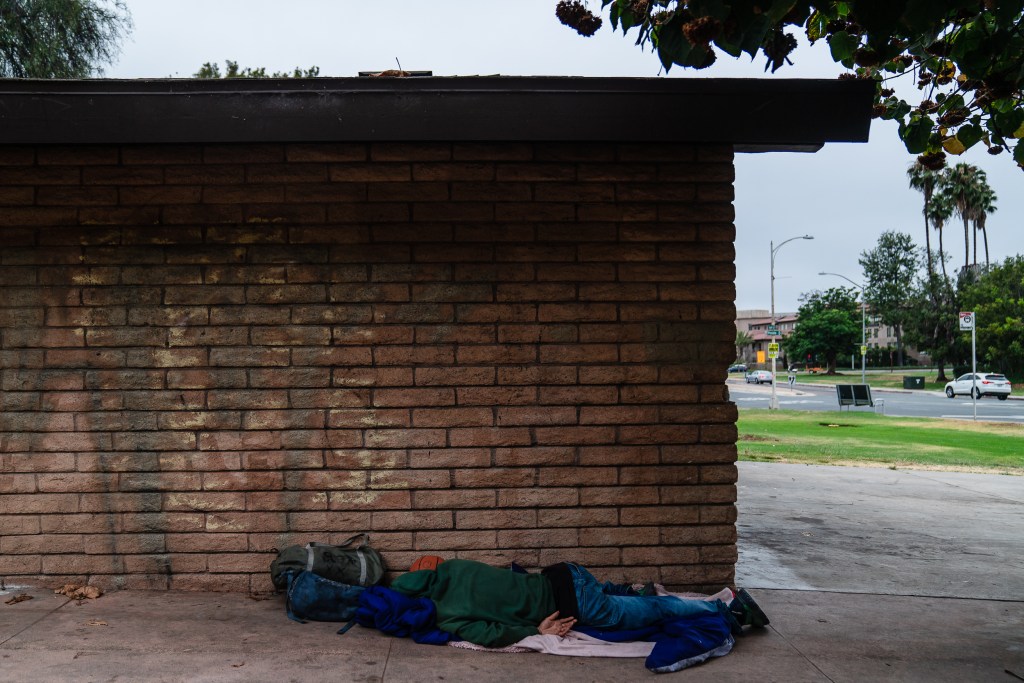 A homeless person sleeps on the ground at a park near Old Town on July 17, 2024. / Ariana Drehsler for Voice of San Diego
By Scott Lewis
Why did you write this? It was my New Year’s essay. It was about the homelessness crisis and, in particular, the people we see every day having breakdowns in public. It was a call to action for city and county leaders to meet the moment with creativity, leadership and urgency.
Where do you see this story going in 2026? Rereading it, I’m struck by how much has changed in a year. The mayor had proclaimed that we were entering an “era of austerity” for the city of San Diego and he was going to fix the structural budget deficit. Since then, city residents have absorbed a long menu of new fees or fee increases but the deficit remains. However, visible street homelessness has significantly improved. And even the ratio of how many people are seeking homeless services compared to how many are finding housing has flipped to the positive side. In part because of our reporting there are now more detox beds available. It used to be like winning the lottery to get one of those beds.
However, one thing that has also changed is that there are now hundreds more people in jail than would have been last year because of harsher penalties imposed by voters on theft and drug offenses. This has surely had an impact as well. Part of the reason things may seem like they’ve improved in the streets is that we have moved the screams to the jails. Now the sheriff has asked for $3 billion to improve jail facilities and county employee unions are seeking a sales tax increase. These discussions will be a big part of San Diego public affairs in 2026.
Encinitas Councilmember Luke Shaffer Charged with Felony Assault, Two Misdemeanors
 Encinitas Councilmember Luke Shaffer during his arraignment at Superior Court North County Division in Vista on Sept. 9, 2025. / Ariana Drehsler for Voice of San Diego
By Tigist Layne
What was this story about? This story was about criminal charges that the District Attorney’s office filed against a sitting elected official in Encinitas, who is fresh into his term. Encinitas Councilmember Luke Shaffer was charged with felony assault and two misdemeanors of hit-and-run driving and willful omission to perform duty, which basically means that a public official knowingly failed to do something they were legally required to do as part of their job.
The charges stemmed from a July confrontation over trash bins between Shaffer and resident Declan Caulfield. Shaffer moved Caulfield’s trash bins to clear space to park his truck. Caulfield moved the bins back, insisting that’s where the bins needed to be. Shaffer then got into his truck and allegedly reversed into the bins and Caulfield’s outstretched palms.
Since we first published this story, a judge reduced Shaffer’s felony assault charge to a misdemeanor and dismissed the willful omission to perform duty misdemeanor. Later, another judge suspended Shaffer’s case with the contingency that he completes anger management and community service hours.
Why did you decide to pursue this story? I pursued this story because, initially, these were serious charges being brought against an elected official. It was shocking to see that a sitting councilmember was being charged with felony assault because of an incident involving a resident. I believed Shaffer’s constituents and residents in Encinitas deserved to know what was happening with a public official that they elected.
City’s Housing Agency Won’t Issue Vouchers for New Housing Projects
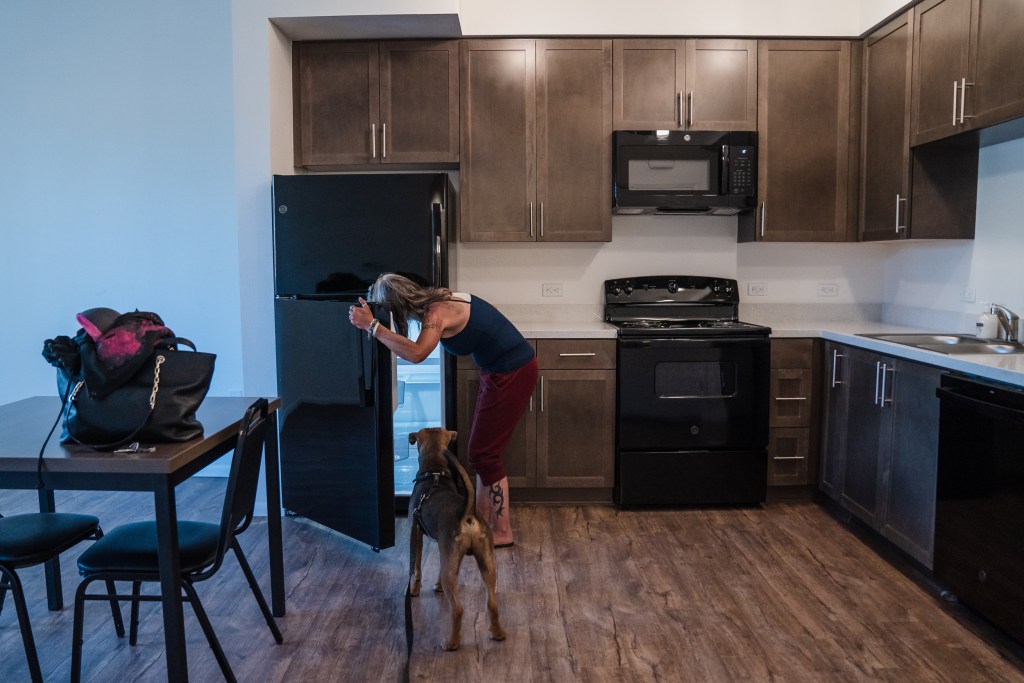 Rachel Hayes with her dog Nino in her new apartment in San Ysidro on June 20, 2023. / Photo by Ariana Drehsler
By Lisa Halverstadt
What’s this story about? The San Diego Housing Commission, the city’s housing agency, made the tough call that it needed to stop doling out new vouchers that have been crucial to helping the city dramatically increase housing options for formerly homeless people and others with very low incomes. These vouchers — known as project-based vouchers — are attached to specific projects to subsidize rents for years to come, helping developers make projects pencil out financially that wouldn’t otherwise and allowing them to serve more people with very low incomes.
The housing agency said its decision was forced by insufficient federal dollars to cover existing commitments and uncertainty about future resources. Officials don’t expect the situation to change for years to come.
Where do you see this story going in 2026? The Housing Commission’s decision will likely have reverberations on the city’s ability to help deliver affordable housing projects for people with the lowest incomes in 2026 and beyond — and slow the development of new subsidized homes for formerly homeless people.
The Housing Commission’s decision also foreshadowed more tough calls that will affect low-income families with housing vouchers in late 2026. The Housing Commission recently approved rent increases for thousands of families with Section 8 vouchers to help address a budget shortfall that it said would otherwise force the agency to halt housing aid for some families.
Mexico Said River Border Wall Broke Treaties. The US Built it Anyway.
 Two people in Mexico walk past the wall that the United States built across the Tijuana River on Jan. 10, 2025. / Photo by Tijuanapress.com, Vicente Calderón
By MacKenzie Elmer
What’s this story about? The story is about how the United States has broken multiple treaties with Mexico by building a piece of border wall through the polluted Tijuana River. Voice of San Diego sued the federal government after they refused to produce public records in a timely matter, which revealed this information. The International Boundary and Water Commission, which is supposed to act as a negotiating body with Mexico on border water issues, was the only federal agency standing in the way of Homeland Security from completing their project. They greenlighted the project despite pleading from Mexico to stall it. The U.S. Environmental Protection Agency also raised alarm over the project, which studies they generated showed could cause deadly flooding in Tijuana.
Why did you pursue this story? I pursued this story because it was clear that this project could cost lives. But it was also clear that U.S. Homeland Security was dead-set on building the project regardless. It remains to be seen what the true impact of the border wall across the river will be. If Mexico fails to keep the border wall clean of trash, or if the United States fails to open the wall before a flood, the wall could devastate communities on both sides of the border. Time will tell.
San Diego Is on the Hook for Monthly $77,000 Payments of Shuttered Senior Shelter
 The Pacific Inn Hotel & Suites in downtown San Diego on March 20, 2025. / Ariana Drehsler for Voice of San Diego
By Lisa Halverstadt
What’s this story about? A downtown hotel that the city once turned into a dedicated shelter for homeless seniors was sitting vacant after the city quietly shuttered the program early last year – and the city was set to pay $77,000 in rent for months until its lease with the owner ended. The city said it closed the 34-room shelter at a time when homelessness among vulnerable seniors was spiking because needed building repairs made the program unsustainable.
The move unsurprisingly upset nonprofit operator Serving Seniors and advocates for homeless seniors who argued the non-congregate shelter was a successful model that should have continued – whether at the hotel on Pacific Highway or elsewhere.
Why did you pursue this story? A reader noticed that the downtown hotel that was once clearly occupied looked to be empty and wondered what was going on. I started asking questions and found that the city had closed the shelter – and was set to keep making rent payments despite the building issue it said forced the closure. Writing about all of this was a no-brainer.
A little post script: A city spokesperson confirmed the city ultimately did make rent payments until the lease ended in June. Though there were some conversations with the landlord, spokesperson Matt Hoffman said the city’s lease required it to make renovations after homeless residents moved out.
The city and its housing agency do still fund some non-congregate beds that are reserved for seniors. They report that there are 18 beds in nine apartment units for seniors at Veterans Village of San Diego and that there are plans to set aside a yet-to-be-determined number of beds for senior women at Catholic Charities’ Rachel’s Promise shelter in mid-2026.
New Safe Parking Site Frees City to Push Campers Out of Mission Bay
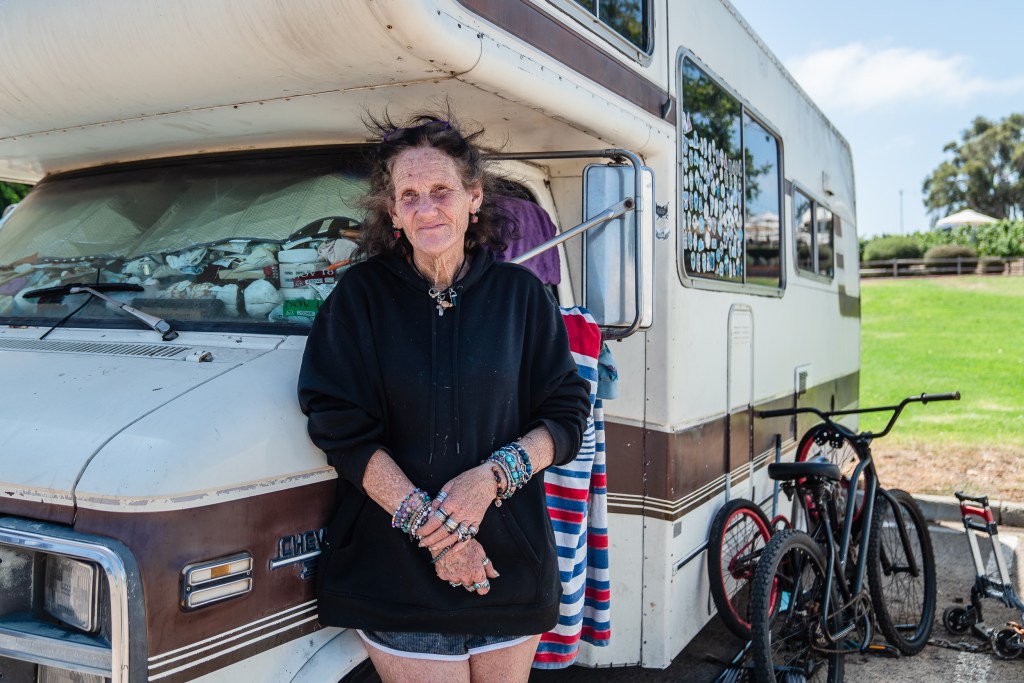 Bridget Montgomery, 56 stands in front of her parked RV in Mission Bay on July 31, 2025. / Ariana Drehsler for Voice of San Diego
By Mariana Martínez Barba
What’s this story about? Residents in Mission Bay were frustrated at a growing number of people living in their recreational vehicles in the area. But because of the opening of H Barracks, a safe parking lot nearby, police could start ticketing campers again.
The city wasn’t able to do that before because of a 2024 legal settlement that said camping citations can only be issued if people have access to a safe alternative. The opening of H barracks allowed police to come back in and start handing out citations.
But folks living out of their vehicle said getting to the safe parking lot came with its own hurdles. Some of them can’t afford the gas to move their car in and out of the lot everyday, as it is only open from 6 p.m. to 7 a.m.
While the city saw this as the only option and needed to continue enforcement, the people living in their RVs found it difficult to just pick up their things and go.
Why did you pursue this story? I pursued this story because it speaks to a tension point where the city is attempting to balance two needs. Mission Bay residents are frustrated at the campers and the settlement allowed the cops to start ticketing. At the same time, people living in their RVs said that the alternative is not feasible for them. In fact, it adds another burden when they’re already pressed for cash.
I think this story also speaks to what works for unhoused people and what doesn’t. While I found some people I talked to were struggling financially to move their cars, other more high-end RVs just liked being in the area. But with those people struggling, I learned that not every solution the city provides is one-size-fits-all. While safe parking lots can be an option for some, they don’t work for everyone.