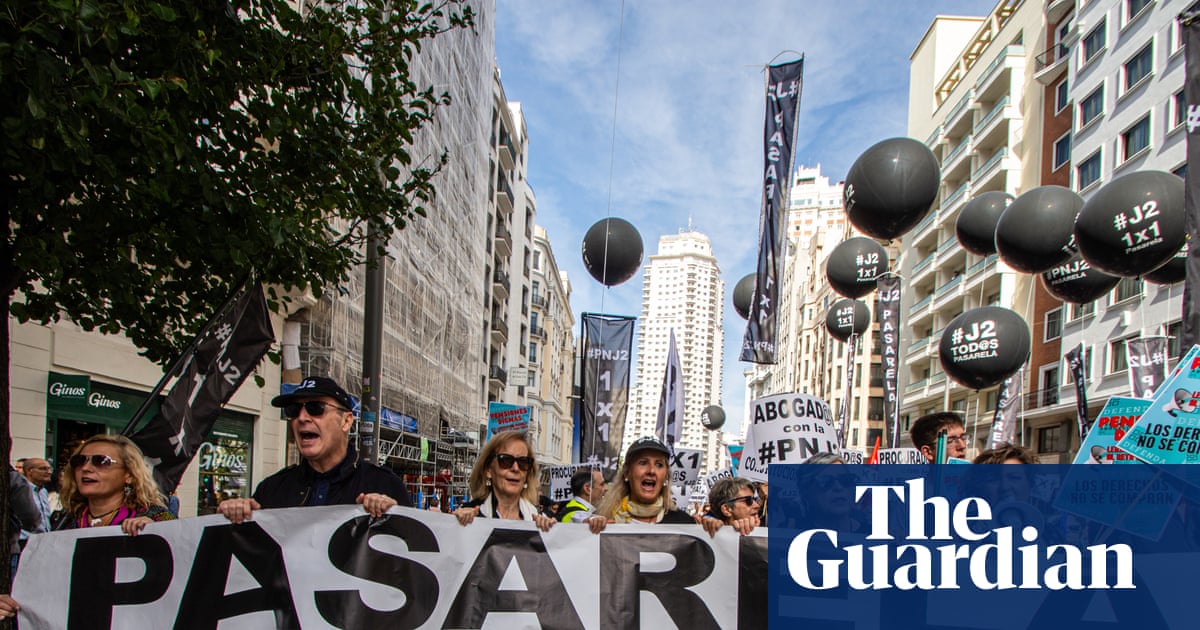
It has played a starring role in one of the worst periods of political turmoil in France since the 1960s. In Germany, it threatens the future of the coalition government. In Spain, thousands have taken to the streets to demand change.
The right to a decent state pension has been a central plank of the European social contract for decades, but people are living longer, birthrates are falling, and the continent’s pension systems are, increasingly, unsustainable.
Most countries operate a “pay as you go” system, whereby those currently in work pay the pensions of those who have retired. So when fewer people are contributing to schemes that have more drawing on them, and for longer, it becomes a problem fast.
Homes for older people in Copenhagen, Denmark. Photograph: NurPhoto/Getty
Occupational and private pensions now make up a sizeable part of retirees’ incomes in many countries. But state pensions remain a welfare cornerstone. Cutting payouts or raising the retirement age is unpopular – and politicians fight shy of reform.
That is because the median European voter is now in their mid-40s and governments have a great deal to lose by penalising older generations. Only a few countries, including the Netherlands, have implemented major changes.
Most face widening shortfalls. Meanwhile, retirement ages differ by up to eight years, pensions vary from €226 (£197) a month (Bulgaria) to €2,575 (Luxembourg), and for 80% of EU pensioners, a state pension is their only income. About 15% are at risk of poverty.
A protester in Paris holds a placard reading ‘retirement at 60 through a pay-as-you-go system and that’s that’ at a demonstration on 16 December. Photograph: Huchot-Boissier Patricia/Abaca/ShutterstockFrance
-
Minimum state pension retirement age: 62
-
Monthly state pension (average): €1,500
-
Share of GDP represented by state pension: 13.4%
-
Population over 65: 40.2%
France’s pensioners earn, on average, fractionally more than people in work, thanks in part to a generous mandatory state pension that, for those with full contributions, pays out a maximum of 50% of previous salary (up to a certain limit).
In practice, that averages out at about €1,500 a month or €18,000 a year. A relatively early retirement age and high life expectancy mean French men can expect to enjoy almost 23 years in retirement and women 26, near the very top of the OECD league.
The scheme has the lowest qualifying age – 62 – of the main EU economies, and French pensions from all sources replace a bigger share of pre-retirement income than in most countries.
All this, though, comes at considerable expense: state pensions cost France 13.4% of GDP, well above the OECD average of 8.1% (the UK figure is 5%). The president, Emmanuel Macron, has tried to overhaul the system but not succeeded.
A first effort in 2019 provoked the country’s largest cumulative wave of strikes since the mass political unrest of 1968. A second attempt, including plans to raise the standard retirement age to 64, faced huge union opposition culminating in a protest that drew an estimated 1.28 million people.
In early 2023, the government finally rammed the overhaul through without a vote in parliament, but the prime minister, Sébastien Lecornu, has since had to suspend it altogether until 2027 in order to survive a no confidence vote.
Die Linke party members hold signs reading ‘No to Merz, Yes to pensions’ at a protest in front of the Reichstag in Berlin on 5 December. Photograph: Lisi Niesner/ReutersGermany
-
Retirement age: 66
-
Monthly state pension: €1,600
-
Share of GDP represented by state pension: 10.8%
-
Population over 65: 39.8%
In the early 1960s there were about six people in work in Germany for every retired person. With ever fewer workers and ever more pensioners, that ratio has slumped to about two to one, and is continuing to fall fast.
The federal government has calculated it would have to spend a quarter of its total budget of €525bn next year in order meet the needs of the statutory pension system, and has come under mounting pressure to change it.
The scheme is mandatory for all salaried workers bar civil servants who have their own system. Just under 19% of gross pay – capped and split between worker and employer – goes into the fund. Pensions are about 48% of the average monthly wage.
Amid fears that young people will bear the brunt of an unsustainable system, the government’s proposals include incentivising private investment, raising taxes for higher earners and increasing the retirement age (planned at 67 from 2029).
The value of pensions as a percentage of average salary will also fall to 47% from 2031 after a bill passed in December. A growing number of pensioners, particularly women, say they are unable to adequately live off their statutory pensions.
A Mütterrente, or retirement bonus for mothers, was included in the recent bill in an attempt to address this. Pensioners do not generally enjoy travel perks and other reductions and many continue to pay rent, as most Germans are not homeowners.
More than 30,000 lawyers, court clerks, architects and engineers demonstrated in Madrid in September over the public pension system. Photograph: NurPhoto/Getty ImagesSpain
-
Retirement age: 66
-
Monthly state pension: €1,500
-
Share of GDP represented by state pension: 12.3%
-
Population over 65: 34.9%
The average monthly state pension, paid to about 6.6 million retirees, is €1,512 in Spain. The state paid out almost €10bn in retirement pensions in October alone, and pensions account for about 12% of GDP.
Although there are 2.6 working-age people for everyone over 65, that ratio is projected to fall to 1.6 to one by 2050, placing further strain on state coffers. By 2048, an estimated 15 million people will be eligible for pensions.
In 2011, the government changed the state pension system and agreed to gradually raise the retirement age – by two months a year – from 65 to 67 by 2027. Retirement age, however, depends on years of paid contributions.
In 2023, Spain’s socialist-led government struck a deal with unions to offset the increase in the number of pensioners by introducing a “solidarity tax” that increased the social security costs on businesses for higher-earning workers.
It also brought in a 0.6% social contribution known as the “intergenerational equity mechanism” – at a 0.5% rate for employers and 0.1% for employees – which aims to top up the state’s pension pot. The rate will rise to 1.2% by 2029.
The government says the system is sustainable and performing well. But in October, about 8,000 people demonstrated in Madrid to demand a minimum pension in line with the minimum wage and an end to the pension gap between men and women.
Residents play chess at an older people’s activity centre in Dragør, Denmark. Photograph: Thibault Savary/AFP/GettyDenmark
-
Retirement age: 67
-
Monthly state pension €965 (plus mean-tested supplement of up to €1,100)
-
Share of GDP represented by state pension: 7%
-
Population over 65: 36.2%
Denmark’s retirement age has increased in line with life expectancy every five years since 2006 with little controversy or even public debate. This year, when MPs voted to increase it from 67 to 70, the highest in the EU, from 2040, marked a turning point.
The Social Democrat prime minister, Mette Frederiksen, had already called for reform, saying her party would no longer vote for a retirement age that automatically followed life expectancy and the system should be more “lenient and fair”.
But her party has been scant on details on how it plans to overhaul a state pension system that costs about 7% of GDP annually, setting the scene for what could become a pensions bidding war before a general election next year.
Many people fear they cannot work until they are 70. Arne Juhl, the face of a Social Democrat campaign for early retirement for disabled people, said he might leave the party, partly because he believed statutory retirement age should not exceed 68.
Damoun Ashournia, chief economist at the Danish trade union confederation, said retirement age had to rise with life expectancy “for the welfare state to be fiscally sustainable”, but the current model was “unnecessarily harsh”.
Polling showed increasing support for parties with specific plans on how to improve the pension system, he said, although proposals by the populist right had been “fiscally irresponsible”. The Social Democrats “really need to present a cohesive plan”, he added.
Signe Munk, a political spokesperson for the Green Left, said the Danish system “increasingly reflects inequality rather than fairness, with widening gaps in health and life expectancy. Addressing this requires political courage”.
Protesters in The Hague hold placards at a demonstration against a new pension law in May 2023. Photograph: Robin van Lonkhuijsen/ANP/AFP/GettyThe Netherlands
-
Retirement age: 67
-
Monthly state pension: €1,580
-
Share of GDP represented by state pension: 6.4%
-
Population over 65: 34.8%
The Dutch system, which like many in Europe combines a state pension (currently €1,580, from age 67), workplace schemes and private savings, consistently finishes at or near the top of an annual world ranking compiled by the Mercer consultancy.
While that does not stop the Dutch complaining about it, their variant of the three-pillar system is internationally acknowledged as adequate for retirees’ needs, transparent and affordable.
The state pension scheme costs just over 6% of GDP, while highly regulated workplace schemes cover more than 90% of employees. Those workplace funds are huge, managing about €1.7trn in assets – the EU’s largest, in a country with 4% of the bloc’s population.
After decades of talks, the Netherlands in 2023 decided to move its workplace funds from defined benefit to defined contribution, meaning there is no guaranteed payout and that part of an employee’s pension will depend on the pot they build up.
The new system, according to the Dutch central bank, will give workers greater flexibility and agency and is “better suited to the current labour market, where employees change jobs more frequently”.