New Yorkers who rely on the MetroCard for more than swipes and dips are grudgingly bracing for the transit system’s familiar farecard to reach the end of the line.
With sales of the plastic silver that pays for subway and bus trips ending on New Year’s Eve, the MTA says almost 94% of commuters have fully shifted away from the gold-and-blue cards in favor of the OMNY tap-and-go fare-payment system that debuted in 2019.
“I remember the transition from tokens and it really blew people’s minds,” Janno Lieber, MTA chairperson and chief executive, said after the transportation authority’s December board meeting. “It was a difficult transition, not everyone was comfortable swiping.”’
But those who remain attached to the card that began replacing the iconic token 31 years ago aren’t quite ready to let it go.
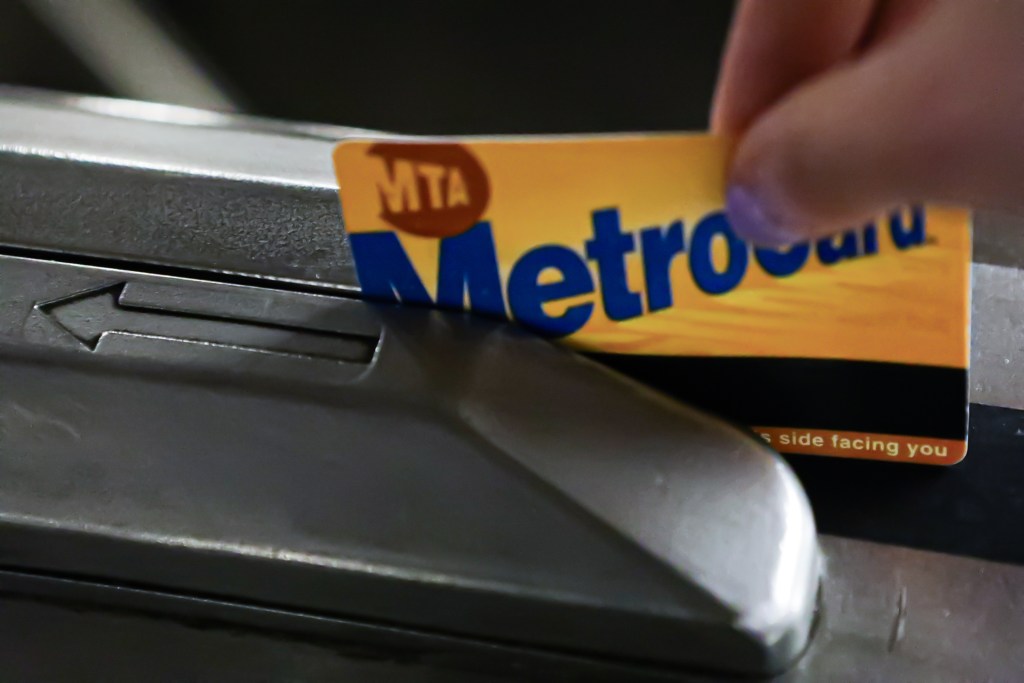 A commuter uses their MetroCard at Union Square, April 29, 2025. Credit: Alex Krales/THE CITY
For aficionados that include artists and songwriters — think of the catchy 1999 Le Tigre song “My My Metrocard” — the latest evolution in how fares are paid is proving to be as tricky as it is for tourists to master the swipe at the turnstiles.
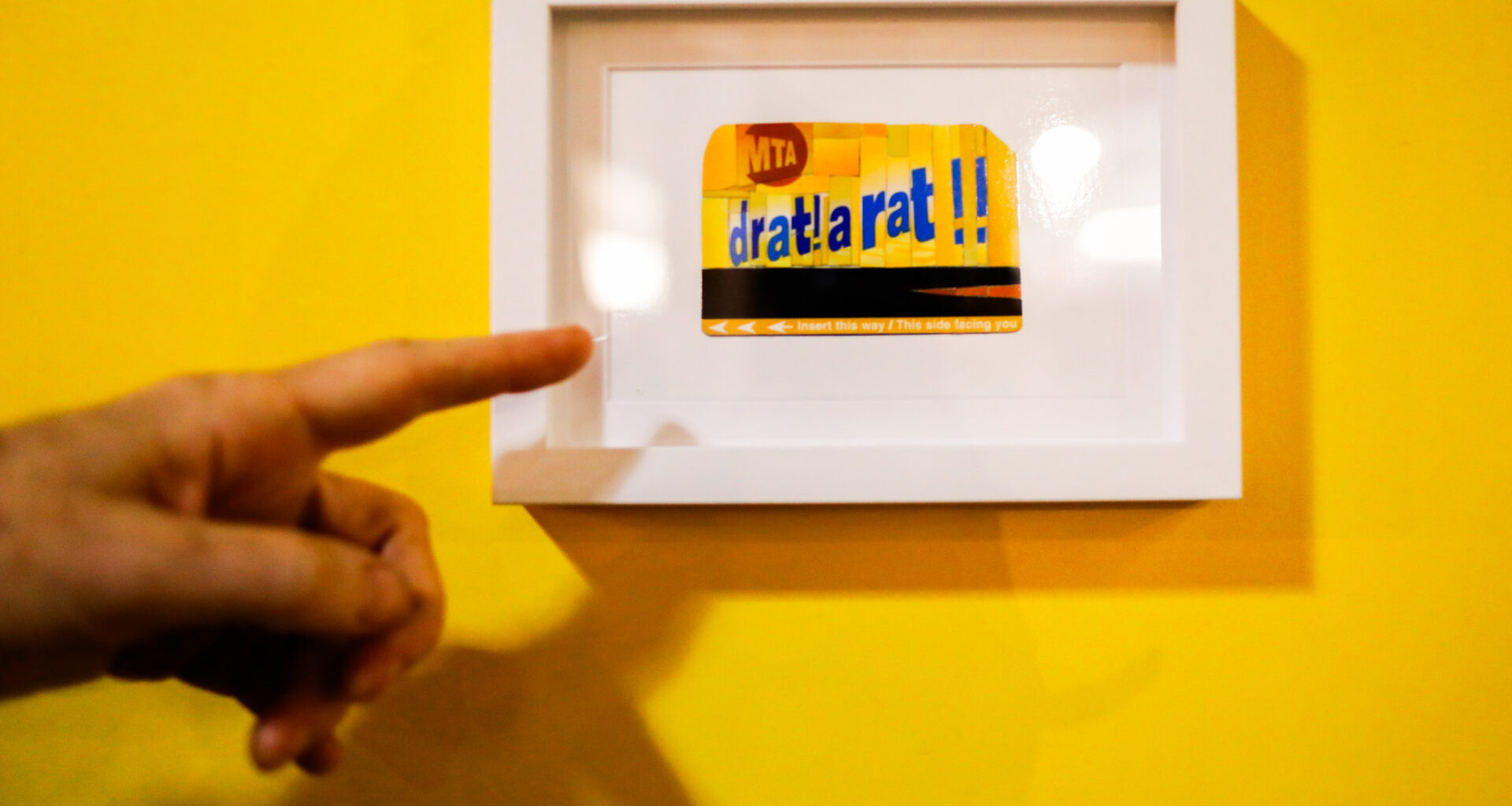
“I had to buy an OMNY card and I felt brokenhearted,” said Thomas McKean, an East Village artist who, for close to 25 years, has created intricate collages by clipping old farecards.
MetroCard collectors are also feeling blue over the last of what the MTA says are 3.2 billion farecards encoded since 1994, which include 700 that made up a MetroCard dress featured in the Broadway musical “In Transit.”
“I started to collect them after my younger son mentioned that one of the cards he was using had an advertisement, it was for 1-800-MATTRESS,” said collector Lev Radin, recalling a long-ago limited-edition card for the defunct bedding company.
Radin’s stash, which he stores in plastic sheets inside albums, features at least one copy of every card ever sold to the public and some that never were issued. Among them is the original and mostly blue MetroCard first issued in January 1994 for use on only a few subway lines.
Others in his set are copies of the more than 400 limited-edition cards distributed over the decades or sold in station MetroCard vending machines. According to an MTA spokesperson, MetroCard promotions last year generated $641,000 for a state authority with a $20 billion annual budget.
 A work by artist Thomas McKean, Dec. 26, 2025. Credit: Alex Krales/THE CITY
Branded MetroCards included five that celebrated the New York Rangers 1994 Stanley Cup, a Modell’s-sponsored version given to fans at Yankee Stadium in 1997 (with a $1.50 fare on it) for the first Subway Series game, one from 2000 that touted the Mostly Mozart and Lincoln Center festivals and a 2022 commemorative card that was available at four Brooklyn stations for the The Notorious B.I.G.’s 50th birthday.
Radin owns copies of each, along with the final three branded cards issued last December, which feature the word “Instagram” leaning on the front in place of the usual “MetroCard.”
But the Bronx grandfather said he has no idea on the exact size of his stash.
“I never counted and I can’t say how many I have,” he said.
Now Radin is among the last few coming to terms with a symbol of the subway that will soon be gone for good and replaced by OMNY, a system whose rollout has encountered delays and software glitches.
“The token, the subway bullet and the MetroCard are these things that when you see them, you immediately think of New York,” said Jodi Shapiro, curator of the ”FAREwell, MetroCard” exhibit that is at the New York Transit Museum through the spring. “New Yorkers are pretty emotionally attached to their transit system.”
For McKean, that means coming to terms with his supply stream eventually drying up, though he estimates that he can still make artistic use of the 5,000 to 6,000 old cards in his apartment “for at least a few years.”
“I stopped believing [the MTA] about the end of the MetroCard and I said, ‘Oh, they’re so disorganized, they’ll never do it,’” he said. “So I was living in a fool’s paradise — and then it kind of dawned on me that they’re serious this time.”
 Artist Thomas McKean at the Chelsea Market exhibit of his MetroCard collages, Dec. 26, 2025. Credit: Alex Krales/THE CITY
McKean stashes his supply of old MetroCards in a wooden box that he calls “kinda like a chop shop.” There are separate compartments for the elements of the cards that he has carefully clipped with scissors.
“In one, I have cut out the M, because that’s very usable,” he told THE CITY. “Another one has the circle with the MTA logo, another compartment has the black stripe.”
McKean said he began making his pieces “sort of on a lark” until he noticed the “beautiful glossiness” of the fare cards and how different print runs could produce different colors.
“So the yellow went from a canary yellow to an orange to an ochre and the blue went from a light blue to medium to quite a dark blue,” he said. “So if I’m cutting out those little strips to make a sky, it’s not just one flat blue, it’s little variations in tone, much like the real sky.”
Prior to 2013, when the MTA applied a $1 “green fee” to each new card purchase, McKean said he would scavenge for what commuters left behind in stations.
“People were quite slovenly,” he said.
 A MetroCard work by artist Thomas McKean on display at Chelsea Market, Dec. 26, 2025. Credit: Alex Krales/THE CITY
But even as he would get “a lot of sorrowful sorrowful looks from people,” McKean said he was pulling in quite a few hauls off of station floors and from behind MetroCard vending machines.
“There were a lot there,” McKean said. “So I discovered a few motherlodes of Metrocards.”
He said he also has received old cards in the mail and a few months back, he met someone who handed him a shopping bag stuffed with them.
“It was a thrilling moment for me,” he said. “It was like a kid getting a whole lot of candy at one time.”
Now McKean, who said he used the token until its final day in March 2003, is running out of time to build that supply.
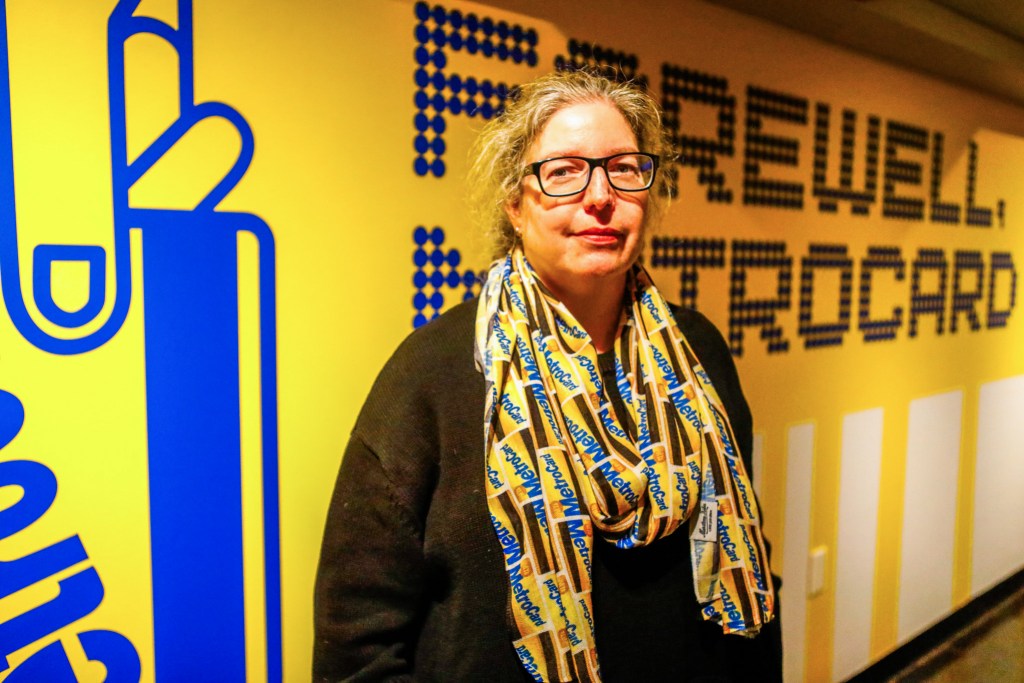 Judi Shapiro helped curate a MetroCard exhibit at the city’s Transit Museum in Downtown Brooklyn, Dec. 19, 2025. Credit: Alex Krales/THE CITY
While the last of the station MetroCard vending machines will soon vanish, the MTA has said the cards will remain usable for a few months into 2026.
“New Yorkers really don’t like change, but they accept change and then they come to love change,” said Shapiro, the Transit Museum curator. “I think MetroCard is a symbol of all of that, as the token was.”
Related