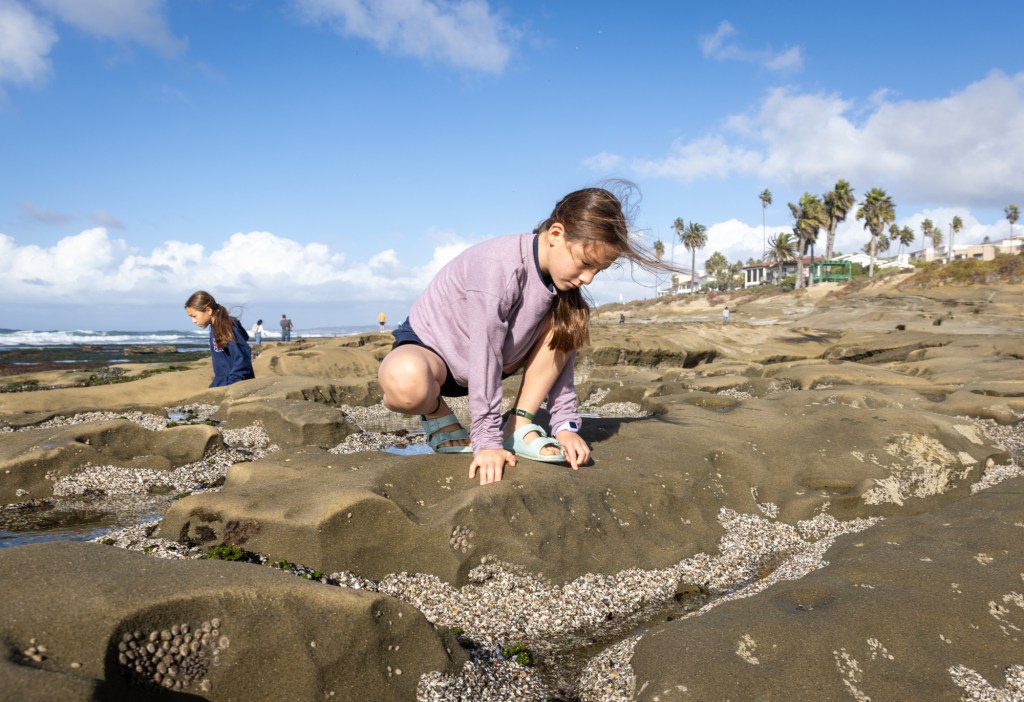
As you enter the tidepools of La Jolla’s Dike Rock, you will find a world of resilient life: bright aggregating anemones and ochre sea stars clinging to stone are hidden local wonders that are exposed and made vulnerable during low tides on the San Diego coast. These creatures are true survivors, enduring a life of constant change — one moment, powerful waves crash over them, and the next, they’re exposed to crisp air and the hot sun.
This narrow strip of coast, called the intertidal zone, is a vital sanctuary that offers a rare and clear view of fascinating sea creatures. These lively places, however, are easily damaged by people. This risk is compounded during the spectacular king tides — happening Friday and Saturday — the most dramatic tidal swings and lowest tides of the year, which expose these small habitats more than ever. Beyond the king tides, other substantial low tides will occur throughout January, offering similar, though less extreme, exposure. Unfortunately, these extreme low tides expose our intertidal worlds to careless walking, rock flipping, and illegal collection that can permanently damage otherwise thriving intertidal life.
To safeguard these coastal nurseries and mitigate these threats, Wildcoast, an ocean conservation organization, runs its Tidepool Ambassador Program, educating visitors on their importance. The animals that live in our delicate tidepools, the ones that can survive both the pounding high tide and the baking low tide, are a priceless nursery for the entire ocean. The intertidal area serves as a safe spot for species like the garibaldi, the official California state marine fish, to grow before they move out to kelp forests. If we lose these coastal wildlife homes, we hurt the health, productivity and resilience of our larger ocean environment.
This is a key reason behind the establishment of California’s scientifically based system of Marine Protected Areas. This state network of 124 Marine Protected Areas, many of which include tidepools, protects ocean habitats so future generations can enjoy them. While the taking of tidepool creatures is against the law inside Marine Protected Areas, many visitors remain unaware of these protections.
To bridge this gap between protection and public awareness, Wildcoast is actively mobilizing its Tidepool Ambassador Program to ensure that visitors can enjoy these coastal sites responsibly and with full awareness of the rules. Our dedicated staff and volunteers will be stationed at vulnerable locations, such as Scripps Beach, prepared to engage the public and offer essential guidance, including distributing our brand-new Tidepool Pocket Guides.
The most powerful tool we have for protecting these fragile habitats is a simple code of conduct for every visitor: the Good Tidepooler Rules. Visitors are encouraged to wear appropriate footwear with good tread and stick to bare rock, avoiding stepping on algae or animals. Take respectful photos and use your Pocket Guide to identify common species like tidepool sculpin or turban snails. Observe things where they are; never pick up or remove animals, shells, or rocks as these items are protected and must remain undisturbed. Never turn over rocks, as you may unknowingly harm the fragile creatures sheltered beneath.
Finally, stop by the Wildcoast station; our ambassadors will be north of the Scripps Pier nearly every weekend of January. They are ready to share their knowledge and answer any questions. If you witness poaching, pollution, or a violation of these standards, do not hesitate to call CALTIP (Californians Turn in Poachers and Polluters) at 1 (888) 334-2258. Protecting California’s MPAs is a collective responsibility.
Crucially, the king tides are also a powerful lesson about the future. Though not caused by climate change, these exceptionally high tides allow us to visualize the permanent sea-level rise expected in the coming decades, driven by the warming of our planet. You can help capture these changes through the California Coastal Commission’s California King Tides Project. Take and share photos of the shoreline during the high tides to create a visual record of what is vulnerable to flooding today, helping us safeguard the future of our coast.
Documenting king tides and acting as responsible stewards during low tides is vital for safeguarding the future of our coast. The king tides expose the beauty and fragility of our environment; it is up to us to ensure that what we see today thrives for all future generations of San Diegans.
Mulligan graduated from UC San Diego in 2022 with a degree in environmental systems and is the senior ocean conservation coordinator for Wildcoast. She lives in San Diego.