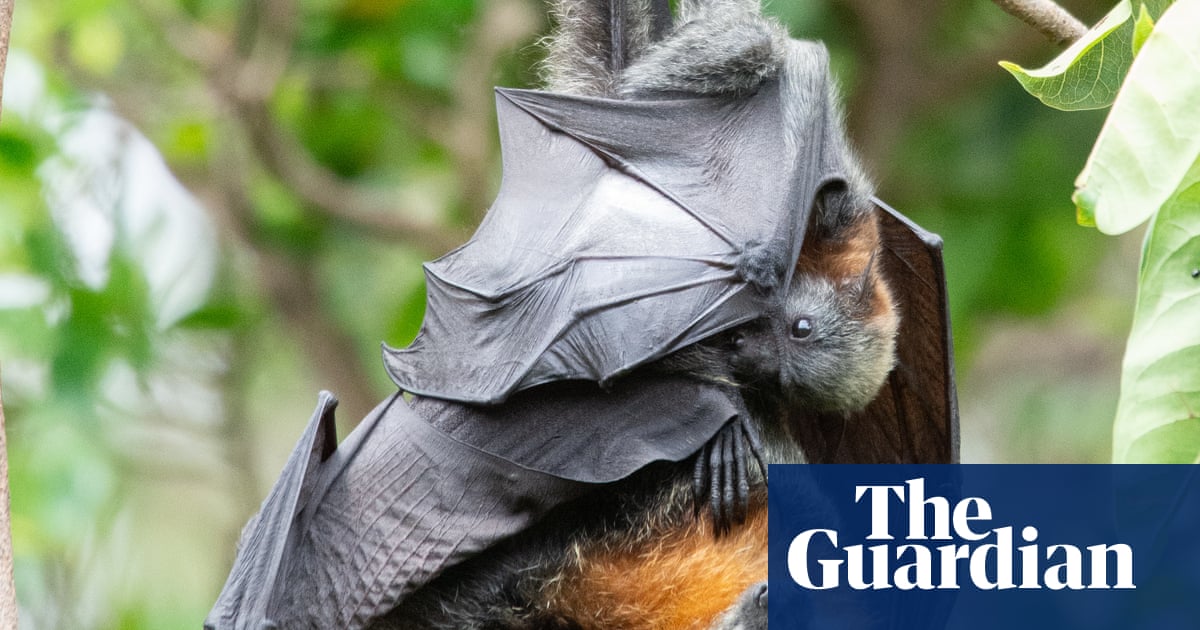
The Queensland government has backtracked on plans to end the shooting of flying foxes from July 2026, continuing a practice wildlife advocates and scientists describe as “ineffective” and “inhumane”.
Permits issued by the state’s environment department allow Queensland farmers to shoot flying foxes for the purposes of crop protection, up to an annual statewide quota set at 1,630 animals. That includes 130 grey-headed flying foxes, listed as vulnerable under federal environment laws, along with 700 black and 800 little red flying foxes.
A three-year phaseout was announced in 2023 and was due to conclude by 1 July 2026, after which shooting would no longer be allowed. The long lead time was intended to give farmers time to move to non-lethal alternatives, such as exclusion netting, which creates a physical barrier between bats and produce.
However, the state quietly reversed course in December, revoking the ban.
Sign up: AU Breaking News email
Lawrence Pope, a spokesperson for the Friends of Bats & Bushcare, said the shooting of flying foxes was “barbaric”, given many animals died slowly, and females carrying pups were often “cruelly smashed by pellets”. He added that while endangered spectacled flying foxes were not part of the quota, they were at risk due to the difficulty in reliably distinguishing different species at night.
Pope said the “unexpected step backwards” was made without consulting conservationists or environment groups.
An impact analysis indicated the department had consulted with local governments and industry.
A spokesperson for the Department of the Environment, Tourism, Science and Innovation said flying fox damage mitigation permits – which allow the “lethal take” of flying foxes by shooting – would remain available “to support farmers in protecting commercial fruit crops” where “all other management options have been exhausted or are unavailable”.
According to the department, any person who has held a permit since 1 September 2012 could apply for permission to shoot the animals provided they had attempted at least two non-lethal methods.
More than 20,000 flying foxes have been shot under the program over 10 years, according to Queensland government data supplied to the ABC.
The Australasian Bat Society strongly objected to the shooting of flying foxes, which it described as ineffective at reducing crop damage and inhumane given “the likelihood of a clean, instantaneous kill is low and the majority of animals that are shot experience a slow death”.
In a position statement on its website, the society said fruit ripening coincided with flying fox breeding season, which meant females were often shot when pregnant or nursing young. “If a female is killed or injured so that she cannot return to the flying fox camp, her single young, which depends on her milk, will die slowly over a number of days.”
Jenny Mclean at the Tolga Bat hospital in Queensland’s Atherton Tablelands said farmers had three years under the phaseout to “get their act into gear” and install exclusion netting, which many good growers had done. “If they can’t afford netting, they shouldn’t be growing fruit crops.”
Rebecca Appleton, who works as an educator and rescuer with Bat Conservation and Rescue Queensland, said exclusion netting was effective at protecting crops without killing bats.
“We would ask the government to invest more in helping the remaining farms to get that set up, [rather] than continue to allow shooting,” she said. “Better for farmers and bats – everyone wins.”
Industry groups were contacted for comment.