A team of astronomers has confirmed the first known system where three galaxies are merging, and all three host radio-bright, actively feeding supermassive black holes. Known as J1218/1219+1035, the system is located about 1.2 billion light-years away and reveals a key stage in the evolutionary journey of massive galaxies.
This rare cosmic configuration, observed through high-resolution radio imaging, offers the clearest evidence yet that black holes can feed and launch jets simultaneously during early phases of galaxy mergers. Only two other triple AGN systems have been confirmed locally, but none had shown radio emission from all three cores, until now.
The findings, led by Dr. Emma Schwartzman of the U.S. Naval Research Laboratory, have been published in The Astrophysical Journal Letters. According to the study, J1218/1219+1035 gives scientists a “front-row seat” to how massive galaxies and their black holes grow together through mergers and mutual gravitational tugging.
The Discovery Started in Infrared, but Radio Made It Clear
The initial signs of something unusual came from NASA’s Wide-field Infrared Survey Explorer (WISE), which detected mid-infrared colors suggesting the presence of at least two active galactic nuclei (AGN) inside a pair of merging galaxies. A third galaxy in the vicinity showed mixed signals, leaving its identity unclear.
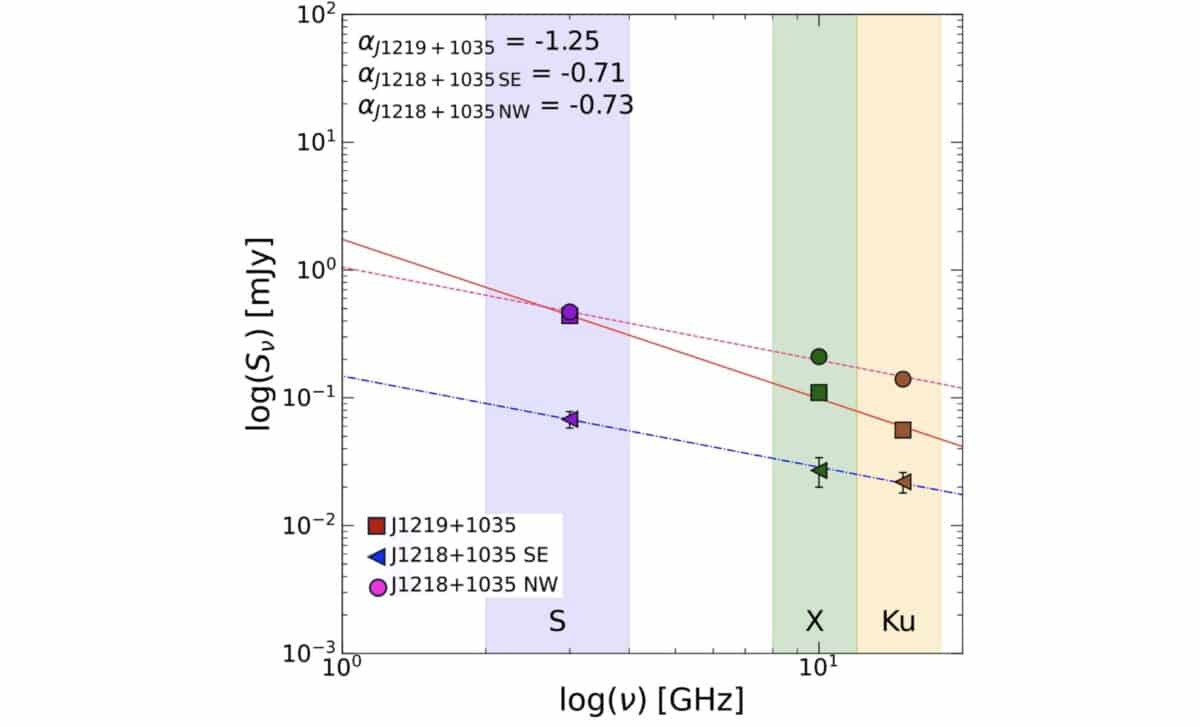 VLA radio spectrum of all cores in J1218/1219+1035. ©The Astrophysical Journal Letters
Follow-up optical data, including redshift measurements, confirmed that all three galaxies were physically bound and interacting, with two separated by 22,000 light-years and the third by 97,000. The system’s structure aligned well with predictions from cosmological simulations, where galaxies drift apart after a close encounter before converging again. But it was only through high-frequency radio observations with the Very Large Array (VLA) and the Very Long Baseline Array (VLBA) that the real breakthrough occurred.
Astronomers observed compact synchrotron-emitting cores in each of the galaxies, emissions that typically signal the presence of supermassive black holes actively feeding and launching jets. The steep spectral slopes seen in the data further supported the non-thermal nature of the sources, ruling out energy from star formation.
Three Black Holes, Three Radio Engines
The newly confirmed AGN (J1218+1035 NW, J1218+1035 SE, and J1219+1035) all emit distinct, compact radio signals. According to The Astrophysical Journal Letters, two of the sources display spectral indices near −0.7, a clear marker of optically thin synchrotron radiation, which is a typical byproduct of black hole jets. The third black hole, J1219+1035, shows an even steeper slope of −1.28, hinting at unresolved jet activity.
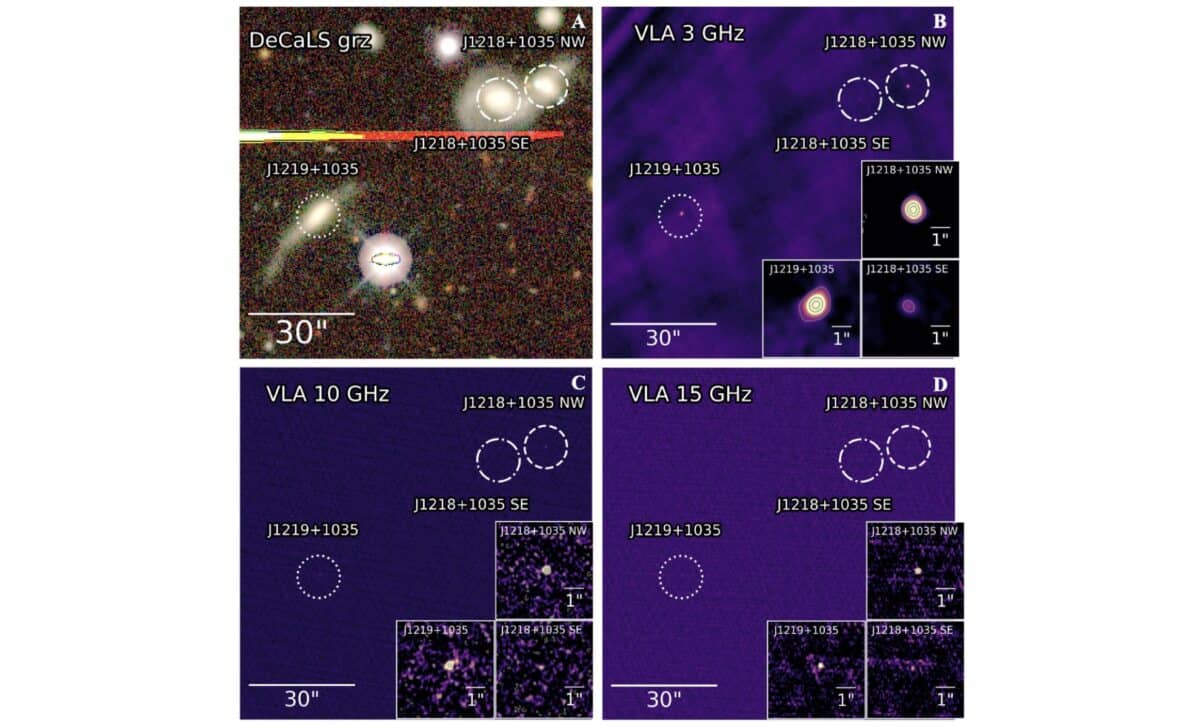 Optical DeCaLS grz images and radio VLA images of J1218/J1219+1035 ©The Astrophysical Journal Letters
VLBA observations set a brightness temperature limit of over 1.7 × 10⁵ K for the central source, exceeding levels that could be explained by star-forming processes, according to the study. This reinforces the conclusion that the system hosts three genuine radio AGN.
Dr. Schwartzman described the significance of the find: “By observing that all three black holes in this system are radio-bright and actively launching jets, we’ve moved triple radio AGN from theory into reality and opened a new window into the life cycle of supermassive black holes.”
Why This System Is Unlike Any Other
Although a few triple AGN candidates have been identified in the past, J1218/1219+1035 is the first confirmed case in which all three black holes are radio-emitting AGN. The only two previously verified systems (HCG 16 and J0849+1114) either lacked full radio confirmation for all nuclei or were further along in the merger process.
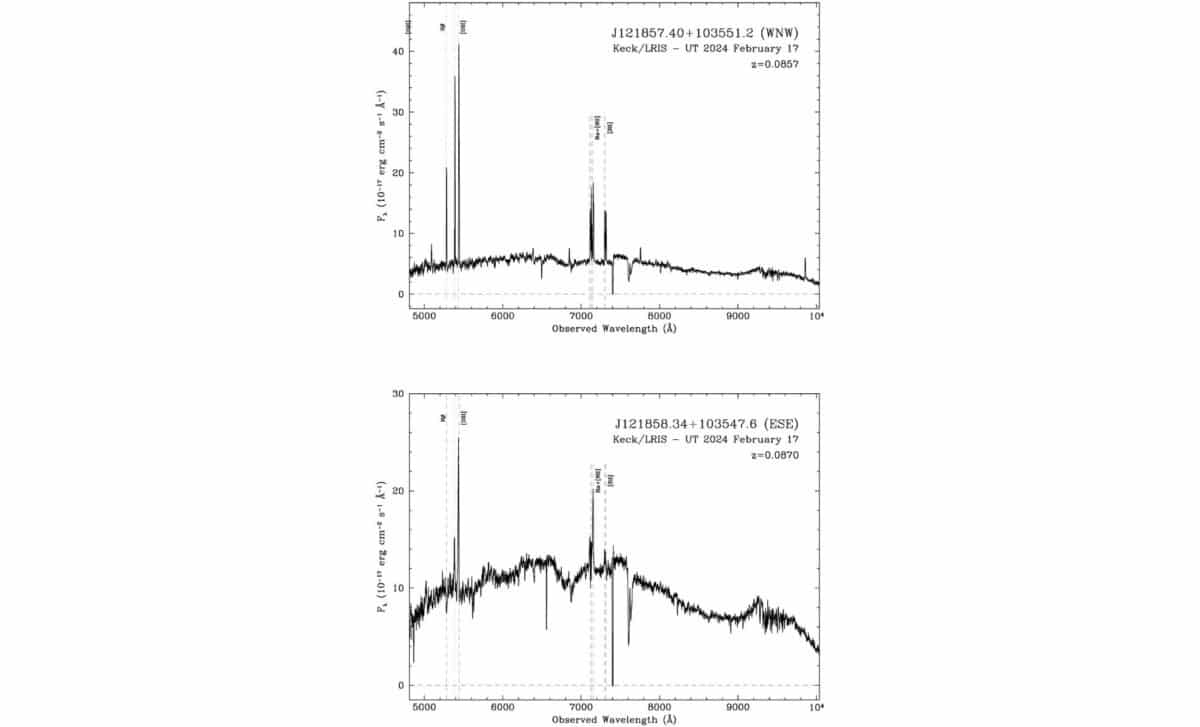 Keck LRIS long-slit spectra for J1218+1035 NW and SE. ©The Astrophysical Journal Letters
According to observations compiled in the same journal, J1218/1219+1035 is an intermediate-stage merger, meaning the galaxies are still distinct but already gravitationally intertwined. Long tidal features seen in optical imaging stretch between them, showing clear signs of dynamic interaction. One of the galaxies, J1219+1035, even presented ambiguous optical features, suggesting star formation might be mimicking AGN activity, yet the radio data revealed its true nature.
The study emphasizes the growing value of radio interferometry in identifying such systems. Traditional optical or infrared methods can be misleading or unclear, especially when dust obscures the galactic centers. According to the authors, combining mid-infrared selection with deep radio imaging is likely the most effective strategy for uncovering more triple AGN.
Although triple AGN systems are exceptionally rare, their discovery helps test long-standing ideas about how galaxies and black holes evolve together. The presence of three simultaneously active black holes within a merger supports hierarchical models of galaxy growth and adds evidence that black hole accretion begins well before galaxies fully coalesce.
The researchers plan to continue observing J1218/1219+1035 in other wavelengths, including near-infrared and X-ray, to better map the host galaxy structures and understand the energy output of each AGN. For now, this unique triple radio AGN remains a powerful example of how the cosmic dance of galaxies can light up the universe in unexpected ways.