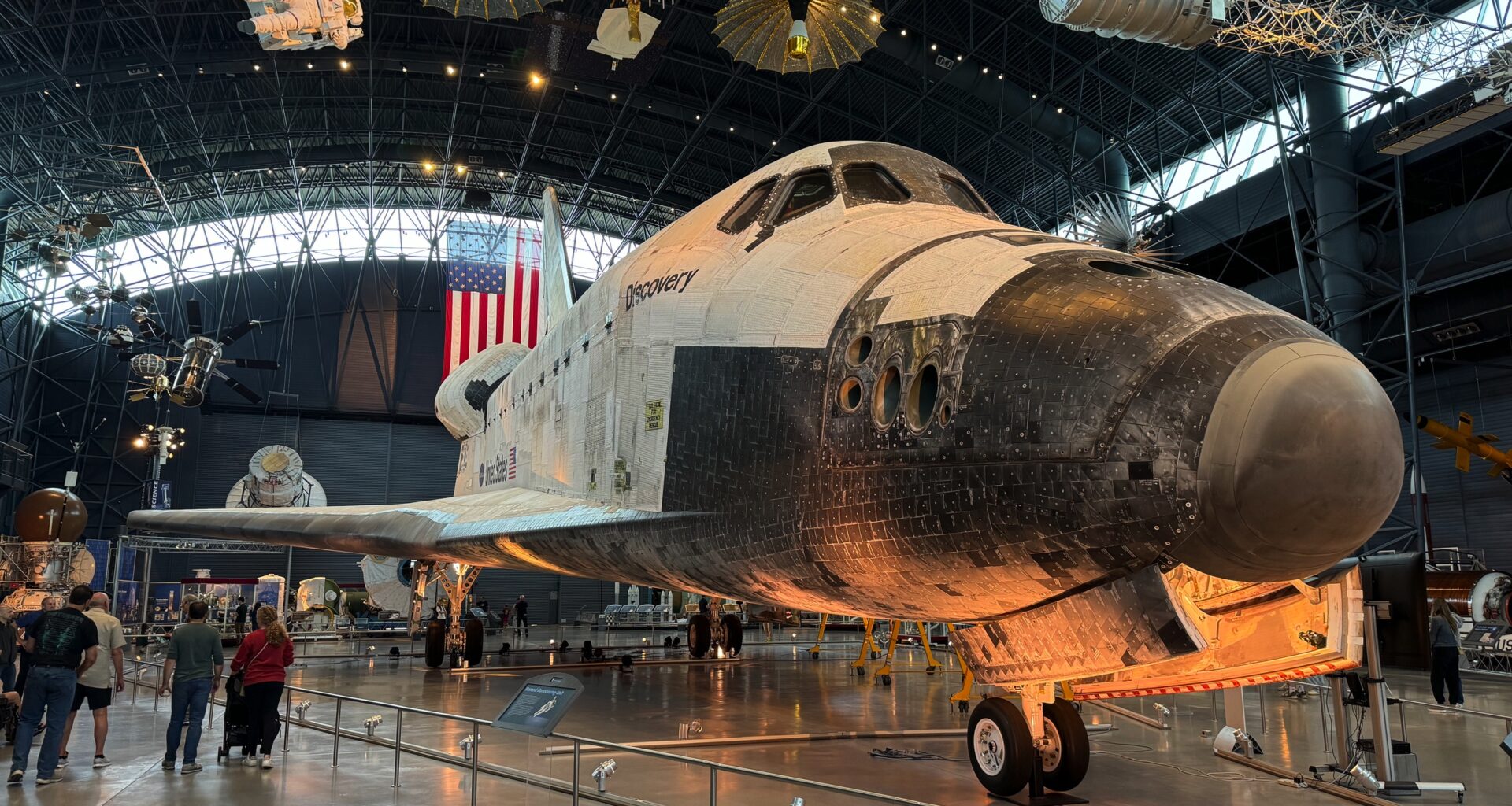
WASHINGTON — NASA Administrator Jared Isaacman suggested he would be open to transferring a spacecraft other than the space shuttle Discovery to Houston.
In a Dec. 23 interview on CNBC, Isaacman said moving the shuttle orbiter from its current home at the National Air and Space Museum’s Steven F. Udvar-Hazy Center in Virginia would depend on whether it could be done safely and within budget.
A provision of H.R. 1, the budget reconciliation bill signed into law in July, included $85 million for a “space vehicle transfer” of a crewed spacecraft to a NASA center involved in the agency’s commercial crew program. The bill directed NASA to identify the vehicle to be transferred within 30 days of enactment.
NASA said Aug. 5 that the agency’s acting administrator at the time, Transportation Secretary Sean Duffy, had selected the vehicle but declined to identify it. Shortly afterward, though, the office of Sen. John Cornyn, R-Texas, announced that the “congressional intent of the law” was to move Discovery to Houston. Cornyn and Sen. Ted Cruz, R-Texas, had earlier introduced legislation explicitly directing the move of Discovery to Houston.
Isaacman said the bill included funding to “return a historic spacecraft to the Johnson Space Center in Houston,” although H.R. 1 did not name Johnson Space Center as the destination.
“My job now is to make sure we can undertake such a transportation within the budget dollars we have available and, of course, most importantly, ensuring the safety of the vehicle,” he said.
In a letter sent to congressional committees and later distributed to media by advocates for keeping Discovery in Virginia, the Smithsonian Institution said both it and NASA estimated the cost of moving Discovery at $120 million to $150 million. That estimate excludes the cost of constructing a facility to house the orbiter at Space Center Houston. A Congressional Research Service report in July estimated the cost of moving Discovery at $50 million to $55 million, while construction of a facility to host the orbiter at Space Center Houston could cost up to $325 million.
Cornyn and Cruz disputed those estimates in October, saying the $120 million to $150 million figures were more than 10 times higher than estimates from unnamed “experienced private-sector logistics firms.” The senators also claimed the Smithsonian was, in effect, lobbying Congress by publishing the higher cost estimates and thus in violation of the Anti-Lobbying Act.
It remains unclear how Discovery would be moved if the transfer proceeds. The orbiter was delivered to the Udvar-Hazy Center, adjacent to Dulles International Airport, in 2012 aboard a modified Boeing 747 that has since been retired. Advocates for keeping the shuttle in Virginia have raised concerns that transporting the orbiter by some combination of truck or ship could damage it.
In the CNBC interview, Isaacman said he would be open to Houston receiving another spacecraft, such as an Orion capsule, if cost or safety issues make moving Discovery impractical.
“If we can’t do that, you know, we have spacecraft going around the moon with Artemis 2, 3, 4 and 5,” he said. “One way or another, we’re going to make sure Johnson Space Center gets its historic spacecraft right where it belongs.”
Transferring an Orion spacecraft to Space Center Houston would likely be far simpler and less expensive than moving a shuttle orbiter. Orion capsules are routinely transported by truck and could be displayed in a smaller, less costly facility than what a shuttle would require.
Isaacman’s comments on Discovery came at the end of an interview that largely echoed themes from other television appearances since he was sworn in as NASA administrator Dec. 18, as well as a Dec. 19 town hall for NASA employees.
He again expressed support for an executive order on space policy signed by President Trump on Dec. 18, calling it “the most significant commitment to American leadership in space since the Kennedy era.” The order largely formalized ongoing NASA activities but set explicit goals of returning humans to the lunar surface by 2028 and “establishing initial elements of a permanent lunar outpost” by 2030.
The order is “basically saying, let’s build a moon base,” Isaacman said, without providing technical or cost details for such an outpost.
Related