If you’re reading this on the web or someone forwarded this e-mail newsletter to you, you can sign up for Globe Climate and all Globe newsletters here.
Good afternoon, and welcome to Globe Climate, a newsletter about climate change, environment and resources in Canada.
In a province with a long and dangerous maritime history, a grounded cargo ship becomes a mammoth cleanup mission, with potential to become an environmental disaster. More on the emergency response in today’s edition.
Now, let’s catch you up on other news.
Noteworthy reporting this week:
- Policy: Ottawa pushes toward scrapping ban on single-use plastic exports
- Agriculture: U.S. avocado growers hope push for trade walls will bear fruit
- Future: Dear Gen Z, you’re not watching the world end – you’re about to build a new one
- Data: Can we predict a white Christmas? A 50-year look at Canada’s snowfall on Dec. 25
- Weather: Jasper residents had to adjust Christmas plans for snow that shuttered Icefields Parkway
A deeper diveOpen this photo in gallery:
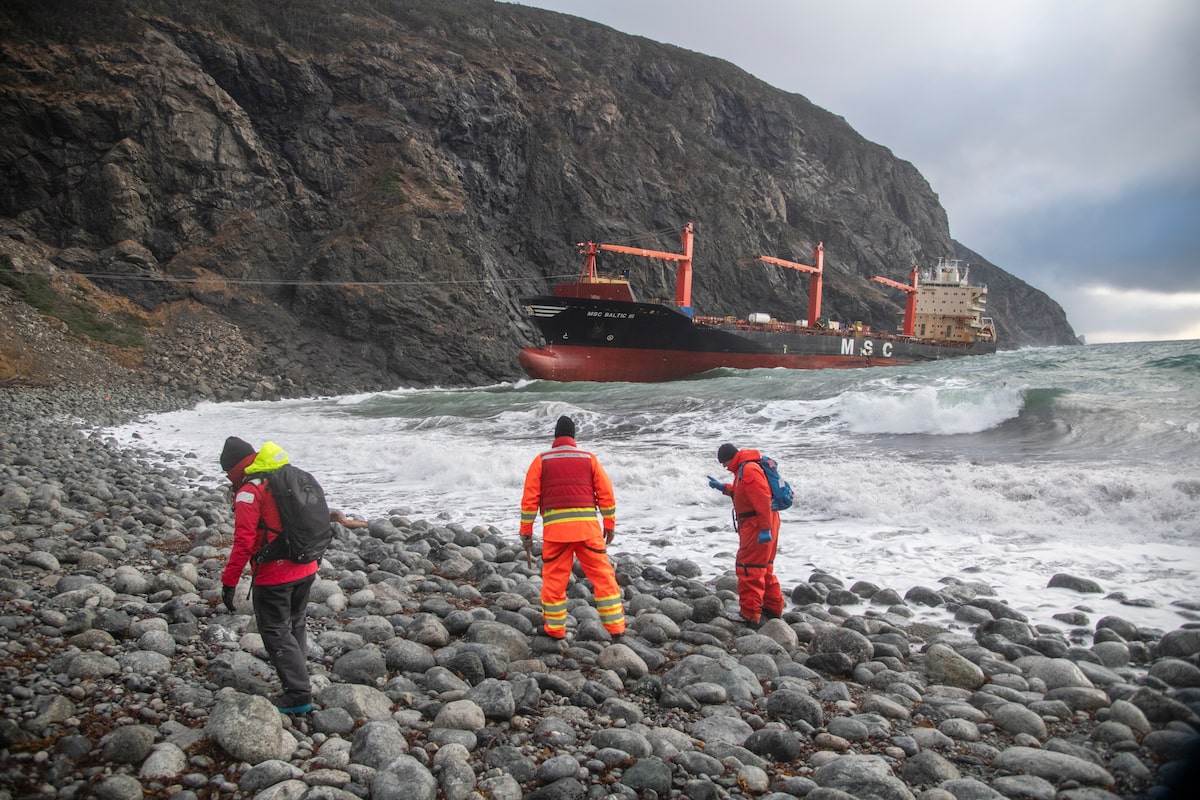
Workers search the shore for any items that may be the result of the grounded the MSC Baltic III. The cargo ship is still stranded here on Nov. 19, 2025.Fred Lum/The Globe and Mail
Battle of the Baltic
For this week’s deeper dive, a closer look at a ship grounded in western Newfoundland and the impending environmental consequences. Story by Lindsay Jones and photography by Fred Lum.
Three-metre swells crash into the cracked hull of the MSC Baltic III along the west coast of Newfoundland. The 200-metre steel cargo ship lost power in the mid-February during a ferocious blizzard and was packed with hundreds of containers of lumber, textiles, plastic beads, legumes and car parts, plus 1,600 metric tonnes of fuel.
Earlier this year, salvage crews offloaded most of the 470 containers and siphoned out much of the fuel, but now, winter is slowing down what’s considered the longest and largest operation in the history of the Canadian Coast Guard. And the environmental damage is still being monitored.
It’s inevitable that the ship will crack in two this winter, said Bruce English, senior response officer with the federal agency’s Marine Environmental and Hazards Response team. “You’re at the mercy of the environment,” he said. “You can’t haul the vessel in, you can’t put more lines on it. You can’t do anything.”
All of this poses a threat to the marine environment. Oily debris has started to wash ashore. Plus, some of the 46 remaining shipping containers contain substances harmful to marine life such as flaxseed oil.
The MSC Baltic III container ship was headed to Corner Brook, Newfoundland, but washed near Lark Harbour.Fred Lum/The Globe and Mail
On days when the wind is less vengeful, salvage crew members can scrape hardened heavy oil lining the walls of six massive fuel tanks. Already, sticky lumps of the hardened oil have been recovered from the shoreline by workers who patrol Cedar Cove and the surrounding coastline daily to look for potential signs of pollution.
So far, 100 oil tar balls have been collected – ranging from the size of a fingernail to a Ping-Pong ball – more than 300 tar coats, and oil stuck to the surfaces of rocks and pebbles on the shore. After a November storm brought waves crashing over the deck of the nine-storey ship, crews recovered about 30 garbage bags of debris coated in oil.
Eventually, after the cleanup, a salvage company will be hired to remove the vessel, a project that will likely include dismantling the ship in pieces, English said.
But in the meantime, people who rely on marine life and fisheries are hoping for a smooth cleanup, and that their communities won’t be touched by further environmental damage.
You can read the full story by Lindsay Jones and see more pictures from Fred Lum.
What else you missedOpinion and analysis
Because it’s not 2015: Why Carney’s pro-oil turn isn’t turning off Canadians
What gives? How are the Liberals winning by promising to undo what they once promised to do, which itself was once a winner? Because that was then, and this is now.
— Tony Keller, staff columnist
Green Investing
Five energy market trends to track in 2026, the year of the glut
This past year was a wild one for the oil and gas industry, punctuated by the 12-day Israel-Iran war in June, U.S. President Donald Trump’s trade wars, the intensified targeting of energy infrastructure in Russia in its war against Ukraine, OPEC’s often perplexing production decisions and the recently threatened U.S. blockade of Venezuela.
So what’s in store for next year? Here are five trends likely to shape the energy landscape in 2026 and beyond – and sorry, but they aren’t all very green.
The Climate ExchangeWe’ve launched the The Climate Exchange, an interactive, digital hub where The Globe answers your most pressing questions about climate change. We have been collecting hundreds of questions and posing them to experts. The answers can be found with the help of a search tool developed by The Globe that makes use of artificial intelligence to match readers’ questions with the closest answer drafted. You can ask a question using this form.Photo of the weekOpen this photo in gallery:
This photo taken on Dec. 9, 2025, shows participants playing Master of Disaster, a board game about disaster preparedness, at a library in Valenzuela, Metro Manila. In a library in the Philippines, a die rattles on the surface of a board before coming to a stop, putting one of its players directly in the path of a powerful typhoon.JAM STA ROSA/AFP/Getty Images
Guides and ExplainersCatch up on Globe Climate
We want to hear from you. E-mail us: GlobeClimate@globeandmail.com. Do you know someone who needs this newsletter? Send them to our Newsletters page.