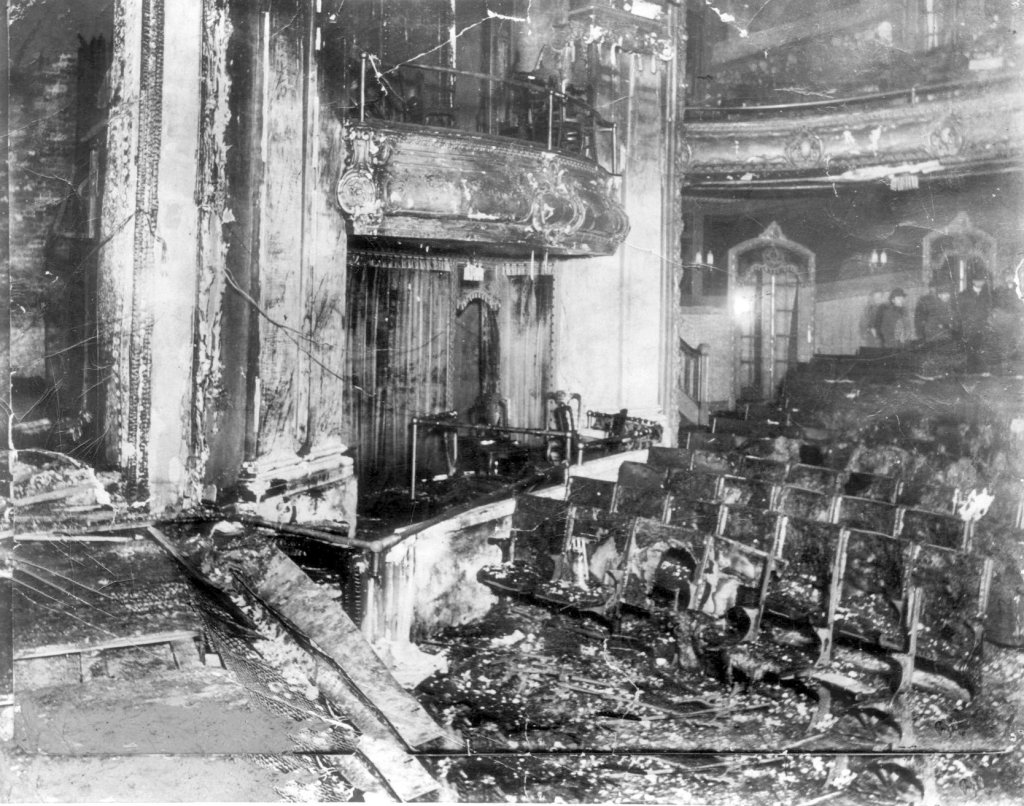
Here’s a look back at what happened in the Chicago area on Dec. 30, according to the Tribune’s archives.
Is an important event missing from this date? Email us.
Weather records (from the National Weather Service, Chicago)
- High temperature: 61 degrees (1884)
- Low temperature: Minus 7 degrees (1909)
- Precipitation: 1.69 inches (1972)
- Snowfall: 5.1 inches (1927)
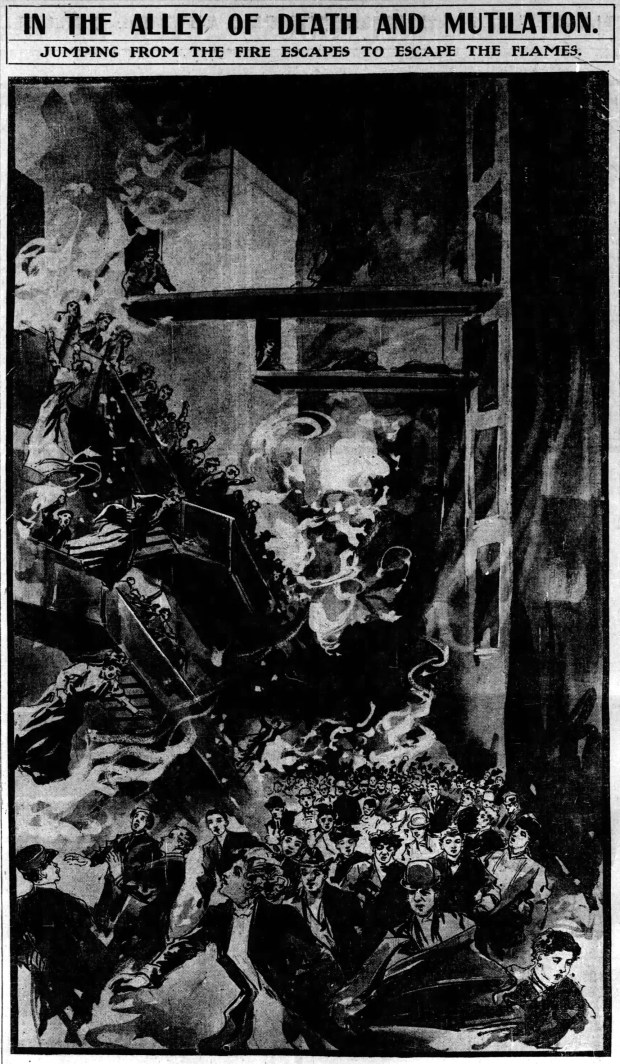 Many of those who could escape the fire at the Iroquois Theatre in Chicago on Dec. 30, 1903, found themselves navigating fire escapes, as this illustration published on Dec. 31, 1903, in the Tribune shows. (Chicago Tribune)
1903: The matinee performance of “Mr. Bluebeard” at Chicago’s Iroquois Theatre, on Randolph Street between State and Dearborn streets, was packed with an estimated 2,000 schoolchildren and families.
The dazzling Iroquois was hastily opened Nov. 23, 1903. Though the “finest, handsomest, and best equipped” theater bragged about its 35 exits, it did not have a sprinkler system, telephone, fire alarm or exit signs. The crowd included a 26-piece orchestra, a cast and crew of 400, and spectators who jammed the balconies and set up camp chairs in the aisles.
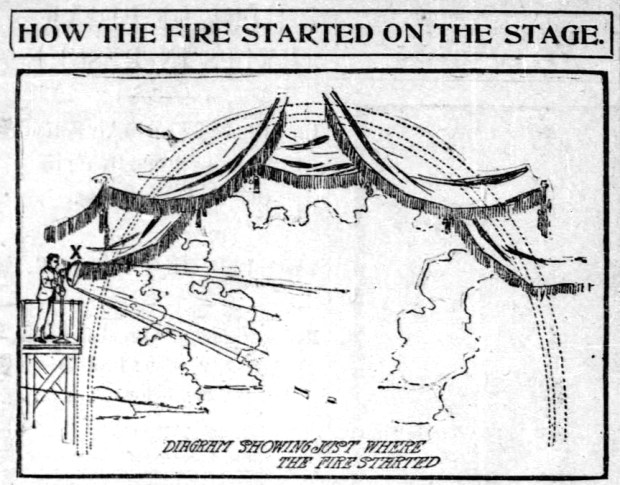 A fire that killed more than 600 people inside the Iroquois Theatre in Chicago on Dec. 30, 1903, started when an arc light set part of a curtain above the stage ablaze. (Chicago Tribune)
The second act had just begun when an arc light near the stage ignited a curtain.
“The first we knew of the fire, was when we saw a tongue of fire, which crept slowly along the red velvet curtain,” survivor Charlotte Plamondon told the Tribune. “As the fire followed the velvet curtain at the top of the stage I could see little girls and boys in the audience point to it as if it were a part of the play.”
As flame licked at the fabric and smoke curled toward the ceiling, the overcapacity crowd of more than 1,800 panicked, rushing for the exits and jammed against doors that opened inward. Some exits were locked; others were nearly impossible to open.
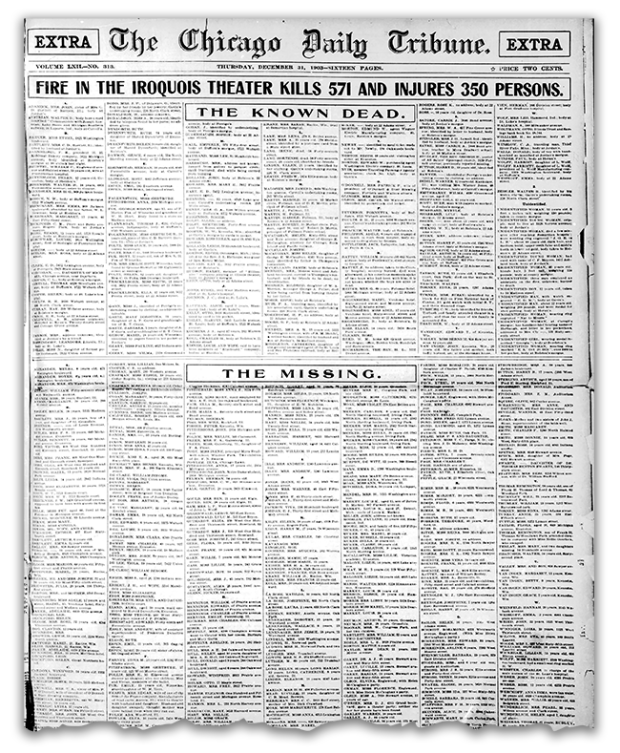
 The Tribune told of the devastating fire at the Iroquois Theatre, published the day after on Dec. 31, 1903, where more than 600 people died. (Chicago Tribune)
Firefighters put out the fire in 30 minutes, but not before it became the worst of its kind in American history with 602 dead — more than twice the toll of the Great Chicago Fire of 1871.
Theatergoers from 13 states were killed in the disaster, which made headlines worldwide, according to Anthony P. Hatch, author of the 2003 book “Tinder Box: The Iroquois Theatre Disaster 1903.”
News accounts were chilling. In a nearby restaurant used to house the dead and dying, “Bodies were everywhere — piled along the walls, laid across tables, and flung down here and there — some charred beyond recognition, some only scorched, and others black from suffocation; some crushed in the rush of the panic,” wrote Tribune reporter Arthur Sears Henning.
The paper’s front page the next day was filled with a list of names of the dead.
Chicago Tribune
The Dec. 31, 1903, front page of the Chicago Tribune after the fire at the Iroquois Theatre.
Though only one victim was buried at Montrose Cemetery, its owner Andrew Kircher established a monument there.
The Iroquois Theatre fire resulted in reforms such as fireproof scenery and stage curtains, illuminated exits and doors that open outward. It also inspired the invention of the exit-door “panic bar,” which still is in use today, and the UL Label Service.
Another theater, the James A. Nederlander Theatre (formerly the Oriental Theatre), opened on the site in 1926.
Want more vintage Chicago?
Subscribe to the free Vintage Chicago Tribune newsletter, join our Chicagoland history Facebook group, stay current with Today in Chicago History and follow us on Instagram for more from Chicago’s past.
Have an idea for Vintage Chicago Tribune? Share it with Kori Rumore and Marianne Mather at krumore@chicagotribune.com and mmather@chicagotribune.com