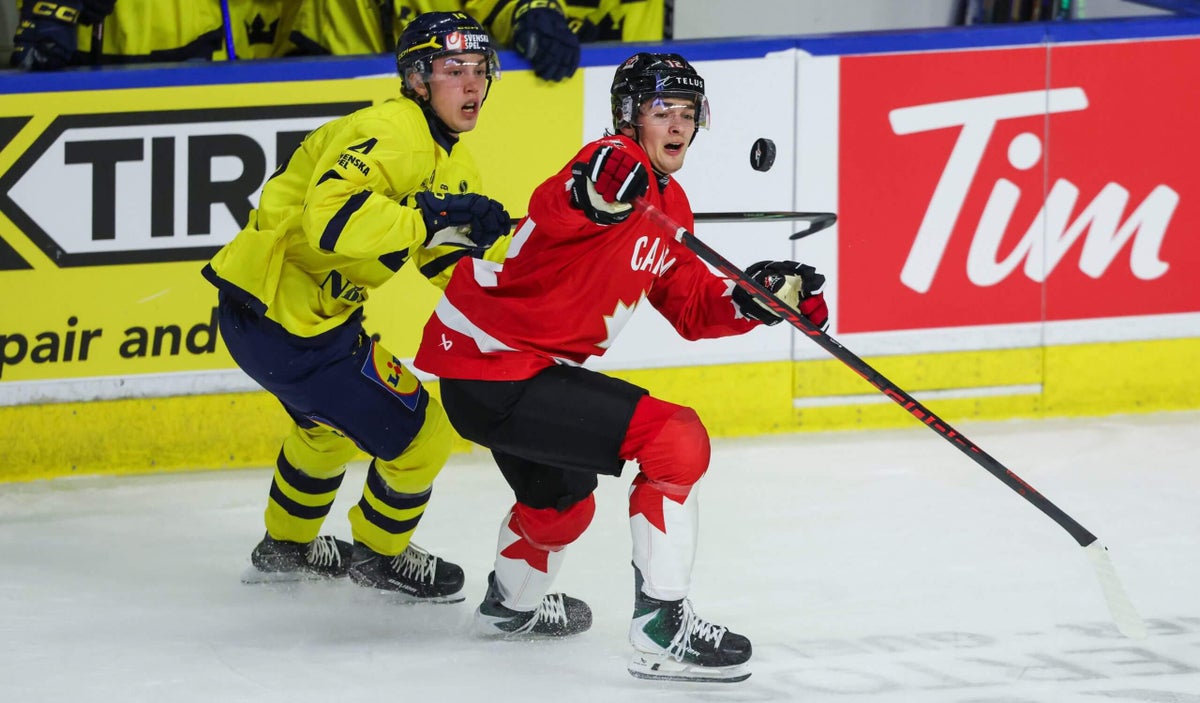
MINNEAPOLIS — Carter Bear can’t forget the play.
It was midway through the second period on March 9, 2025, and his Everett Silvertips were down 2-1 on the road to the Portland Winterhawks. After a scrum in the right circle in the offensive zone, the puck squirted to the left-wing corner. Bear chased it like he always does and finished a check on his right shoulder along the boards on Portland defenseman Max Psenicka. As he did, he felt Psenicka fall backwards, and Psenicka’s leg kicked up in their brief clinch, catching the back of Bear’s leg.
When he instinctively got back up onto his feet, his right one gave out. He didn’t know it at the time, but 56 games into his draft year with his WHL-contending Silvertips, his season — and the big plans that he had for the offseason that would follow it — was over. He’d lacerated his Achilles tendon.
“For the doctor to say I’m not going to be playing for the rest of the season, it was pretty hard to hear,” Bear said, looking back on the moment. “It was definitely tough. It was not easy.”
At the time, he was playing at a 49-goal, 100-point 68-game pace. Despite the injury, the Detroit Red Wings — who he said he had “no clue” were going to select him — took him with the 13th pick in the 2025 NHL Draft. And 295 days after the accident, he stepped out onto the ice at 3M Arena as a member of Team Canada at the World Juniors.
The journey from that night in Portland to this one in Minneapolis was paved by his work ethic — a work ethic which defines his game on the ice and has defined his story off it.
A little less than four months before the injury, the Silvertips were in Seattle, and their new head coach, Steve Hamilton, was beginning to realize what he had in No. 11.
The Silvertips won the game 5-2, and Bear had a hat trick.
A couple of them were “really impressive,” according to Hamilton, and as time went on, his appreciation for Bear as a player for his team only grew, too.
“Over the course of the year, I just caught myself appreciating some of the things that he did that maybe don’t stand out, but when you see it over and over again, you realize there’s a pattern here,” Hamilton said. “He scores goals where he just finds a way, and he sticks around. But that Seattle game was my first introduction to what became a 40-goal season.”
Bear had two things that drove him: he was “incredibly smart,” and he had a “level of determination that you don’t see.”
“He’s a second, third and fourth effort guy. He just kind of never quits on anything and turns the most casual of plays into something simply because he tracks, outworks, strips pucks and finds a way,” Hamilton said. “(That) doesn’t always get appreciated from a distance, but when you see it firsthand over and over, you really do value that.”
That made the injury to his alternate captain a “devastating” one, not just for Bear but also for Hamilton’s team.
“It had a huge impact on our team. And it had a huge impact on Carter,” Hamilton said. “It was an unorthodox summer for him going through the draft and then going through the rehab process after that to get prepared to play. It was not a typical summer for him.”
Instead of doing the rehab at home in Winnipeg with his longtime strength and conditioning coach Richard Burr, the Red Wings signed him to an entry-level contract, and he did his rehabbing in Detroit all summer.
“I’m pretty grateful Detroit did all that for me,” he said. “It was a pretty long process. But I just stuck with it and kept my head up. To get to where I am now, I’m pretty proud of it.”
Because of the injury, he wasn’t able to participate in the World Junior Summer Showcase, either. He eventually returned to play with Everett on Oct. 10.
Early on, Hamilton said there was some rust, and Bear got off to a slow start, registering just five points in his first eight games of the season.
Asked if the injury and lack of skating and proper training impacted it, he refused to go there, however.
“I don’t really like to use excuses,” he said. “I was limited strength when I came back, but nobody wants to hear that.”
But as time went on, his game started to polish again and, according to Hamilton, “he was playing really, really good hockey” when Team Canada called.
Bear fielded the call around 1:30 p.m. on Sunday, Dec. 7, from Canada’s general manager Alan Millar. It was an off day, and he was sitting in his room doing nothing.
Millar told The Athletic that if they selected the team in October, Bear wouldn’t have been on it because of the injury and the slow start.
But in the final eight games before they announced the team, Bear registered nine goals and 15 points. And Hockey Canada was paying attention.
“He’s an example where you can’t rush to decisions based on the start of the year,” Millar said. “You have to take everything into context. The injury, what did his summer look like? Carter, for me, is an honest player, brings us versatility, can play up and down the lineup. I think he’s a guy that can help you win. We kept that in mind as we were making our final decisions.”
Bear says the invite, and eventually surviving a round of cuts, meant more to him because of what he’d been through to earn it. So did Monday night’s debut, after he was the team’s scratch at forward for their first two games.
Before the tournament started, he said he’d get to work for Team Canada.
“I envision myself playing the same game that I always do for Everett. Just a hard-nosed player that gets into the dirty areas — not scared to do anything at all. I play simple and get into the hard areas,” he said.
On Monday against Denmark in his debut, he played just 6:32 but impressed, registering four shots on goal (third-most on the team) in nine shifts.
“I thought he played really well tonight,” head coach Dale Hunter said postgame. “I thought he skated well, stuck to the systems, used his speed, got in on the puck a lot, was in front of the net and defensively he was good. And as a coach, we like the defensive side, too. He was all-around really good. You’ve got to be ready when you go in so that you can stay in. And he was.”
Bear says work ethic comes from the place and the people he comes from.
His parents were born on the Peguis First Nation reserve two hours north of Winnipeg. The Peguis First Nation is the largest in Manitoba, with a population of more than 11,000, and his “whole family background on both sides is Indigenous.” Most of his family still lives there, and he visits often in the summer. His dad, mom, grandfather and other family members run a family business called the Indigenous Management Group, which helps Indigenous people in the province manage their finances. On Monday, when he made his World Junior debut with Team Canada, many of them were in attendance.
“I’m very proud of my background and what my ancestors did,” Bear said in a long conversation with The Athletic pre-tournament. “It’s very special to represent them and my background. And it’s cool to see all of the young indigenous players coming up. That’s home.”
He also grew up as the middle child with two sisters, playing the same style on the lacrosse field as he did on the ice, and had to earn everything after he was drafted 132nd in the 2021 WHL Prospects Draft.
“When he first arrived in Everett, expectations for him as a sixth-round WHL draft pick, you’re never quite sure where his development could take him, and I just think every year he has gotten better and better and we’ve certainly benefitted from that,” Hamilton said.
Hamilton describes him as a quiet but incredibly competitive player who is well-respected and loved by his teammates.
Now that he’s healthy again, the two things he, Hamilton and the Red Wings want to work on next are his skating, which Hamilton said has never held him back but is an area for improvement, and filling out his 6-foot, 179-pound frame.
“You have the frame that you have, and then it’s just about being as powerful and explosive as you can be within that,” Hamilton said. “And I think Carter’s got lots of room to grow within his and as he gets stronger, I think that’ll help all aspects of his game because he certainly isn’t a play-on-the-outside type of guy, so he’s going to need that strength to get to the inside and do the work that he’s used to doing.”
They have no doubt that he’ll put the necessary work in on both of those fronts, though.
“He just really does his talking on the ice,” Hamilton said. “He’s not about frivolity and all the extras. He’s getting down to business.”
— With reporting in Niagara Falls, Ontario