Society has mythologized eccentricity as an essential trait of genius. We expect geniuses to be odd, so we interpret quirks through that lens.
Quite simply, extraordinary minds live differently.
Wyatt C. Hedrick certainly would seem to qualify. Though a Cadillac man with two parked at his home, and one each at his offices in Fort Worth, Dallas, and Houston, Hedrick was said to prefer bumming rides from friends and colleagues, employees, and other company executives to get around Texas.
Hedrick’s commute to his Dallas office was unconventional, to say the least. According to a report years ago by the Star-Telegram, Hedrick would hitch a ride to the old Dallas–Fort Worth Turnpike — now simply Interstate 30 — slip past the tollbooth and thumb another ride off someone he knew on the other side.
That qualifies as different, but Hedrick was different in every sense as an architect and engineer.
Hedrick’s Fort Worth-based company was one of the largest in the country at the time of his death in 1964 at age 75. The firm had completed jobs all over the world and had more than 900 on the payroll.
Wyatt C. Hedrick Architect and Engineer had revenues of more than $1.3 billion between 1922 and 1963. Adjusted for inflation, that’s about $13 billion today.
Hedrick’s footprint in Fort Worth and across the Southwest is immense. Dozens of his buildings still rise across the city, their design as striking today as ever. His Art Deco and Zigzag Moderne works are counted among the best examples of their kind anywhere.
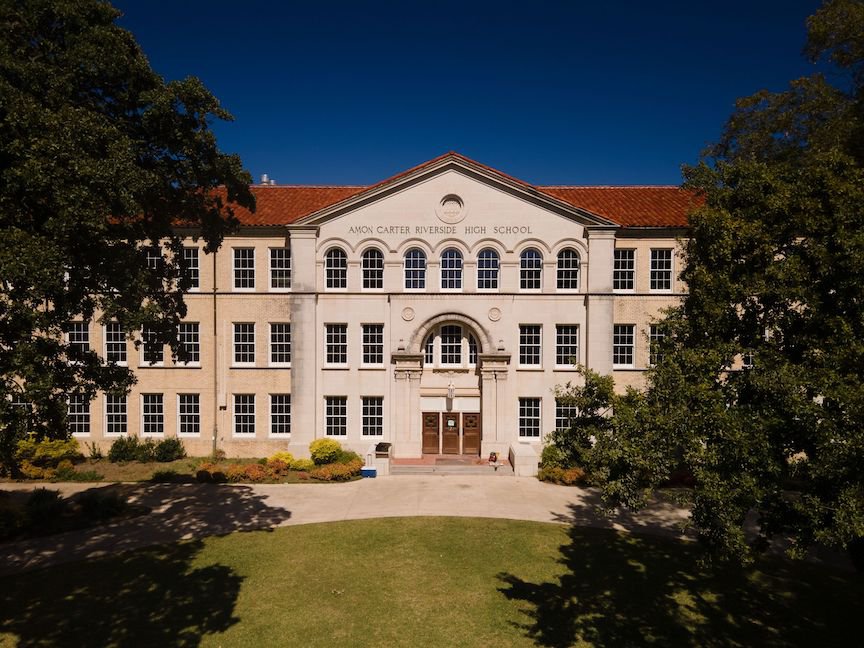
Hedrick’s firm was responsible for many of the city’s significant Art Deco buildings, including the Will Rogers complex, the T&P Terminal and Warehouse, and the Central Fire Station. Hedrick and his chief designer, Herman Koeppe, also designed Carter Riverside High School and the city’s — that is, Amon Carter’s — Greater Southwest International Airport.
His vanished landmarks include the Medical Arts Building and the Aviation Building, both demolished in the 1970s. According to Southwestern Architect magazine in 1928, the Medical Arts Building was voted by Texas architects as one of the 12 best buildings in Texas.
“They kind of worked hand in hand because Hedrick wasn’t a trained architect,” says John Roberts, an architect and board member of Historic Fort Worth Inc., of Hedrick and Koeppe. “Hedrick was a trained engineer. So, Koeppe did a lot of these designs.”
Hedrick was born to a family of tobacco farmers in Virginia. He earned a bachelor’s degree from Roanoke College in 1909 and followed that with an engineering degree in 1910 from Washington and Lee University.
He moved to Dallas for work at an engineering firm, but in 1914 he formed Hedrick Construction. In 1921, he became a partner in the Fort Worth architectural firm, the famed Sanguinet & Staats.
“They named their firm Sanguine Stats and Hedrick,” says Roberts, who has documented many of Fort Worth’s buildings through his website Architecture in Fort Worth. “St. Mary’s of the Assumption Catholic Church and the Fort Worth Club are two of the few buildings in that transition period that had the credit of all three architects.”
Hedrick bought out his partners in 1922.
With a distinguished look and celebrated identity, Hedrick, according to a profile in the Star-Telegram, caught the eye of Madison Avenue. He was featured in Lord Calvert’s “Men of Distinction” campaign — a whiskey ad that cast him as the picture of midcentury success: poised in his office, a model of his Shamrock Hotel gleaming behind him, and a highball glass in hand.
The timing of the campaign couldn’t have been worse. Hedrick was then building a project at Baylor University, the world’s largest Baptist educational institution with J. Frank Norris ties that treated alcohol consumption with scorn and revulsion, as well as a moral failing. When the ad ran, the reaction was said to be swift and final. Baylor severed ties, and Hedrick was never invited to build there again.
Texas Tech University, TCU, and Texas Wesleyan University had no restrictions on such social enterprises. He designed several buildings on each campus.
The last building in Fort Worth with Hedrick’s fingertips was the Fritz G. Lanham Federal Building in downtown, Roberts says.
It was being constructed when he died in 1964 at age 75. The firm closed its doors shortly after.
Notable works by the firm of Wyatt Hedrick