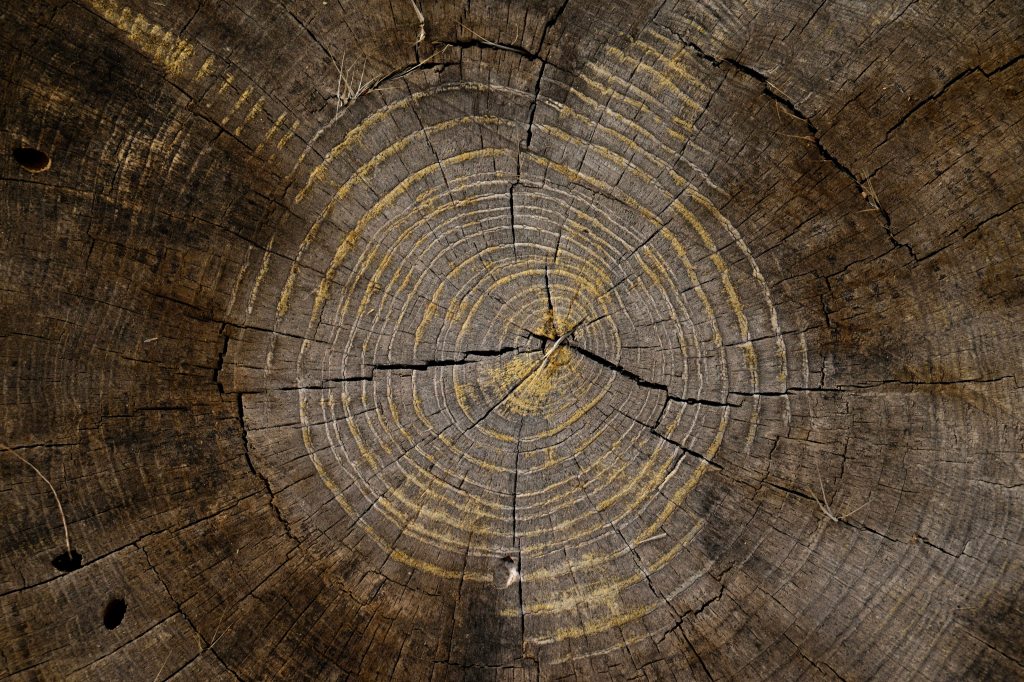
From cottonwoods and apple trees to a pine older than the state, Boulder County’s trees hold some of the area’s history — going back hundreds of years.
In an area full of forest land, nailing down the most impressive tree in Boulder County is a difficult task — but the Colorado Tree Coalition knows some standouts.
“I volunteer for the Colorado Tree Coalition as their state champion tree coordinator — or big tree hunter, if you want to call it that,” Neil Bamesberg said of his work. Bamesberg has worked with the tree coalition for years and is the official keeper of the champion tree list.
The champion tree list kept by the nonprofit coalition is a record of the three largest reported trees of each species in Colorado, Bamesberg said. Boulder County has been home to 72 of the trees on the state champion list, with one tree near Longmont making it to the national champion list, he said.
Bamesberg pointed to the community, west of Longmont, called Hygiene.
“And there was a cottonwood nominated there in 1967, and that was a national champion up until the ’90s,” Bamesberg said.
The National Champion Tree Program’s list honors the largest trees in the U.S., and the tree in the Hygiene area was the largest of its species, the lanceleaf cottonwood, for the years it made the list, Bamesberg said. The tree died in 2012 — but Bamesberg was able to measure it, he said.
“The tree was 137.5 inches in diameter — that’s basically 11½ feet. So this is a monster tree. It was amazing,” he said. “It was 96 feet tall, and what we call the crown spread, or the branch spread, was 99 feet.”
With those impressive measurements, Bamesberg said he estimates the tree could have been over 120 years old when it died. Currently, Colorado’s largest tree is a just over 200-inch diameter narrowleaf cottonwood in Hinsdale County, according to the National Champion Tree Program’s online database. Hinsdale is located far southwest of Denver, and just east of Telluride.
Beyond the cottonwoods, Boulder County also has a rich history tied to its apple trees, according to Amy Dunbar-Wallis, who works with the University of Colorado Boulder’s Apple Tree Project.
The Apple Tree Project “has been going since about 2018, and we are a group of researchers, CU students and community members with the goal of mapping, tagging and measuring the oldest remaining apple trees in Boulder County and now across the state,” Dunbar-Wallis said.
The project is intended to preserve Boulder County’s history of apple orchards and apple growing, a tradition that goes back to the late 1800s, according to the project’s website. Drought, disease, the Prohibition era and the popularity of Red Delicious apples grown in Washington led Boulder’s apple orchards to fall into disrepair in the early 1900s, the project’s website says.
However, many apple trees still remain in Boulder County and beyond, and some of them are unique cultivars, Dunbar-Wallis said. A cultivar, from “cultivated” and “variety,” refers to a type of apple — like Red Delicious, Honeycrisp or Granny Smith — that’s grown by grafting apple trees together in an effort to produce fruit with a particular flavor, Dunbar-Wallis said.
The variety of apples in Boulder County, according to Dunbar-Wallis, represent the work of some early residents to grow new cultivars or plant seedlings from other places — including the work of George Washington Webster.
“George Washington Webster came from Ohio, and he’s credited as being the first blacksmith in the area,” Dunbar-Wallis said. He raised his family on a property in the Hygiene area, and when his daughters moved to California, he “went out to California a lot to visit them, and when he went to California, he would bring back different varieties of apples and cherries, and then he would grow the trees at this property and sell the produce.”
Although the earliest apple trees planted on Webster’s property, now owned by Boulder County and called the Zapf farm, are probably gone, it’s still home to many apple trees that are likely 80-100 years old, Dunbar-Wallis said.
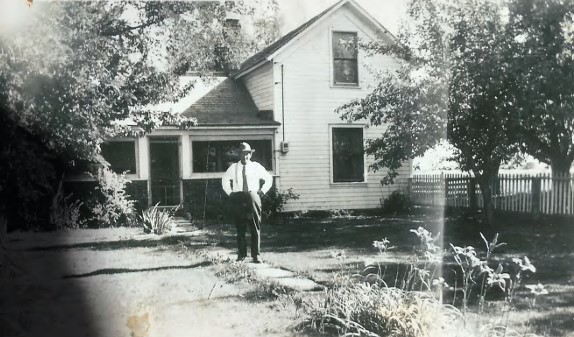 Louis A. Birkley is seen standing in front of a house on what is now known as the Zapf farm property in this photo from 1941. The photo was part of a presentation about the farm given to Boulder County commissioners in 2018. According to Amy Dunbar-Wallis, the rightmost tree is likely an apple tree. (Courtesy of Boulder County Parks and Open Space)
“What’s really interesting about this property is of the trees that are left, only one of them is a cultivar — the other trees that are all really old are all seedling trees,” Dunbar-Wallis said. “Seedling trees are really interesting because, like the name says, you plant the seed and a tree grows up, but you don’t know what sort of flavor you’re going to get with those trees like you would if you planted a cultivar.”
Because of the way apples grow, even a seed taken from a Red Delicious apple and grown into a new tree may not produce an apple that tastes like the original Red Delicious, Dunbar-Wallis said. Instead, apple farmers will use the process of grafting to create a cultivar to guarantee the fruit’s specific taste, she said.
As part of preserving Boulder’s apple-growing history, the Apple Tree Project keeps those unique cultivars alive at orchards in the area, Dunbar-Wallis said.
One preservation orchard sits at the intersection of Jay Road and the Diagonal Highway, and the other is on the CU campus and is sometimes used as an outdoor classroom, Dunbar-Wallis said. Both orchards are open to the public, she said.
Once the trees start producing apples, “people will be able to try out fruit that folks had during the homesteading era,” Dunbar-Wallis said. The project also has an online map that shows the locations of apple trees in the area.
At least one tree in the county is still alive today whose age dwarfs the Hygiene cottonwood and Webster’s apple trees, according to Vivienne Jannatpour, a spokesperson for Boulder County parks and open space.
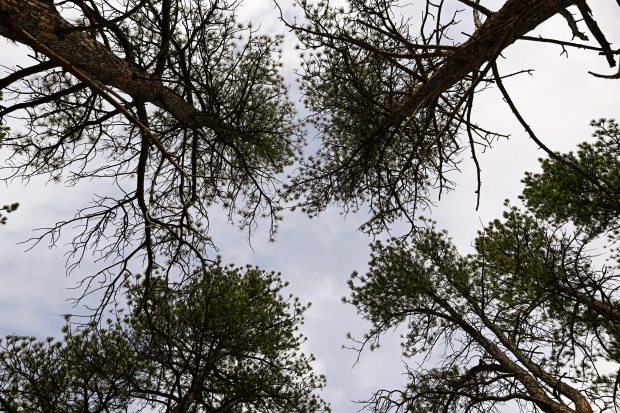 Trees stand in the area of the Boulder County Parks and Open Space Heil Valley Ranch on Dec. 11. A ponderosa pine in the valley was studied, as part of a 2013 project, that dated back to the 1550s. (Matthew Jonas/Staff Photographer)
As part of a 2013 project to reconstruct fire histories in the area, the county took samples of some trees in the Heil valley. The oldest of those samples revealed a ponderosa pine dated to 1554, Jannatpour said.
The project involved taking cores from a sample set of trees, and it would be very difficult to trace the 1554 core to an exact tree, Jannatpour said, but it shows that the county’s oldest trees could hold history from before the widespread colonization of Colorado.
Colonizers in Colorado “did serious damage to the history of native people in Colorado by obliterating the history along the Front Range — you’ll find (very little) accurate information about what happened in Colorado,” said Richard Williams, who works with the Truth, Restoration and Education Commission of Colorado.
The commission, in partnership with the nonprofit People of the Sacred Land, works to piece together the history of Colorado’s native inhabitants who were forced from their land — but the task is a difficult one, Williams said.
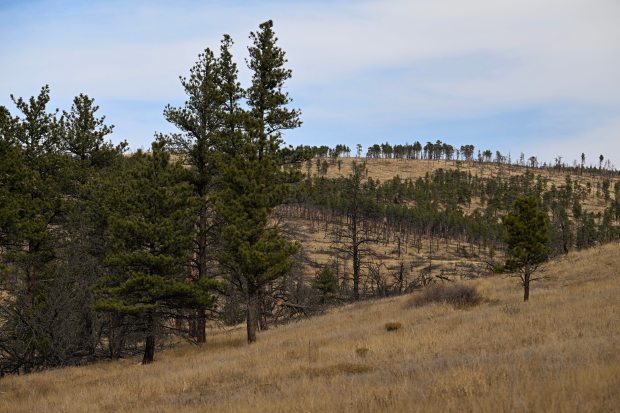 Trees damaged in fire are seen in the area of the Boulder County Parks and Open Space Heil Valley Ranch on Dec. 11. (Matthew Jonas/Staff Photographer)
Williams said deliberate efforts to bury pieces of Colorado history like the Sand Creek Massacre and a lack of legal treaties between Natives and settlers for the land in the early days of colonization mean that records are hard or impossible to find.
“All you have to ask yourself is why are there no American Indian reservations on the Front Range? What happened, and why? And why don’t people know about it?” Williams said.
The Front Range was home to multiple Native nations, Williams said, and when the oldest recorded tree among the Heil valley samples was a sapling, the Apache likely were among those who called the area home.
“The land of Boulder was never legally taken,” Williams said. “We’re really trying to gather information to get a better idea of what was happening in this neck of the woods” before and during the displacement of Native people, he said.