A new study published by the Royal Astronomical Society (RAS) is sending shockwaves through the world of astrophysics. Researchers from Yonsei University in South Korea suggest that dark energy, the mysterious force behind the universe’s expansion, may be weakening, opening the door to a catastrophic reversal known as the Big Crunch. This theory, detailed in the peer-reviewed journal, challenges two decades of scientific consensus and introduces a chilling possibility: the universe may not expand forever, but collapse into a fiery singularity instead.
Dark Energy May Be Slowing Down
For decades, the dominant theory has held that dark energy causes the universe to expand at an accelerating pace. But the new findings suggest a very different trajectory. The team, led by Professor Young-Wook Lee of Yonsei University, re-analyzed supernova data, the same data that originally led to the discovery of dark energy in 1998, and found signs that the acceleration may actually be slowing down.
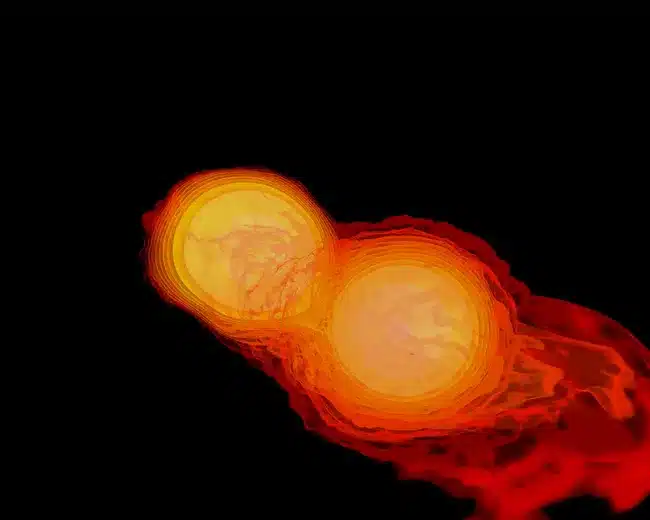 Scene from a NASA animation showing two neutron stars colliding. (Image credit: NASA’s Goddard Space Flight Center)
If this trend continues, the universe could eventually reverse direction, halting its expansion and collapsing inward. This idea isn’t just theoretical. Observations from the Dark Energy Spectroscopic Instrument (DESI) in Arizona showed unexpected changes in the rate of galactic acceleration. These observations prompted scientists to reevaluate core assumptions about dark energy.
Professor Ofer Lahav of University College London, commenting on the findings to the BBC, said: “Now with this changing dark energy going up and then down, again, we need a new mechanism. And this could be a shake up for the whole of physics.”
This profound shift could completely rewrite how physicists understand the structure and future of the cosmos.
The Big Crunch: A Cosmic Reversal of the Big Bang
The concept of a Big Crunch is not new, but it has long been considered unlikely given the prevailing belief in accelerating expansion. This new study, however, revives the idea with fresh data and mathematical models.
In a Big Crunch scenario, gravity would overcome dark energy’s weakening push, pulling galaxies back toward each other. Over billions of years, stars, planets, and entire galaxy clusters would start collapsing into a condensed core, reversing the outward motion that began with the Big Bang.
“The fate of the Universe will change,” warned Professor Lee, indicating just how transformative these findings could be for cosmology. Telescopes would begin to see galaxies merging, stars colliding, and increased heating of the cosmic microwave background, a fossil echo of the Big Bang.
Fireball Universe: What Happens At The End?
As the collapse intensifies, temperatures across the universe would rise drastically. According to the Wilkinson Microwave Anisotropy Probe team at NASA, “At these high temperatures, hydrogen was completely ionized into free protons and electrons.” This process would turn the cosmos into a high-energy soup of charged particles.
Eventually, the entire universe might shrink into a superheated fireball, consuming all matter, light, and even space-time itself. Celestial bodies would be torn apart, and atomic bonds would cease to hold. All that once existed would be reduced to a singular, dense point, the ultimate end of time.
Scientific Debate: Between Caution and Controversy
Not all astrophysicists agree with these findings. Professor George Efstathiou of the University of Cambridge dismissed the study, calling the data interpretation “weak” and suggesting that it might reflect “messy details of supernovas” rather than a true signal of changing dark energy.
Despite this skepticism, the RAS publication has sparked intense discussion. The fact that hundreds of papers now debate competing theories about the universe’s fate underscores the level of uncertainty, and the potential for discovery in this field.
Whether or not the Big Crunch becomes the accepted model, the possibility alone has reinvigorated interest in cosmic fate and forced scientists to confront the unknown.