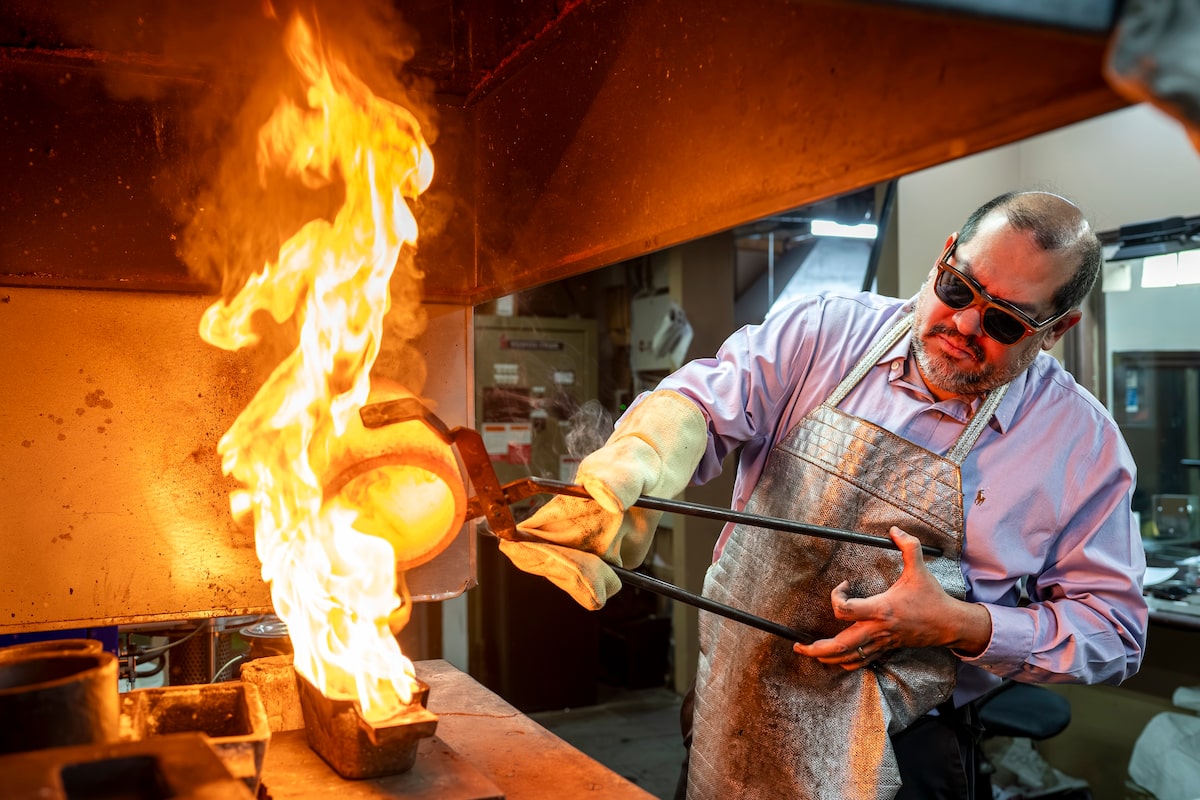
Atef Salama, owner of Express Gold Refining, pours molten gold into an ingot while working at a small smelting facility at the back of the company’s offices in Toronto, on Dec. 19, 2025.EDUARDO LIMA/The Globe and Mail
In the remote northeastern Ontario town of Timmins, new pickup trucks fill gold mine parking lots. In the Yukon, nearly 130 years after the start of the Klondike gold rush, investment is pouring in once again. And at a small refinery in downtown Toronto, people are turning their old gold jewellery into cash.
Across Canada, investors, companies and individuals are scrambling to take advantage of gold’s astonishing run. In late December, the price of gold surpassed US$4,550, up more than 70 per cent from a year ago, and marking a threefold increase from 2015.
These executives got extra rich off gold and silver’s astronomical gains this year
In the process, gold is leaving its mark on Canada’s economy, pumping up exports and boosting Canadians’ stock market returns. Yet measuring gold’s impact on the Canadian economy isn’t cut and dried, say economists. And while the metal’s eye-popping price gain is boosting local communities around mines and filling government coffers, it has yet to translate into a broader economic boom for the country.
The starkest example of how gold has shifted Canada’s economic narrative is on display almost every month, when the country’s trade numbers are released. Gold has become an increasingly influential part of Canada’s export picture, accounting for close to 8 per cent of annual exports as of September.
In fact, Canada now exports more gold than it does former top exports such as assembled passenger vehicles, forestry products, farm and fish products and industrial equipment.
The surge in gold exports has also contributed heavily to what early success Canada has had in diversifying its exports away from the U.S. this year.
Of the 11-per-cent increase in non-U.S. exports in the first nine months of the year compared to the same period in 2024, one-third was due to gold alone, an analysis of Statistics Canada trade data shows. Two-thirds of Canada’s gold exports went to Britain, where London serves as the largest market for trading precious metals.
Of course, this phenomenon could also work the other way if gold prices experienced a prolonged correction, resulting in a drag on Canada’s trade numbers.
The reality is the current gold export boom is almost entirely a function of the metal’s price increase rather than the quantity of precious metals being shipped, which is roughly the same as a decade ago.
What’s more, the balance of payments method for measuring trade – the metric most commonly cited by Statscan each month – captures payments that occur with a change of ownership, even if gold doesn’t physically leave the country. As such, in the Bank of Canada’s most recent Monetary Policy Report, the bank’s analysis of how tariffs have affected exports specifically excluded gold from consideration, because gold is “frequently re-exported, stored or shipped for financial or custodial reasons.”
Looking past the price movements, “gold is relatively limited in terms of how much of a payback there is to the economy,” said Doug Porter, chief economist at Bank of Montreal. The value added from mining gold and silver amounted to less than three-tenths of 1 per cent of Canada’s gross domestic product in 2024, he said, and that has grown only slightly over the last decade.
Regardless, those who work in the industry say the run up in prices over the last few years has kick-started activity on a number of fronts, and those gains are starting to add up.
For one thing, production is on the rise and new mines are being developed, which is no small feat in a country where building mining infrastructure has become increasingly difficult because of the lengthy, complex regulatory process and the uncertainty surrounding approvals.
“We’ve struggled as a country to open up new mines but even though we’ve only opened a small handful of critical mineral mines, we’ve been more successful at opening gold mines thanks to gold prices driving more incentives and more investment,” said Photinie Koutsavlis, vice-president of economic affairs and climate change at the Mining Association of Canada.
The surge in gold exports has also contributed heavily to what early success Canada has had in diversifying its exports away from the U.S. this year.EDUARDO LIMA/The Globe and Mail
Canada’s gold production climbed 32 per cent over the last 10 years as of 2024, allowing the country to overtake the U.S. to become the fourth-largest gold producer behind China, Russia and Australia. In 2025, Statscan’s monthly mineral production numbers show gold output as of October jumped by 11.5 per cent from the same period in 2024.
In Northern Ontario, gold’s rise has sparked a rush of new prospecting activity, said Bill McRae, interim president of the Ontario Prospectors Association. He added that with gold prices elevated, even low-grade sites that would have been ignored in the past have become economically feasible.
For the Timmins area, which has produced more than 70 million ounces of gold since 1910 – an amount worth US$300-billion at today’s prices – wealth from the new rush is visible everywhere.
“We’re on the cusp of a really big expansion here, and people working in mining, they have money,” he said. “You go into a mine parking lot these days and 90 per cent of the vehicles are trucks that are less than a year old.”
In late December, the price of gold surpassed US$4,550, up more than 70 per cent from a year ago, and marking a threefold increase from 2015.EDUARDO LIMA/The Globe and Mail
Several of those mine properties are now owned by Toronto-based Discovery Silver Corp. DSV-T, which acquired the Porcupine Complex of mines from Denver-based Newmont Corp. NGT-T earlier this year. The company plans to spend heavily to upgrade existing mines, restart one shuttered mine and explore for new deposits in the area, said Tony Makuch, Discovery’s president and chief executive officer, who grew up in the area as the son of a gold miner.
Over the next three to five years, he said employment on the project is expected to double from the current 1,300 workers. That’s part of a broader increase in employment in gold and silver mining, which over the last decade grew by 48 per cent to 23,625 in 2024 and narrowed the gap with employment in motor vehicle manufacturing (excluding parts manufacturing), which over the same period shrank by 12 per cent to 35,900, according to Statscan.
“The gold price gives us the opportunity to invest in one of the great gold producing regions in the world in Porcupine,” Mr. Makuch said, adding that Discovery expects to pay $118-million in federal and provincial taxes for the year. “Governments are trying to fund programs. Well, gold is money from the ground, it should be considered a critical mineral.”
Discovery Silver Corp.’s Dome Mine near Timmins, Ont., which it acquired in April, 2025.Supplied
Those prospects helped make Discovery the top-performing stock in the S&P/TSX Composite Index in 2025.
In fact, of the top 20 performing stocks in the benchmark index based on year-to-date returns, 18 were precious metals companies. That’s benefited Canadian equity investors even if they don’t directly own gold stocks themselves, with the S&P/TSX soundly trumping its U.S. counterpart, the S&P 500 Index, in 2025.
“Even without gold producers, the TSX has held its own against the S&P 500, but gold has definitely been our X-factor,” said Mr. Porter.
Similar patterns are unfolding in other gold mining regions in the country.
In the Yukon, 2024 brought the highest level of placer gold production – gold recovered from loose material such as sand and gravel – in the territory’s history, according to the Yukon Geological Survey.
Meanwhile, companies with hard rock exploration projects in the Yukon raised more than $400-million in 2025, double the amount from the year before, said Mike Burton, director of innovation, industry and business development for the Yukon government, with spending going to support local businesses including helicopter rentals, camp supplies, accommodation and drilling businesses. “A lot of that increased activity can be attributed to the price of gold,” he said.
Atef Salama, owner of Express Gold Refining, assists customers at his Toronto business on Dec. 19, 2025.EDUARDO LIMA/The Globe and Mail
Far from the mines, in a downtown Toronto low-rise office building atop a dentist’s office, Atef Salama, the vice-president of Express Gold Refining, has a front-row seat to the gold frenzy. Express, a fourth-generation gold business started by Mr. Salama’s grandfather in Egypt in 1912, offers gold trading and refining services and is seeing a steady flow of traffic to its doors.
“Gold has proven to be a hedge against inflation, a hedge against uncertainty, so it’s doing what it’s supposed to in the market, but what’s changed is people are paying more attention now,” Mr. Salama said.
On a recent morning in the company’s cramped refining room, protected behind bulletproof glass, an employee melted down the accumulated workspace dust and scraps from a local jeweller, fashioning a small 140-gram bar of various precious metals (42 per cent gold, the rest silver, platinum and some trace metals) for the client.
Mr. Salama holds a small batch of gold jewelry before melting it at the company’s smelting facility.EDUARDO LIMA/The Globe and Mail
Earlier, Mr. Salama showed off some of that morning’s refining output: a heavy, pockmarked gold bar worth around $400,000. “Good things come in small packages,” he said, adding the business is preparing to offer secure storage services to clients because the risk of theft of gold from their homes has intensified. “That’s our next push, building that secure infrastructure for Canadians and to keep it in Canada.”
What’s unclear is how a prolonged price correction for gold could impact the economy. As Ms. Koutsavlis, with the Mining Association of Canada, notes, “Gold doesn’t follow what economists would say are the fundamentals of supply and demand, it’s so politically and almost emotionally driven that you can’t forecast what the price will be with any certainty.”
Back in Timmins, Mr. Makuch said he takes a long view. “I’ve been through cycles since the 1980s, what you learn is you’ve got to have discipline,” he said, noting Discovery’s aim is to get its “all-in sustaining cost” down to US$1,500 an ounce from the current US$2,100.
“The price of gold gives us the opportunity to build ourselves up, so if the price does come down, we’re still able to be there.”
Nabil Salama, 85, father of Atef Salama, examines a batch of gold jewellery.EDUARDO LIMA/The Globe and Mail