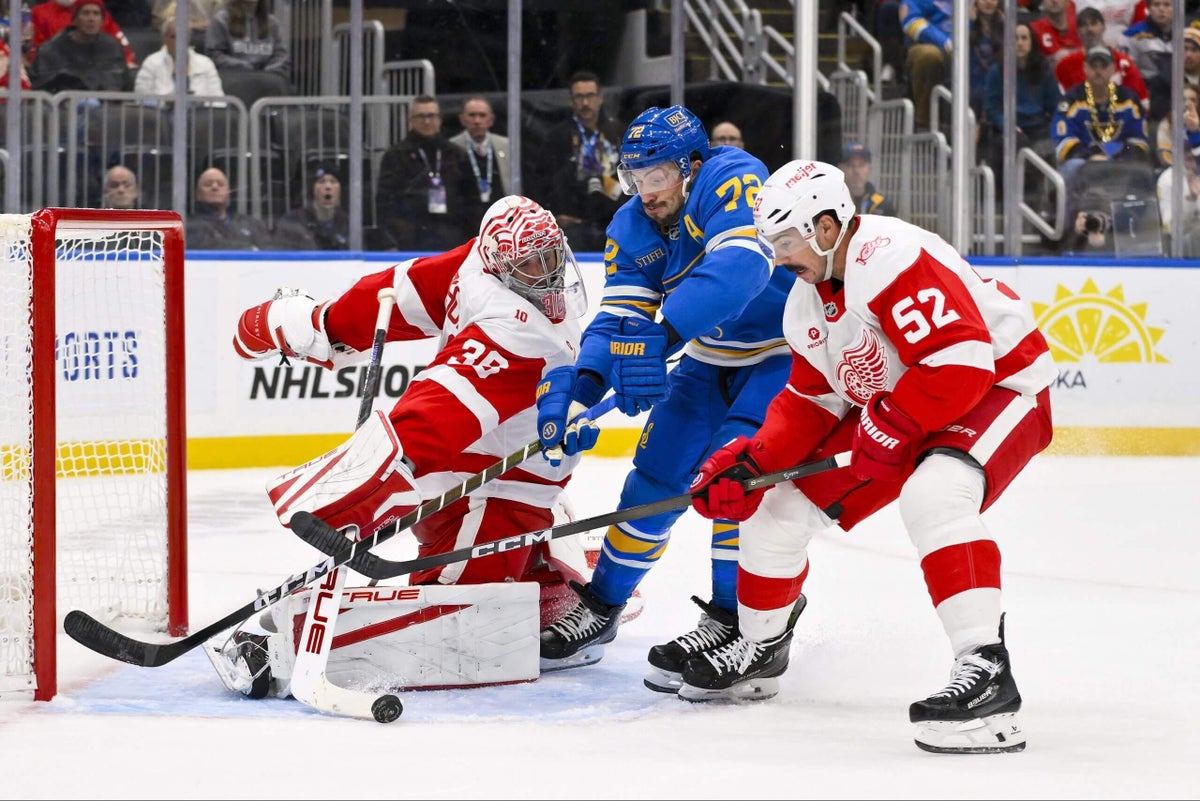
A whole lot is going right for the Detroit Red Wings right now.
Sitting atop the Atlantic Division as they prepare to hit the season’s midpoint Wednesday night against Winnipeg, the Red Wings are on pace for their best season in more than a decade. Their star defenseman, Moritz Seider, is squarely in the Norris Trophy conversation. They have two potential 40-goal scorers in Dylan Larkin and Alex DeBrincat. And they have three rookies contributing in the lineup, giving them plenty of room to keep growing as well.
“I’ve been on good teams,” three-time Stanley Cup winner Patrick Kane said on Tuesday. “And this is a good team.”
How good, though? That remains to be seen. And general manager Steve Yzerman still has a chance to help determine the answer.
In some ways, Yzerman’s relatively quiet offseason last summer is working out for Detroit. Most of the top names on the free-agent market didn’t actually make it to July 1, instead re-upping with their current teams before free agency opened. In the wake of that, the Red Wings opted to make a few additions around the margins. They signed forwards Mason Appleton and James van Riemsdyk to the bottom six, and depth defensemen Jacob Bernard-Docker and Travis Hamonic, then took a swing on one larger move, trading for veteran goaltender John Gibson.
Both of those forwards have been nightly regulars for the Red Wings, with van Riemsdyk’s nine goals tied for fourth on the team. Gibson, in goal, has recently started to find the high-level form Detroit was looking for in trading for him.
Meanwhile, the relative lack of other moves left a path for rookies such as Emmitt Finnie and Nate Danielson to push their way into the nightly lineup, with Finnie spending most of the season so far on the top line.
For a team looking to snap a nine-year playoff drought, while simultaneously building toward the future, those are all important developments. And in the big picture, Detroit’s season is going about as well as it could be.
But as the Red Wings have seen over and over in recent seasons, it only gets harder from here. And not just because Detroit has one of the NHL’s toughest remaining schedules.
As the calendar creeps closer to April, the hockey gets harder, faster and tighter-checking as teams build up toward the playoffs. And while the Red Wings seem to be heading in the right direction in all three facets, they still have plenty of questions to answer about how they’ll fare in those kinds of games.
The largest focus for those questions, right now, is on the blue line.
In Seider, Detroit has a legit Norris candidate as a do-it-all workhorse who is tilting the ice as well as just about anyone in the league. His defense partner, Simon Edvinsson, appears to be taking a leap as well, giving the Red Wings a strong top pair.
On the second pair, the Red Wings have found a solid duo in veteran Ben Chiarot and rookie Axel Sandin-Pellikka. Chiarot is having arguably his best season as a Red Wing, and Sandin-Pellikka has started to tap into more of his offensive potential over the last month. In the regular season, it’s a serviceable pairing.
But in the playoffs, it’s fair to wonder how the young Sandin-Pellikka will hold up to the physicality and speed in a second-pair role. Even now, the Red Wings have been outscored 30-17 with Sandin-Pellikka on the ice at five-on-five. His expected goals share is better than that, at 45.82 percent, and considering he’s just 20, taking some lumps is all part of the process in the grand scheme of his development.
Considering the rookie is still being somewhat sheltered right now, though, it’s fair to say that asking him to play a true second-pair role in playoff games would be a tall task. Just last game, you saw an example, when a heavy John Tavares forecheck forced Sandin-Pellikka into a third-period turnover that the Maple Leafs quickly turned into a go-ahead goal.
Again, some of that is part of the learning curve for a first-year NHL defenseman. But if the Red Wings were able to bump him down a pair as the games got tougher, they could ease in Sandin-Pellikka more selectively. And in the process, upgrade their third pair — arguably an even bigger problem so far this season.
Hamonic and Albert Johansson haven’t looked like a natural fit when they’ve played together on the third pair. And while Bernard-Docker has had his positive moments, with neutral-to-good underlying numbers in sheltered minutes, he and Johansson have struggled at times to break the puck out under heavy pressure.
In a recent game against Dallas, Bernard-Docker had three consecutive shifts whose lengths were 2:09, 1:40 and 3:10 — an extreme example, to be sure, but a glimpse into the potential risk in a potential playoff game, when the pressure only goes up.
The point here: if Detroit could add a legit No. 4/5 defenseman at this deadline, it could either plug that player right into the second pairing, or match him with Johansson in the short term, with the plan to eventually bump them up with Chiarot as the hockey gets harder late in the season.
Granted, it’s debatable whether Johansson and Sandin-Pellikka are a natural fit together, either, as two younger, smaller defenders, but in the right deployment, their mobility and smarts feel at least manageable, while adding more certainly stability to Detroit’s lineup overall.
That thought process is why I highlighted Justin Faulk as a potential fit in a recent article, which asked The Athletic staff to identify a trade candidate for each team from Chris Johnston’s latest trade board.
Faulk is playing much more than a 4/5 role in St. Louis, on a struggling Blues team. His 22:45 average time on ice trails only Philip Broberg among St. Louis skaters. He’s been productive, with 20 points through 40 games, and the Blues have outscored their opponents 28-26 in his five-on-five minutes. The expected goals numbers haven’t been as favorable (45.65 percent xG share), but if Detroit needs a proven veteran to play a second-pair role in tight games, Faulk fits the bill and brings legit puck-moving ability, too.
There are other names on the trade board who could make sense as well in this kind of role, including Pittsburgh’s Brett Kulak (a lefty) and Chicago’s Connor Murphy. New Jersey’s Dougie Hamilton would be a bigger ticket acquisition, and it’s worth noting St. Louis does have an even higher-impact RHD on its roster in Colton Parayko, who would be a highly appealing target — though he didn’t make Johnston’s trade board.
Calgary’s Rasmus Andersson is the splashiest name on the board, though it feels unlikely the Red Wings would get into the kind of bidding war Andersson could command for a pure rental. Kulak and Murphy would be lower-cost rentals, while Faulk could split the difference with an additional year of term — but not a prohibitive amount.
Regardless of the names, though, the Red Wings have done everything they can so far to merit some reinforcements for the home stretch. Their top players have raised their level, virtually across the board. And they’ve gotten key contributions from down the lineup, too. But they could still use an upgrade — especially on defense.
There’s still plenty of time before the March 6 trade deadline, of course. But the long Olympic break means that the deadline will be here quicker than it seems.
And if the Red Wings remain in a playoff spot by March, the biggest need for Yzerman to address is becoming clearer by the day.