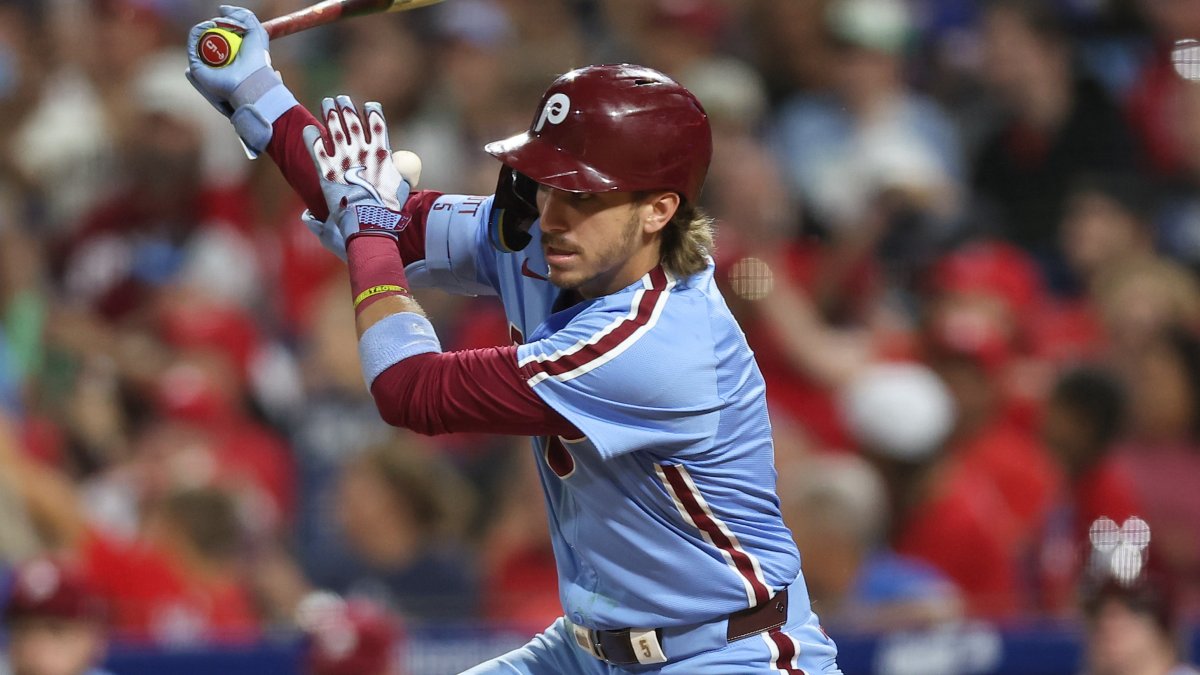
The Phillies need Bryson Stott to be steady. Defensively and on the bases, that has rarely been a concern.
As Philadelphia continues to build championship-caliber rosters, the question entering Stott’s age-28 season is whether his late-season offensive progress can carry over.
His 2025 regular season broke into three distinct stretches: a productive start, a midseason regression and a strong finish.
Breaking it down
Through his first 27 games, Stott slashed .297/.374/.436 for an .810 OPS. Good things happened when he made contact. His .359 batting average on balls in play (BABIP) led the Phillies and ranked 16th among 165 qualified hitters.
The production, however, came with underlying warning signs. His expected batting average (xBA), based on exit velocity and launch angle, was .239 which was 58 points below his actual average, suggesting favorable batted-ball luck. His average exit velocity was just 83.9 mph, the second-lowest in the majors (per FanGraphs).
The batted-ball mix helped sustain it. Stott posted a 22.8 percent line-drive rate, placing him in the top 25 percent of hitters, even ahead of New York’s Aaron Judge.
Over the next 70 games, the results swung sharply in the other direction. Stott hit .206/.276/.300, and his .577 OPS ranked third-worst in the MLB.
This time, the luck went the other way. His BABIP dropped to .231, the fourth-lowest in baseball during that span. Contrary, his xBA was .235, nearly identical to his early-season mark, yet the hits did not fall.
Interestingly, the contact quality improved. His average exit velocity jumped to 88.6 mph, but his line-drive rate fell to 16.6 percent (142nd of 156 qualifiers), shifting more balls into less productive contact.
Things did come together late. Over his final 50 games, Stott hit .310, 12th-best in the league among qualifiers, with an .880 OPS. The underlying numbers aligned more closely with the results. His average exit velocity held at 88.2 mph, his xBA rose to .270, his line-drive rate returned above 20 percent and his hard-hit rate climbed.
When the season ended, Stott finished with a .719 OPS, which was four percent below league average (96 OPS+).
The constants
The biggest offensive limitation remains left-handed pitching. Stott owns a career .666 OPS against lefties and fell to .575 in those matchups in 2025.
“Bryson Stott is a really good player,” Dave Dombrowski said at the end-of-season press conference. “He is an everyday player, but at times, I’m sure [Rob Thomson] will rest him versus tough left-handers.”
Defense and speed continue to anchor his value. In 2025, Stott recorded eight Outs Above Average, placing him in the 94th percentile league-wide. He also ranked in the 86th percentile in sprint speed.
He has also continued to produce in leverage situations. For his career, Stott owns a .742 OPS with runners in scoring position compared to a .701 overall OPS. In 2025, that number jumped to .917. He led all qualified second basemen in extra-base hits with runners in scoring position and tied for the lead in total bases.
The biggest improvement
Plate discipline showed meaningful growth. After posting chase rates north of 30 percent in each of the previous two seasons, Stott reduced his out-of-zone swing rate to 23.6 percent in 2025.
His 23.3 percent chase rate ranked in the 81st percentile, according to Baseball Savant, and he saw a career-high 4.40 pitches per plate appearance.
There was also an ironic split in approach. When swinging at the first pitch, Stott hit .366 with a .592 slugging percentage (.948 OPS), collecting 26 hits. When taking the first pitch, his OPS dropped to .681.
Optimism for ’26
Stott enters 2026 after showing late-season signs of returning to his 2023 offensive profile, when he hit .280 with 49 extra-base hits and a .747 OPS.
Line drives remain the key for the former first-round pick. Three seasons ago, Stott posted a career-high 20.9 percent line-drive rate and a career-low 32.7 percent fly-ball rate. In 2025, his most productive stretches again coincided with a line-drive rate above 20 percent.
Dombrowski has repeatedly emphasized the importance of doubles-driven offense, and Stott hit 32 in his career-year 2023 compared to 22 last season.
Lineup usage may also factor in as Rob Thomson weighs his options. The numbers point to Stott excelling as a “second leadoff” type. He owns a .910 OPS in the No. 9 hole for his career, his best mark in any lineup spot, often turning the order over ahead of Trea Turner, Kyle Schwarber and Bryce Harper.
If his line-drive percentage and improved plate discipline carry over, Stott profiles as an above-average offensive second baseman, even without a full breakthrough against left-handed pitching.