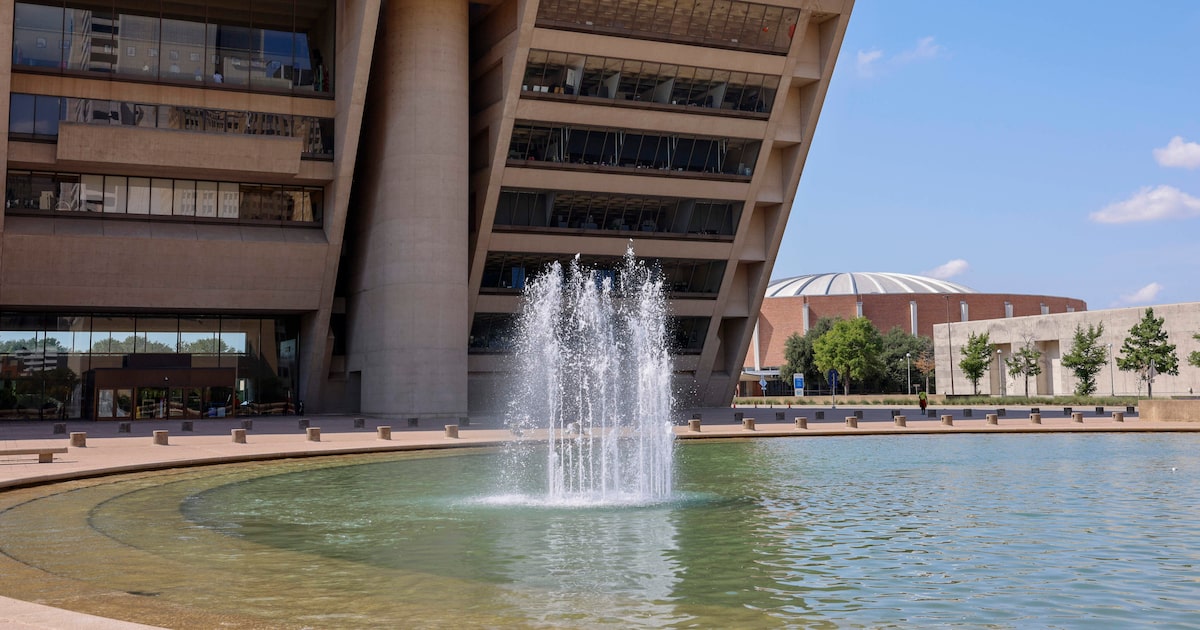
Supporters of relocating Dallas City Hall are brushing aside a new architects’ report that argues the city can redevelop downtown without demolishing the I.M. Pei-designed building, calling the group’s analysis overly focused on preservation.
Backers of a move say the study underplays the financial and operational challenges of keeping City Hall in place and overlooks what they see as a rare chance to redevelop a large, city-owned site that could simplify financing and accelerate downtown investment.
Former Mayor Ron Kirk, a proponent of moving City Hall, said the city should not limit its options by starting from the premise that the building must be saved, particularly given the cost of renovating the aging structure.
“Don’t lock yourself into an emotional decision that says, ‘Oh, we can’t tear this building down,’” Kirk said. “You could spend $400 million repairing an aging building and still lose the opportunity to keep downtown vibrant.”
Political Points
Former Mayor Tom Leppert echoed that view, framing the issue as a broader question about downtown’s future rather than a single building. He warned that renovation costs for the 47-year-old City Hall, estimated at $343 million to $595 million over the next decade, could climb higher, as major public projects often do.
“For me, the big decision is not just City Hall,” Leppert said. “It’s how we make a great downtown.” He added that relocating city operations into a modern commercial building could reduce long-term operating costs.
The pushback comes after a group of 10 former presidents of the American Institute of Architects released a report urging the city to spare City Hall and instead pursue large-scale development on other underused sites downtown, such as the former Reunion Arena, vacant parking lots behind City Hall and roughly 30 acres near the Kay Bailey Hutchison Convention Center.
Some developers and civic leaders counter that the report doesn’t take into consideration the full advantages of the City Hall site itself, a large, contiguous, city-owned parcel that could simplify financing and redevelopment.
They also note that two of the three alternative sites identified by the architects are privately owned or already tied to other development plans.
“It seems like a functionally obsolete building,” said developer Ray Washburne, arguing that City Hall’s condition should be evaluated on its own merits, separate from any arena proposal.
The report and reactions to it mark the latest turn in the monthslong debate over the future of Dallas City Hall: should the city prioritize preserving a civic landmark, or seize a rare chance to reshape its urban core and southern edge of downtown.
The architects, meanwhile, stand by their point that an arena can be built without sacrificing City Hall.
The group said their focus was intentionally narrow, only aimed at determining whether other downtown sites could accommodate a large-scale sports or entertainment district without sacrificing City Hall. They have other research marked for the future about the assessment of the building.
“Those two questions are happening concurrently,” said Bob Meckfessel, one of the report’s authors, criticizing the city’s condensed timeline for evaluating City Hall’s future and saying he believed an improper process may not yield good results.
The Dallas City Council voted Nov. 12 to direct City Manager Kimberly Bizor Tolbert to explore alternatives for the City Hall building, including a full assessment of the facility, its land and surrounding properties.
The Dallas Economic Development Corporation is overseeing the assessment of City Hall’s future, with a report to Tolbert due by Jan. 19 and a public presentation of the findings planned to occur before the council’s finance committee on Feb. 23.
Speculation of what that redevelopment could be includes a new arena for the Dallas Mavericks, although the NBA franchise hasn’t publicly declared any interest in moving to the City Hall site.
Council Member Paul Ridley, whose district covers downtown Dallas and has been a critic of the city’s handling of the issue, called the architects’ report a decisive rebuttal to claims that City Hall must be moved to spur development.
“What that report does is to undercut, if not destroy, the argument that we have to (move) City Hall to create more developable land, because there’s no demand for what we have already,” he said.
Deputy Mayor Pro Tem Gay Donnell Willis said she’s keeping an open mind, but noted that some of the suggested sites are privately owned or already earmarked for other projects.
“That doesn’t mean there couldn’t be receptivity,” she said.
City Hall debate, at a glance
The question: Should Dallas renovate its iconic I.M. Pei–designed City Hall or relocate government offices and free the site for redevelopment?
Architects’ case: Ten former presidents of the American Institute of Architects argue City Hall does not need to be demolished. Their report says large projects, including a potential arena, could instead fit on other underused downtown sites.
Sites cited by architects:
• Former Reunion Arena site
• Parking lots behind City Hall
• Roughly 30 acres near the Kay Bailey Hutchison Convention Center
Pushback: Critics say the report sidesteps City Hall’s aging condition, long-deferred maintenance and the value of unlocking prime, city-owned land. They also note two of the three alternative sites are privately owned or already tied to other plans.
What’s at stake: The decision could shape downtown Dallas for decades, affecting public finances, land use and any future sports or entertainment district.
What’s next: City Council members say they want full data before deciding whether to repair, relocate or redevelop City Hall, with debate expected to intensify after getting an assessment of the building’s future from the Dallas Economic Development Corporation.