Have a question about Philly’s neighborhoods or the systems that shape them? PlanPhilly reporters want to hear from you! Ask us a question or send us a story idea you think we should cover.
SEPTA reported some positive changes over the past year, like the appointment of general manager Scott Sauer, a drop in major crimes, a new two-year contract with the Transport Workers Union and ridership that has recovered to about 80% of pre-pandemic levels.
But there was no shortage of bad news.
Several unexplained fires on aging Regional Rail trains. Weeks of train cancellations and delays. Sharp criticism from the federal government. A prolonged state budget battle that led to a fare hike, route cancellations and threats to discontinue several Regional Rail lines. And most recently, a maintenance snafu that shut down the Center City trolley tunnel for two months and counting.
As a tumultuous year finally comes to a close, here’s a review of some of the major developments and a peek at what lies ahead for SEPTA in 2026.
SEPTA’s ongoing budget battle
At the start of 2025, SEPTA faced a $240 million annual deficit due to rising costs, reduced fare revenue and the expiration of federal pandemic relief aid. The agency reduced the deficit to $213 million by freezing salaries, reducing hiring and making other cuts.
Pennsylvania Gov. Josh Shapiro renewed his proposal to boost spending for the state’s transit authorities by nearly $300 million, and Republicans again gave it the cold shoulder. The governor and some legislators expressed support for a new tax on skills games that could fund the spending bump, and there was talk of regulating and taxing marijuana, but both ideas faced major hurdles.
In response, Sauer presented a doomsday budget for 2025-26 that would boost fares by 21.5%, eliminate bus routes, reduce trip frequency throughout the system, end daily train service after 9 p.m., discontinue special trains for ballgames and eventually eliminate five Regional Rail lines in addition to other cuts.
“Given the dramatic impact that these measures will have on ridership, the reality is that we would start the dismantlement of public transit for our city and region as we know it today,” he said.
The funding battle became caught up in a broader fight over the state budget, which state Senate President Pro Tempore Kim Ward described as the “worst one” she’d seen in her career. Riders packed a public hearing on SEPTA’s budget in May, testifying about their dependence on the system and the devastating impact the cuts would have on them if they went through.
Feds order train fixes
The five-county transit authority was also challenged by a series of fires that broke out in its fleet of Silverliner IV Regional Rail cars, all at least 50 years old.
The first occurred in February near Crum Lynne Station in Ridley Park, destroying a car, and was followed by four others in June, July and September. No one was seriously injured in the blazes.
In August, SEPTA inspected all the cars and took steps to improve crews’ responses to signs of railcar problems, such as the appearance of smoke or warning lights coming on. Removing cars for inspection led to shorter, more crowded trains and scores of cancellations. When two more fires occurred in September, the Federal Rail Administration issued an emergency order requiring a more robust response.
“The pattern of failures persuades FRA that reliance alone upon the prior assurances and cooperation of SEPTA is not possible, nor in the interest of public safety,” Robert Andrew Feely, FRA acting administrator, said in October.
U.S. Secretary of Transportation Sean Duffy sought to blame Shapiro for the lack of funding that he argued contributed to the fires, writing in a letter to the governor, “Your administration has failed to secure stable State funding, forcing SEPTA into a chronic spiral of service cuts and deferred repairs.”
Feely ordered the agency to do more worker training, inspect the older Silverliner IV cars and install heat-detection systems, which led to more service disruptions in October. Inspections wrapped up in November, but the repairs and the shortage of railcars have continued.
Shapiro provided SEPTA with $219.9 million in state discretionary funding to help pay for the work. The agency is leasing 10 railcars from Baltimore and has started the long process of commissioning new cars, which are expected to cost $2 billion and require federal funding.
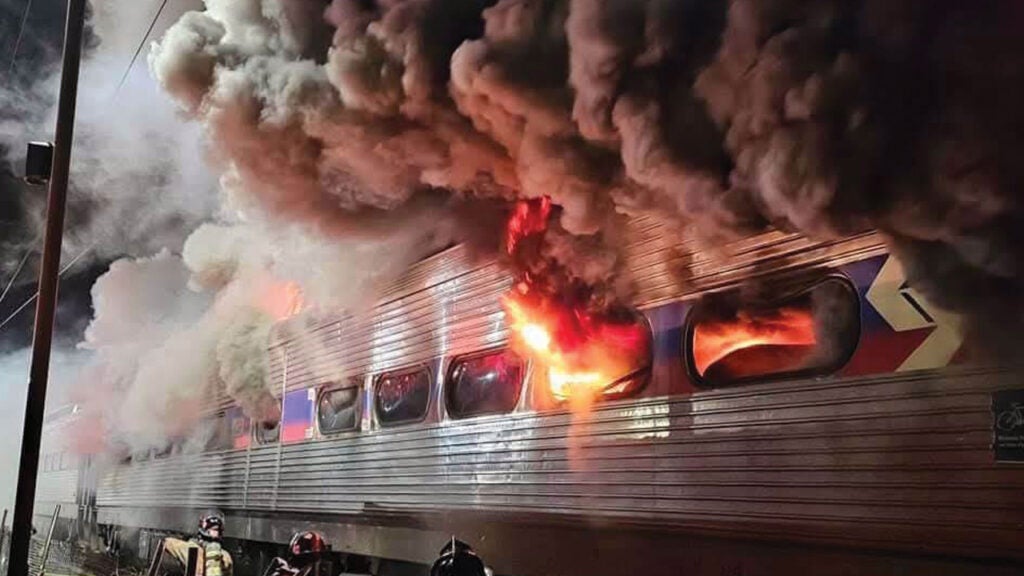 A SEPTA train en route to Wilmington, Del., went up in flames in Delaware County on Feb. 6, 2025. (6abc)
Bus fires and stalled trolleys
In addition to the Regional Rail fires, SEPTA dealt with some other notable equipment challenges.
In June, a battery in a decommissioned electric bus sparked a fire in a North Philadelphia parking lot that burned at least 16 buses and caused a spike in air pollution levels. It was the second such fire in SEPTA’s troubled Proterra electric bus fleet, which it had used in 2019 and 2020 before pulling them out of service.
The Trump administration’s Federal Transit Administration demanded information on how the buses were being stored and criticized the federally funded program that had paid for them.
“This is not the first green deal initiative to backfire with serious long-term ramifications, bringing into question how safe and efficient these investments are,” FTA Administrator Marcus Molinaro said in August.
More recently, in November, SEPTA shut down the Center City trolley tunnel under the Schuylkill River after an attempted equipment upgrade damaged the overhead trolley wires and connecting points. The power poles that connect the trolleys to the wires started popping off, cutting power to the cars and stranding them mid-trip.
Maintenance workers have been trying to smooth out and lubricate the damaged wires, but said they will ultimately have to replace 5 miles of wires.
SEPTA has been waiting for the arrival of ordered materials, and meanwhile is directing riders to use the El, special shuttle buses that are running trolley routes or other bus lines. Officials have said they hope to reopen the tunnel in early January.