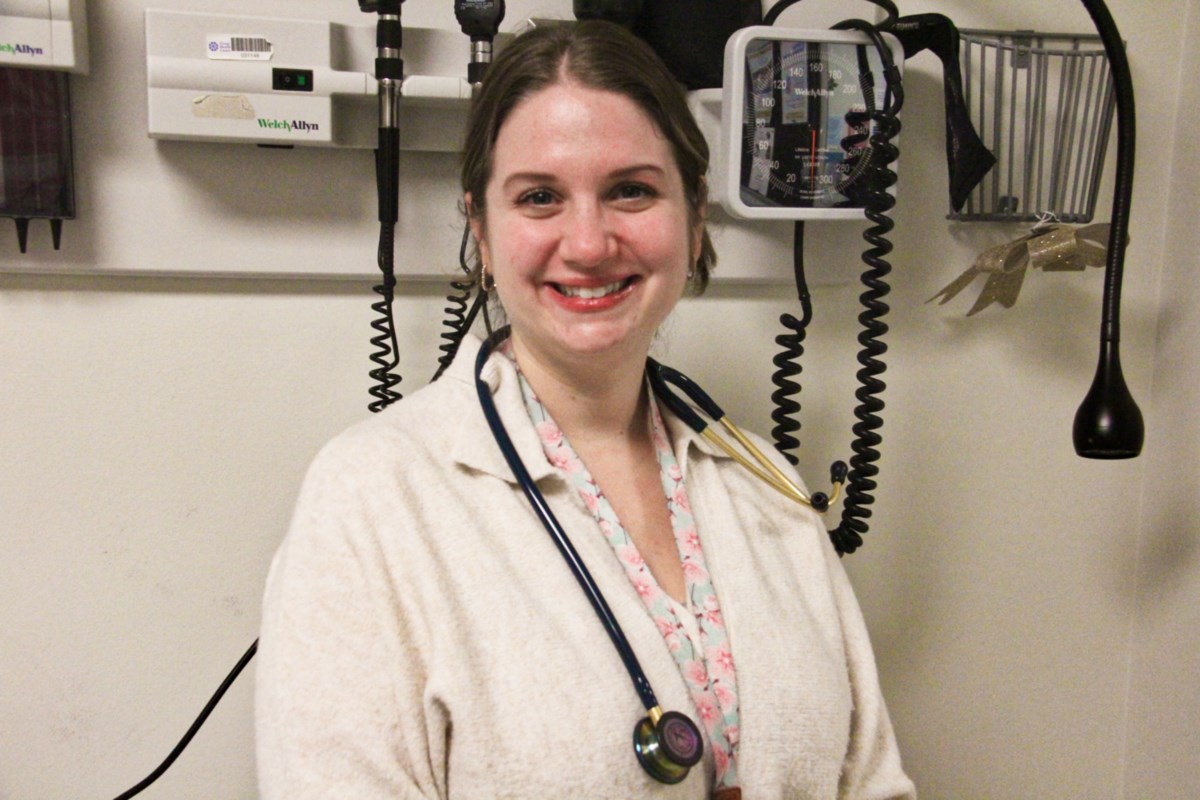
Lauren Beeson of the Group Health Centre is one of thousands of NPs across the province helping to address the urgent shortage of primary care providers
Professional, experienced and confident, Lauren Beeson is among a group of medical professionals appearing in greater numbers on the healthcare landscape.
She is a nurse practitioner.
“I love my job,” said Beeson, currently treating patients at Group Health Centre’s Same Day Clinic.
“I like being able to help people in the moment at the same day clinic. Let’s say they have a terrible cough, they’ve had it for weeks and they’ve done everything they can at home and now they’re coming to me for help. That’s what I like about it. I’m able to give them some relief.”
Nurse practitioners, or NPs, were limited in what they could do for patients in the past. That has changed in the last few years.
NPs can diagnose and treat illnesses, prescribe medications, order diagnostic imaging tests such as X-rays, CT scans, MRI tests and ultrasound and also refer patients to specialists.
“There used to be restrictions on what an NP could prescribe or what tests they could order. My more experienced colleagues have told me stories about how they had a tiny list before. It was very limited prior to when I became a nurse practitioner in 2019,” Beeson said.
“There are certain types of heart tests at the hospital that we cannot order and certain government forms that we cannot authorize but I would say that’s pretty much the extent of it. It’s really quite extensive in terms of what we are now able to do.”
A Sault native, Beeson earned a Bachelor of Science in Nursing degree at Sault College and worked as a registered nurse, first in Orillia and then Elliot Lake, before returning to her hometown.
“I wanted to do something that involves caring for people and nursing is exactly that,” Beeson said.
Though she was a compassionate bedside nurse, Beeson followed through on her desire to add to her skill set and began studying to become a nurse practitioner in 2016.
Her training was a hybrid of online and in-person instruction through Sudbury’s Laurentian University.
She moved back to the Sault in 2017 and officially became a nurse practitioner in 2019.
She has worked at GHC’s Same Day Clinic since July 2020.
Approximately 3,750 people work as nurse practitioners in Ontario and the employment outlook for NPs in the province is described as very good for the 2025-2027 period, according to the Ontario government.
More NPs have been added to GHC’s ranks to address the shortage of primary care providers in Sault Ste. Marie.
“It was very hard to find an NP job only five years ago,” Beeson said. “Right now NP jobs are everywhere.”
NPs are not the only answer to the primary care provider shortage but they bring a lot to the table, Beeson said.
“We’re part of the solution, absolutely.”
“The difference between a nurse practitioner and a physician in the grand scheme of things is the type of training that we have. We have our education as a nurse practitioner but we also have our prior experience as a nurse at the bedside. That’s a huge positive.”
She recommends being an NP.
“Becoming a nurse practitioner is a career of the future, 100 per cent,” Beeson said.
“If a registered nurse is thinking about becoming an NP, if they want to have a change in their lifestyle, if they have young children, or if they want to have no shift work it really is a good choice.”
Beeson said her work as a nurse practitioner at GHC’s Same Day Clinic is never dull.
“There are a lot of viral illnesses but I’ll also see newborn babies come in for a weight check after they’ve been discharged from the hospital. I’ll see somebody that hurt their ribs or has a sore knee. There’s mental health as well, people looking for some help and I do what I can for them. So, I see quite a variety. My job in the same day clinic is mostly what we call episodic care, meaning I can offer them some solutions and then they would follow up on any chronic issues with their family doctor.”
“You’re never going to stop learning. Every day is going to be different. It won’t get stagnant,” Beeson said.