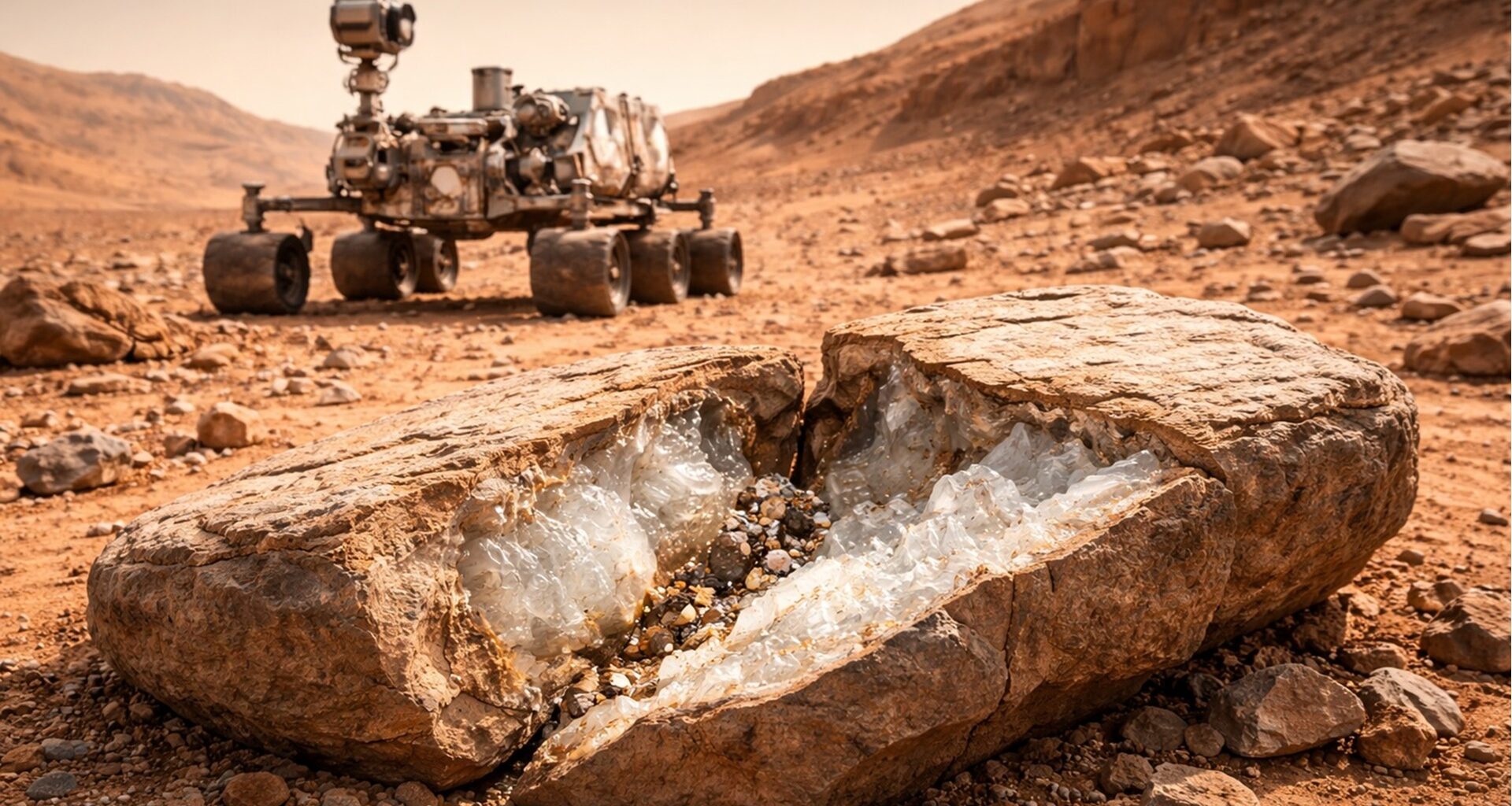
The accidental breakage of a rock by the rover in the Gediz Vallis channel revealed yellow crystals of elemental sulfur, a rare and unprecedented chemical condition that challenges current theories about the geological and environmental history of the Mount Sharp region on Mars.
NASA’s Curiosity rover accidentally discovered elemental sulfur crystals on May 30, 2024, in the Gediz Vallis canal. The unprecedented find occurred after the vehicle broke through a rock, revealing unknown environmental conditions on Mount Sharp.
Chemical context and the uniqueness of the discovery
The Curiosity rover wasn’t intended to generate headlines with an immediate moment of discovery while traversing the surface. It simply drove over a rock during its mission.
The accidental maneuver broke the rock and exposed something that scientists had never previously confirmed. planet Mars. The interior of the rock revealed bright yellow crystals of elemental sulfur, a material also called native sulfur.
— ARTICLE CONTINUES BELOW —
This specific detail is important because Curiosity has found sulfur on Mars several times in past explorations. However, the element usually appears trapped in… sulfates, which are salts formed when water evaporates.
Pure sulfur is chemically different and forms under a relatively restricted set of specific environmental conditions. The NASA team states that these conditions have not been associated with the known history of this specific location.
Even more surprising to the mission team is that the rover didn’t find a single isolated strange rock. It found what the mission technically described as an entire field of light-colored stones.
These rocks were very similar to the one the rover had accidentally crushed during its passage through the Martian terrain. The amount of material found in the area immediately caught the attention of the researchers in charge of the project.
The Curiosity project scientist, Ashwin Vasavada, summed up the problem and the team’s excitement in one sentence. He stated that finding a field of rocks made of pure sulfur is like finding an oasis in the desert.
Geological location and terrain characteristics
The discovery occurred in the Gediz Vallis channel, identified as a winding groove located in Mount Sharp, in Gale Crater. Mount Sharp rises approximately 5 kilometers above the Earth’s surface.
The Curiosity rover has been climbing the geological layers of this mountain since 2014 as part of its mission. The vehicle uses the mountain as a natural timeline of environmental changes that have occurred in Mars’ history.
Since October 2023, the rover has been exploring a sulfate-rich region in this specific area of the terrain. This chemical composition already indicated an aquatic past linked to evaporation and changes in the local chemical composition.
The new discovery adds a piece to the puzzle that doesn’t fit neatly into the previous geological story. Scientists thought they were deciphering a coherent narrative from the rocks analyzed up to that point in the exploration.
Gediz Vallis is also a place where the landscape itself is impressive for mission observers. NASA states that scientists suspect the channel was carved by flows of liquid water and debris.
Detailed observations from Curiosity suggest that both energetic floods and landslides shaped the site. These dynamic geological events formed different debris deposits over time on the surface of the Martian channel.
Becky Williams, a researcher at the Planetary Science Institute, summarized the past climate situation very clearly. She stated categorically that this was not a peaceful period in the geological history of the planet Mars.
Scientific implications and caution in the analysis
On Earth, the chemistry of sulfur is deeply linked to geology and biology in diverse ecosystems. Some microbes use sulfur compounds to obtain energy, and the element appears wherever there is interaction between water and heat.
However, it is crucial to maintain logic when analyzing the data sent by the rover. Finding sulfur, even in its pure form, is not the same as finding life on the planet’s surface.
What this discovery provides is a more precise map of the types of chemical environments that existed in the past. This is the necessary foundation even before questioning whether microbes could have survived there.
NASA itself adopts a cautious stance regarding the conclusions drawn from this new material finding. In a later update, in 2024, the agency observed how pure sulfur behaves on our planet.
The agency noted that, on Earth, pure sulfur is associated with active volcanoes and hot springs. NASA added that there is no evidence at Mount Sharp to point to either of these causes.
This uncertainty about the geological origin is precisely the crucial point of the ongoing scientific investigation. Elemental sulfur can be produced through various pathways, and different pathways imply very different environmental conditions.
Some conditions may be wetter, others warmer, and some may involve complex chemical reactions. The next step is to determine which scenario actually corresponds to the rocks that Curiosity is currently observing.
Future of the mission and new objectives
The Curiosity rover has been collecting data around the sulfur field and documenting the channel in detail. The work includes capturing wide panoramas of the area for later analysis by scientists on Earth.
At the end of 2024, NASA reported that the rover was preparing to leave this location. regionThe vehicle must leave the Gediz Vallis canal to begin a new stage of its long journey.
Curiosity will begin a months-long journey toward a region known technically as “boxwork.” This area features a large pattern of ridges that may have formed through subterranean geological processes.
These ridges may have formed when minerals carried by groundwater filled fractures in the original rock. Subsequently, these minerals hardened, creating the structures that the rover will investigate in its next phase.
One of the reasons this destination is important is the nature of the saltwater underground environments. These locations are considered plausible habitats on early Earth and are of great scientific interest for comparative studies.
Curiosity scientist Kirsten Siebach described the fascinating box-shaped structure in this specific way. She stated that these ridges contain minerals that crystallized underground, where the environment would have been warmer.
In addition to the higher temperature, there would have been salty liquid water flowing through these geological structures in the distant past. Therefore, the discovery of sulfur does not end the debate, but serves as an important reminder.
This demonstrates how Mars exploration actually works in practice for mission control teams. An accidental rover error can reveal a new target for highly relevant scientific study.
A single mineral could force scientists to rewrite parts of the chemical history of the red planet. The discoveries continue to challenge previous assumptions about the environmental and geological evolution of Mars.