
The “Little Foot” skeleton is one of the most complete hominin individuals ever discovered, and has the odd distinction of having been found and recovered in two separate time periods years apart. It is, though, the subject of much dispute.
This is a diary series in which we take a closer look at hominins, fossil ancestors of the human family.
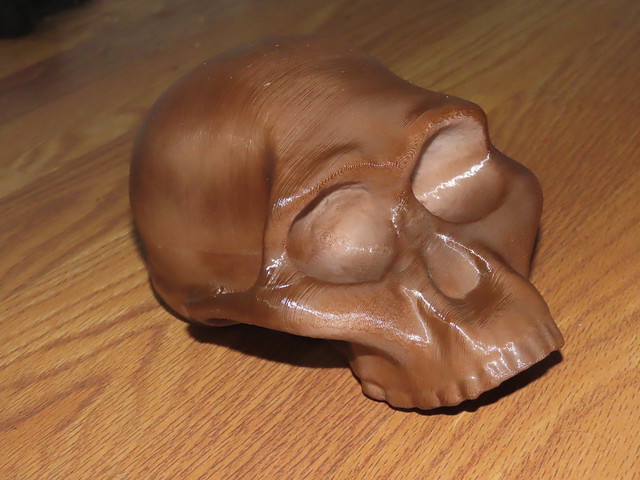
A 3d print of Australopithecus prometheus skull
The story of A. prometheus begins in 1924. At that time, an Australian anthropologist named Raymond Dart was teaching at the University of Witwatersrand in Johannesburg, South Africa. South Africa was then a scientific backwater, but when fossil bones began to be uncovered by local lime mining companies, Dart arranged for any new discoveries to be sent to him. In 1924 he was sent a box of fossils from the Taung mine, and noticed the fossilized skull and brain cast of a young primate. It was, he realized a hominin. It would become world-famous as “The Taung Child”, and was given the name Australopithecus africanus. After much controversy, A africanus would become central to the story of human evolution and would establish Africa as the cradle of humankind.
A year after the Taung find, Dart received another shipment of fossils, this time from a mine in Makapansgat. They contained bones from antelopes and other large mammals, and many of them were stained gray or black, which, some chemists who examined them concluded, contained large amounts of free carbon that, they speculated, may have come from a fire. Dart pointed to these findings in a 1925 paper and speculated that the bones may have been the remains of ancient human hunting.
It wasn’t until 20 years later, in 1945, that organized excavations began at Makapansgat, led by Dart’s colleague Phillip Tobias. Tobias found fossil baboons which indicated to Dart that the deposits were much older than he had previously believed, and he now considered that the blackened bones he had examined earlier had not been produced by Homo sapiens, but by much earlier australopithecines. So sure was he of this conclusion that when some fossilized skulls were found in 1946, Dart eagerly concluded that they were hominins who had used fire, and he coined the name Australopithecus prometheus for them, after the Greek mythological figure who had brought fire to humans. Dart was all set to publish his conclusion when these “australopithecine” skulls were re-examined and were unmistakably found to be baboons, and not hominins at all. Disappointed, Dart abandoned the draft scientific paper announcing his “prometheus” finding.
But he got another chance a year later, when James Kitching, a student working on Tobias’s team at Makapansgat, found a piece of skull consisting mostly of the occipital bone at the back, and sent it to Dart. By itself, the occipital bone, now designated as “MLD-1”, does not give much information, but Dart was delighted, and convinced himself that here at last was the maker of the fire-blackened bones. Dart quickly resurrected his name Australopithecus prometheus and, in a 1948 paper, now applied it to the occipital bone from Makapansgat.
Then he went further. Tobias had not found any stone tools in the deposits, and it seemed anomalous to many researchers that an ancient hominin would have the controlled use of fire without any tool culture. So Dart concluded that these early australopithecines had indeed used tools, but that they had all been made from modified bones, teeth and horns, which he grandly termed “Osteodontokeratic Culture (ODK)”. In a series of papers and lectures, he declared that the earliest hominins had been carnivorous hunters, fashioning lethal weapons from these materials instead of stone and systematically killing other animals and, Dart reasoned, each other. In one paper, he breathlessly related, “On this thesis man’s predecessors differed from living apes in being confirmed killers: carnivorous creatures that seized living quarries by violence, battered them to death, tore apart their broken bodies, dismembered them limb from limb, slaking their ravenous thirst with the hot blood of victims and greedily devouring livid writhing flesh.” It would become the basis for the “Man the Killer Ape” stereotype which would dominate paleoanthropology and popular culture for years.
Subsequent research, however, demonstrated that Dart had been wrong in many ways. The bone and horn pieces which he had identified as “tools” and “weapons” had actually been broken by carnivores and scavengers and then further damaged after burial by natural geological processes. The black stain on the bones was not produced by fire or cooking, but was the result of natural manganese minerals in the soil. And the occipital bone which Dart attributed to his “prometheus” was indistinguishable from the already-known Australopithecus africanus. “Australopithecus prometheus” did not actually exist, and the name was quietly dropped. Dart himself soon accepted the conclusion that the Makapansgat fossils were from the same species as the Taung Child.
But the name would re-appear later.
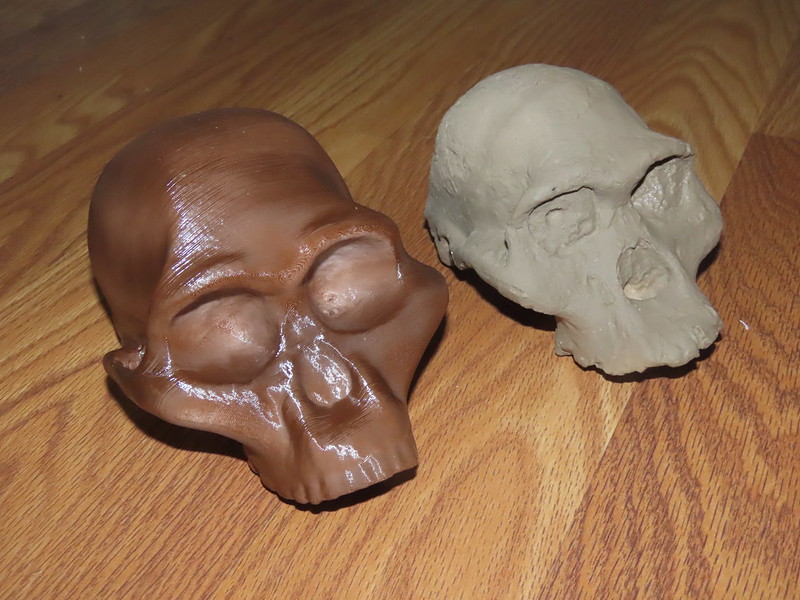
3d prints of A prometheus and A africanus
In the 1980s a series of excavations was carried out at Sterkfontein by Tobias, who was now a prominent paleoanthropologist in his own right. Sterkfontein had already yielded a number of significant finds, including fossils from the genera Australopithecus, Paranthropus and Homo. Unfortunately, much of the sediments inside the cave were breccia, a form of compacted and hardened fragments of stone and gravel similar to concrete. Many of the skeletons were from animals who had fallen into the cave or had been killed by predators and the bones washed through holes in the ceiling by flash floods. As a result, the fossils were broken and fragmented, and hard to interpret.
In 1994, researcher Ronald Clarke, from the University of Witwatersrand, was going through some stored boxes in the museum’s collection which had been labeled “Cercopithecoid”. Clarke had previously done excavations at the Swartkrans site. As he examined the small fossils in storage from Sterkfontein, he came upon four ankle bones which looked like they had all come from the same individual, and recognized that they bore the signs of a hominin. When Clarke showed the bones to Tobias, they dubbed the find “Little Foot” as a joking contrast to the legendary North American “Bigfoot”.
Three years later, in another box of fossils, he found more of the foot bones and, significantly, a piece of tibia bone from the shin that had been cleanly broken off. He realized that it might be possible to find the other half of this broken-off bone still visible in the wall of the cave, and indeed after a two-day search, museum students located the bone. Excavation revealed more bones, and it became clear that the entire remainder of the skeleton may have been buried inside the cave wall. For the next 20 years the team painstakingly chipped away the hard breccia using airscribes and dental picks, being careful not to damage any of the soft and powdery bones—each of which had to be chemically hardened as it was exposed. (The calcite-rich flowstone inside the cave had chemically removed much of the calcium from the bones.) At one point they discovered that a part of the skeleton had fallen further down the cave and had been sealed inside a separate cavity, which necessitated digging through a layer of hard flowstone.
Gradually they uncovered a skeleton that was some 90 percent intact, making it the most complete australopithecine found so far. (The kneecaps and some of the vertebrae are missing, and some of the foot bones had been destroyed by the lime miners.) Clarke’s full scientific description was not published until 2018.
The first order of business was to date the fossil and establish its age, and this was difficult. On the surface, African fossil finds can usually be dated through radiological studies of the volcanic ash layers which frequently punctuate the geological layers, but this method was not possible inside the Sterkfontein cave. The Little Foot find was initially dated, then, by examining the monkey and other bones that were found along with it and comparing them to other fossils of known age. This gave a rough estimate of 3-3.5 million years. However, this dating method was inherently unreliable since there was no way to know how much time had elapsed before each animal had fallen into the cave and been buried, and it was widely assumed that this date was too early.
Later, some experimental methods were used to date the calcite-rich flowstone cave deposits that had formed around the bones, and other attempts used newer methods of radiological dating. The results were all over the place: flowstone measurements gave an age of 2.5 million years in 2002, another study of uranium-lead decay in the flowstone gave an age of 3.3 million years in 2014, and in 2015 a process called “cosmogenic nuclide isochron dating”, using the isotopes aluminum-26 and beryllium-10, gave a date of 3.67 million years—about the same age as Lucy. A new biochronological study of the fossils found alongside the skeleton in 2024 gave a date of 3.6 million years, and this date now seems to have been accepted by most authorities. However, the dating still remains uncertain and controversial.
The skeleton is remarkably complete, allowing a detailed study. Measuring a little over 4 feet tall, it belongs to an adult female weighing around 75 pounds. The well-worn teeth indicate that she was relatively elderly. The pelvis and the relatively long legs are adapted for upright walking, but there are still adaptations for tree-climbing: the arms are still relatively long (though the legs are longer), the finger bones are curved for climbing, the upward-facing shoulder joints, scapula and collarbones are very apelike, and the big toe of the foot diverges somewhat from that of Homo but not as much as in modern apes, indicating that she may have retained an ability to move effectively through the trees. (Though some authorities interpret the big toe as being inline like that of a modern human with little divergence. Some other researchers, however, have instead concluded that the toes were more divergent and apelike than Clarke thought, perhaps indicating a more arboreal lifestyle.)
Clarke speculated that Little Foot may have lived something like a modern Chimp, spending much of her time on the ground but perhaps returning to the trees at night as a protection from predators. He also opined that the divergent big toe was an evolutionary holdover from an earlier more apelike ancestor, and that the foot was already in the process of becoming more specialized and adapted for moving around on the ground on two feet.
The skull was somewhat long and flat, and had a brain capacity of around 408cc. Some who have studied the skull have looked at the impressions of the brain on the inner surface and concluded that the grooves indicate a structure more similar to apes than to humans. The teeth are large, and the wear pattern indicates a varied diet of fruit, leaves, and possibly roots or ground tubers.
At first, Clarke attributed the skeleton to an unspecified species of Australopithecus, and later opined that it was an early form of A africanus. As the find became more complete, though, Clarke changed his mind and decided that Little Foot differed significantly from africanus in its odd mixture of both humanlike and apelike traits, especially in the feet, teeth, and skull, and that it represented a different species. Since Dart had previously described a different species of Australopithecus from the area near Sterkfontein, Clarke decided to resurrect that name, and formally named Little Foot, along with some other bones from Sterkfontein and Makapansgat, as Australopithecus prometheus.
It caused a storm of controversy. Taxonomically, Dart’s prometheus had been invalidated when he failed to show that it was different from africanus, making the name unusable. And now, many authorities argued, Clarke had also failed to demonstrate that the differences he saw between prometheus and africanus were enough to distinguish the two and were not simply normal variation within the africanus species. They considered Little Foot to represent an older member of the already-known Australopithecus africanus.
The matter is still a topic of hot debate, and there does not seem to be a consensus yet.
NOTE: As some of you already know, all of my diaries here are draft chapters for a number of books I am working on. So I welcome any corrections you may have, whether it’s typos or places that are unclear or factual errors. I think of y’all as my pre-publication editors and proofreaders. 😉