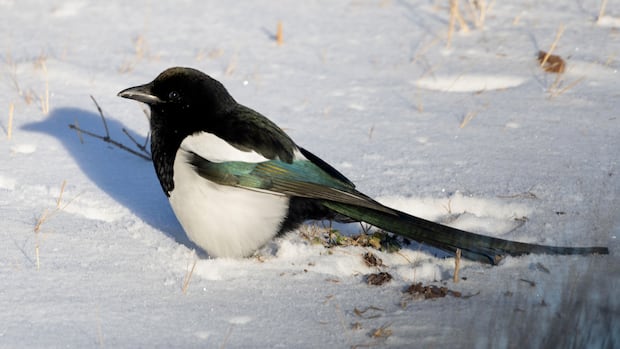
It’s hard to go a day in Calgary without seeing magpies or hearing their iconic screech.
The magpie is the city’s most commonly observed wild animal, according to iNaturalist, a citizen science website where people can track sightings and observations of wildlife worldwide. The platform puts sightings of magpies well ahead of mallards and Canada geese, the city’s second- and third-most commonly spotted animals.
Many Albertans have a love-hate relationship with magpies: on the one hand, they were recently voted Edmonton’s official bird, and were the runner-up behind the black-capped chickadee in Calgary’s mascot bird contest. On the other hand, many consider them pests.
There are 18 species of magpie worldwide.
Calgary is home to the black-billed magpie, and their ties to Calgary run deep. In fact, they predate the city.
WATCH | Clever magpie earns social media stardom in Edmonton:
Lots of people hate magpies, but this TikTok-famous bird is changing that perception.
Local artists Trew and Gabs befriended a clever magpie in Edmonton and made it famous on TikTok. Short film produced by CBC Creator Network.
“Magpies co-evolved with bison,” said Calgary naturalist Brian Keating. “And the bison herds were, as you know, immense, and so the magpie population was significant.”
With those vast bison herds now gone, magpies have adapted to picking insects off the backs of cattle on farms throughout the Prairies, as well as eating whatever they can get their claws on.
Being year-round residents of the Prairies means they’re hardy creatures, able to thrive in the scorching heat of summer and the freezing temperatures of winter.
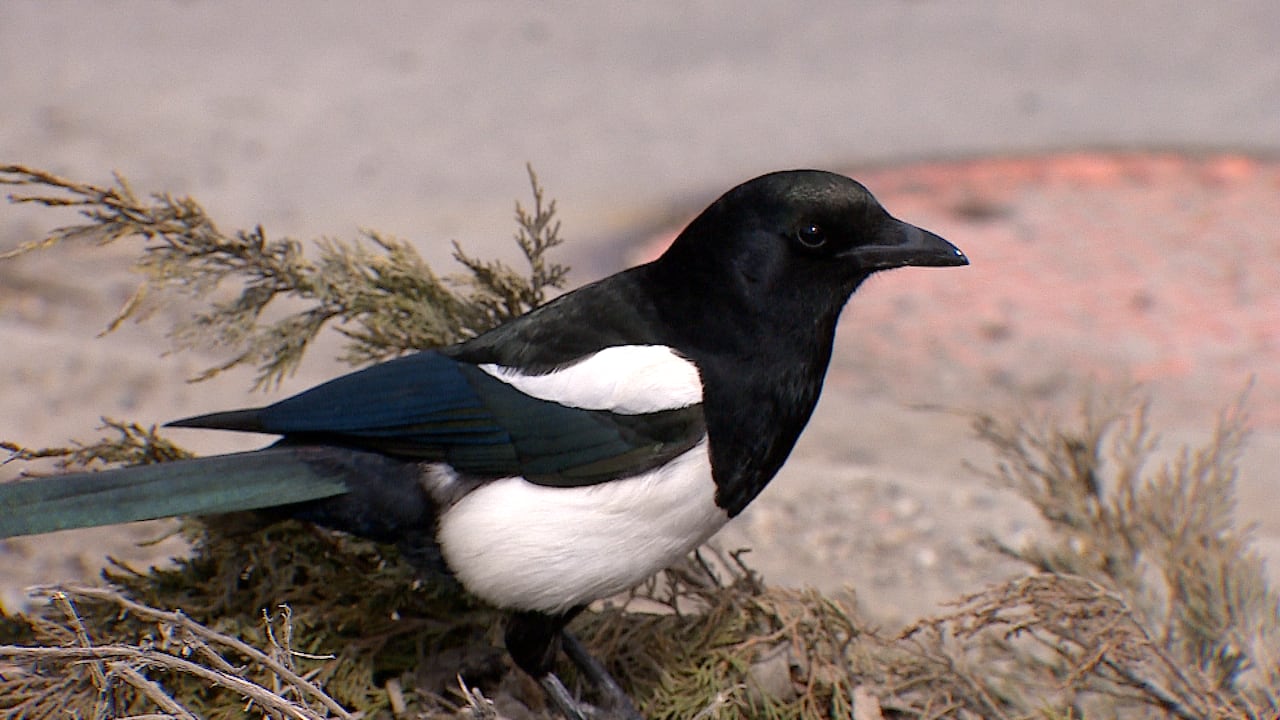 Magpies are year-round residents of the Prairie provinces, meaning they don’t migrate during the winter, unlike many other common birds in Western Canada. Whether it’s a sunny day or a snowstorm, expect to see magpies in urban and natural areas across Alberta. (CBC)
Keating pointed to research that has been done on magpie diets, which found the birds primarily live off of roadkill and carrion in the winter, and insects in the summer.
“In other words, they’ve adapted to the harsh reality of limited food in the winter, but exploit opportunities to the abundant food source of beetles and other insect life in the summer,” he said.
In the spring, they also rob other birds’ nests.
“And I think that’s one of the reasons why human beings find them so frustrating,” said Keating.
WATCH | Give magpies a chance, Calgary naturalist Brian Keating says:
Magpies live loudly, take over trees
Magpies are loud, obnoxious and quite the pranksters. Naturalist Brian Keating urges Albertans to give them a chance — despite this homeowner struggling to be rid of the critters.
Being so adaptable and intelligent is something magpies have in common with ravens and crows, which they’re closely related to as part of the corvid family.
“They are a feathered primate, essentially, in their ability to think,” Keating said.
He pointed to studies that have demonstrated the intelligence of corvids, like ravens using sticks and stones as tools to get food, and the Eurasian magpie becoming the first non-mammal to recognize itself in a mirror.
Ravens and crows are so similar to magpies in terms of behaviour and intelligence that Keating says they “really are just a non-colourful magpie in a sense.”
But one thing magpies don’t have in common with many of their corvid cousins is they’re not nearly as widespread.
Why haven’t they expanded their range?
Ravens and crows are abundant in every province and territory. The blue jay, a fellow corvid, is more common on the East Coast but can nonetheless be found across Canada.
Meanwhile, the farthest east magpies are known to live in Canada is near the Manitoba-Ontario border.
It’s not entirely clear why magpies haven’t been able to expand their range, but it’s most likely due to their preference for the Prairies, where they reside year-round, says Andrea Gress, special projects co-ordinator at Birds Canada.
“I think the magpies have just found a niche area that they like, and maybe they don’t need to expand elsewhere,” she said.
They’re just one example of a Canadian corvid that has adapted to life in a specific climate. Others include the Canada jay, which is typically found at higher elevations, and the Steller’s jay, only found in the coniferous forests, mountains and foothills of Alberta and British Columbia.
 Birds Canada special projects co-ordinator Andrea Gress with a Canada jay on her head. Like the magpie, the Canada jay is a member of the corvid family, and it’s adapted to specifically thrive at higher elevations. (Submitted by Andrea Gress)
“With magpies, they don’t really venture far from where they’ve hatched,” she said. “That also reduces how quickly their range might expand, because they’re just hanging out in the spot they’ve always known as home, and if things are good, there’s no reason for them to go farther.”
And judging by how common they are in Calgary and Edmonton, they’ve certainly done well for themselves in urban areas.
Magpies thrive in urban environment
Sara Jordan-McLachlan, who studies Calgary’s urban wildlife, says magpies have become a core component of the city’s ecosystem.
“One of the benefits of magpies that maybe people don’t think about is pest control,” she said.
Not only do magpies feed heavily on insects, but Jordan-McLachlan said she’s observed magpies picking ticks off the backs of deer and moose in Calgary’s parks.
“They’re excellent little helpers in the urban environment,” she said. “Even if they’re a little bit noisy.”
She also pointed to reports of there being a symbiotic relationship between magpies and coyotes in urban environments, in which the bird helps the predator find prey and scavenges on the leftovers.
“These are really beautiful birds that are adapting into this environment, and we’re pretty lucky to have them,” Jordan-McLachlan said.