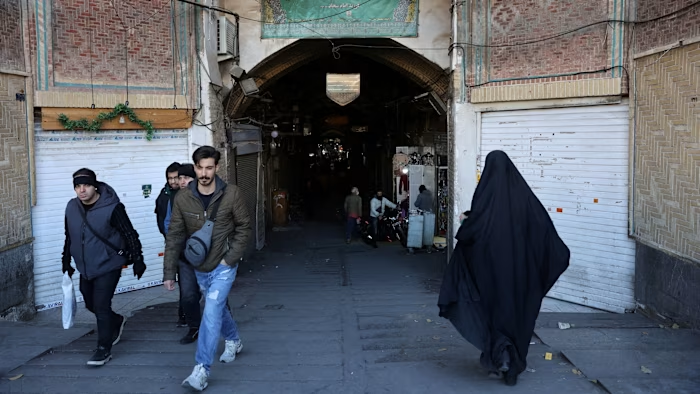
When shopkeepers selling mobile phones and other electronics in Tehran’s business district shut their premises on Sunday to protest against the country’s currency plummeting, not many would have expected them to trigger the largest nationwide demonstrations in years.
In the days since, shop closures and rallies have spread to the capital’s historic Grand Bazaar, universities and other cities around Iran, as popular frustration over soaring inflation and the collapse in living standards in the Islamic republic boils over.
“Out of respect for all Bazaar merchants and shopkeepers, we have no further sales,” one iron dealer in Tehran wrote online, announcing it too would remain closed. “Perhaps this will serve as a wake-up call.”
The protests remain smaller as yet than the mass demonstrations that broke out during the 2022 Woman, Life, Freedom movement, which were triggered by the death of a woman in police custody for allegedly wearing a hijab improperly.
But they have emerged as a crucial test for Masoud Pezeshkian, the moderate president who came to power around 18 months ago vowing to reform the economy, secure sanctions relief through better relations with the west and make life easier for ordinary Iranians.
Instead, everyday difficulties have only deepened. In the months since Israel launched a 12-day war with Iran in June, the currency has hit a record low, oil revenues have shrunk under sanctions and annual inflation rose above 40 per cent in December.
 Protesters came out in force in Tehran on Monday © EPA
Shirin, who lives in Tehran and runs an online food business, said she had temporarily halted her services to support shopkeepers.
“Transportation costs have risen sharply. Demand . . . has dropped because purchasing power has collapsed and people have to prioritise essentials,” Shirin said. Using only her first name to avoid repercussions, she added: “The situation has become so severe that many feel it makes more economic sense to stay home and do nothing.”
Pezeshkian has so far largely sought to take a conciliatory tone in hope of de-escalating the protests, seeking to assure merchants and trade guilds that a task force had been set up to resolve their problems.
But the situation, in a country with a history of heavy-handed crackdowns on protests, is volatile. More than 300 people were killed when the Islamic republic responded to the months-long 2022 demonstrations with force, according to Amnesty International.
As protests this week spread to cities including Hamedan, Arak and Isfahan, and small towns in various provinces, local media reports and video footage online showed a heavy presence of riot police. They were deploying water cannons, tear gas and firing shots to disperse crowds.
Several people have been killed, confirmed by Iranian media, including what Norway-based NGO the Hengaw Organization for Human Rights said were two protesters aged 28 and 21 in the city of Lordegan on Thursday.
Officials also said a member of the Revolutionary Guard Corps volunteer force was killed on Wednesday night by “rioters” in Lorestan province. Dozens of people have been detained.
 Abdolnaser Hemmati, the new head of the Central Bank of Iran, waves to the media after being appointed on Wednesday © ZUMA Press Wire/Reuters Connect
In an attempt to assuage protesters’ concerns, however, authorities appointed a new central bank governor Abdolnaser Hemmati, who has promised to restore economic stability. The rial, which had dropped to new lows in recent weeks, rose slightly over news of the replacement.
The ministry of higher education also dismissed security managers at the University of Tehran and two other major universities, with local media reporting that the dismissals were due to the “mistreatment” of protesting students.
Pezeshkian described improving people’s livelihoods on Thursday as “the government’s red line”, with addressing economic concerns being a “non-negotiable”.
Mohammad Movahedi-Azad, the prosecutor-general, said however that while peaceful protests were “understandable”, “any attempt to turn economic protests into tools of insecurity, destruction of public property . . . will be met with a legal, proportionate and decisive response”.
Nonetheless, despite heightened security in parts of Tehran, daily life has continued largely as normal across much of the city, with residents going about their lives uninterrupted.
Since the June war, which the US also briefly joined to bomb Iranian nuclear sites, Pezeshkian’s government has sought to keep the public onside by granting more social freedoms — such as easing restrictions on women’s dress codes — and supporting low-income households through food vouchers.
He has also signalled a willingness to restart talks with the US over the future of Iran’s nuclear programme, in another attempt to secure sanctions relief. However, the two countries remain at loggerheads on a range of issues.
Ali Saadvandi, economist and founder of EconClinic, a private banking and economics training institute in Tehran, said that beyond sanctions, years of chronic mismanagement of Iran’s economy and energy supplies had eroded public confidence.
Recommended

“Addressing economic dissatisfaction requires an increase in the government’s social capital and restoration of public trust in economic policymaking,” he said.
“It is clear that this path is unsustainable,” he added. “Sooner or later, the government will have to move towards real reforms, but without social capital, those reforms are bound to fail.”
Shirin, the food business owner, was not optimistic. “It would be wishful thinking to expect the government to fundamentally rethink its policies. Experience shows they rarely listen,” she said.
“Still, I hope this will push the government to address problems rather than sweep them under the rug. Maybe there is still a way back from all the damage they have caused.”