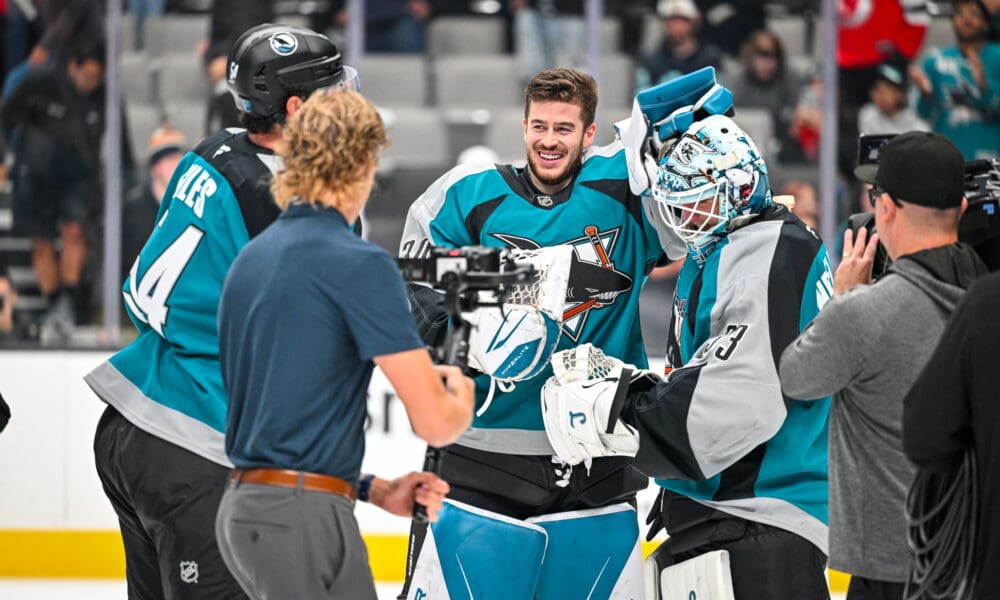
It’s not just young goalies who have to get over, in game, giving up a bad goal.
Those who reach the pinnacle of their craft often credit a desire for continued learning, whether they’re just starting out or have been working on their trade for many decades. The same is true with hockey, specifically with goaltenders who face physical difficulties, of course, but are also plagued by the mental aspects of expectations.
While many associate younger, developing players with learning and improving their craft, those in the NHL never stop advancing their knowledge. The San Jose Sharks currently have both, a young up-and-coming goaltender in Yaroslav Askarov and a veteran in Alex Nedeljkovic looking to make a big role for himself.
Both discussed gutting it out when you’re not at your best.
“I’m still learning and still growing,” said 29-year-old netminder Nedeljkovic. “It’s hard, and I think you have to go through it in order to learn from it. You’ve got to see it.”
Nedeljkovic, who is in his ninth NHL season, has played 17 games for the Sharks this season. During that time he has recorded a 5-7-2 record with a .895 save percentage and a 3.06 goals-against average.
The majority of learning for goaltenders at the NHL level is focusing on the mental side of the game.
“When guys have a tough night, you could see it on their faces and whatnot, but then it’s how you show up the next day,” said Nedeljkovic. “[Then] two nights later, you watch the same guy, and he looks totally confident, and puts up a 40-save shutout, or a 50-save effort, like it doesn’t phase them. That’s part of being a professional and being at your best, just moving on.”
For Nedeljkovic, his form of moving on is simple. “[I] just take a little sip of water and just tell myself, ‘Go get that next puck.’ Ultimately, that’s all you can do. It’s done. It’s over now, and they’re not taking it off the board.”
Yaroslav Askarov, meanwhile, is faced with the expectations of being the No. 1 goalie for the San Jose Sharks and growing into that. This season, he’s appeared in 26 games and has a 15-10-1 record.
“We’re trying to develop [Askarov] and get him to be the guy for this organization going forward,” head coach Ryan Warsofsky said. “There are going to be moments where he’s going to have some nights where he doesn’t feel his best, but [he] can grind it out [and] make some big saves early or late in games, like he did against Vancouver [in a 6-3 win on Dec. 27]. Asky’s learning and developing just like everyone [else].”
There was one of those moments in Monday night’s game against the Anaheim Ducks. While the Sharks were up by a goal, Askarov tried to play the puck behind the net. He ended up turning the puck over to Anaheim, and Troy Terry swiftly found the back of the net.
“I was like, that’s the game when I have to start play with the puck more,” Askarov said post-game, referencing a pre-game conversation about overcoming adversity with San Jose Hockey Now. “[Then] that happened, and I was like ‘What a fucking idiot.’ Especially against this team [and their forecheck].”
When all was said and done though, Askarov ended the night with 38 saves on 42 shots in a 5-4 win, showing his ability to bounce back quickly: “This can happen sometimes, a bad bounce. So [you] just have to keep your head up and just [keep] moving on. [The game is] 60 minutes. You have to battle through that.”
Askarov did the same thing on New Year’s Eve, after three long goals allowed against the Minnesota Wild. When the San Jose Sharks needed him most, he turned away Quinn Hughes on an OT breakaway, then he shut out the Wild in the shootout.
“He’s mentally tough,” Warsofsky said.
“Sometimes it’s bad lessons, but it’s still a great experience,” Askarov said on the morning of the Ducks tilt. “You have to go through that, [to keep] moving on.”
As Warsofsky noted, Askarov is one of many young players on the San Jose Sharks roster which creates some additional challenges for a young goaltender, as there are bound to be growing pains for those around him as well.
But no matter the score, Askarov is learning to stay within himself and what he can control.
“No matter what [the score is], [whether] we’re leading by five, or we’re losing 5-3, you have to keep battling and keep focused on the next shot, no matter what’s going on on the ice,” he said.
“For us, it’s finding a way to just make that one more save and just giving us a chance, in the end, to get a win and [Askarov’s] done a great job with it,” Nedeljkovic said about his tandem mate. “He’s just battled. The numbers, they’re not what you want [them] to be right now, but at the end of the day, all that matters is wins and he’s been winning a lot for us.”
Askarov, in fact, has a 6-4-0 record in December, a winning mark, despite an .875 Save %, a testament to how he’s learning to gut out wins.
“The moment is not too big for him, he’s embracing it all. That’s the best part, he’s looking at it as an opportunity and a challenge to be better. His mindset is perfect,” Nedeljkovic said. “I don’t think I’ve seen a day where he’s been at the rink, and not smiling. He’s always smiling, he’s always having fun. He’s just happy to be here, happy to be on the ice and happy to be playing. It’s what you need.”