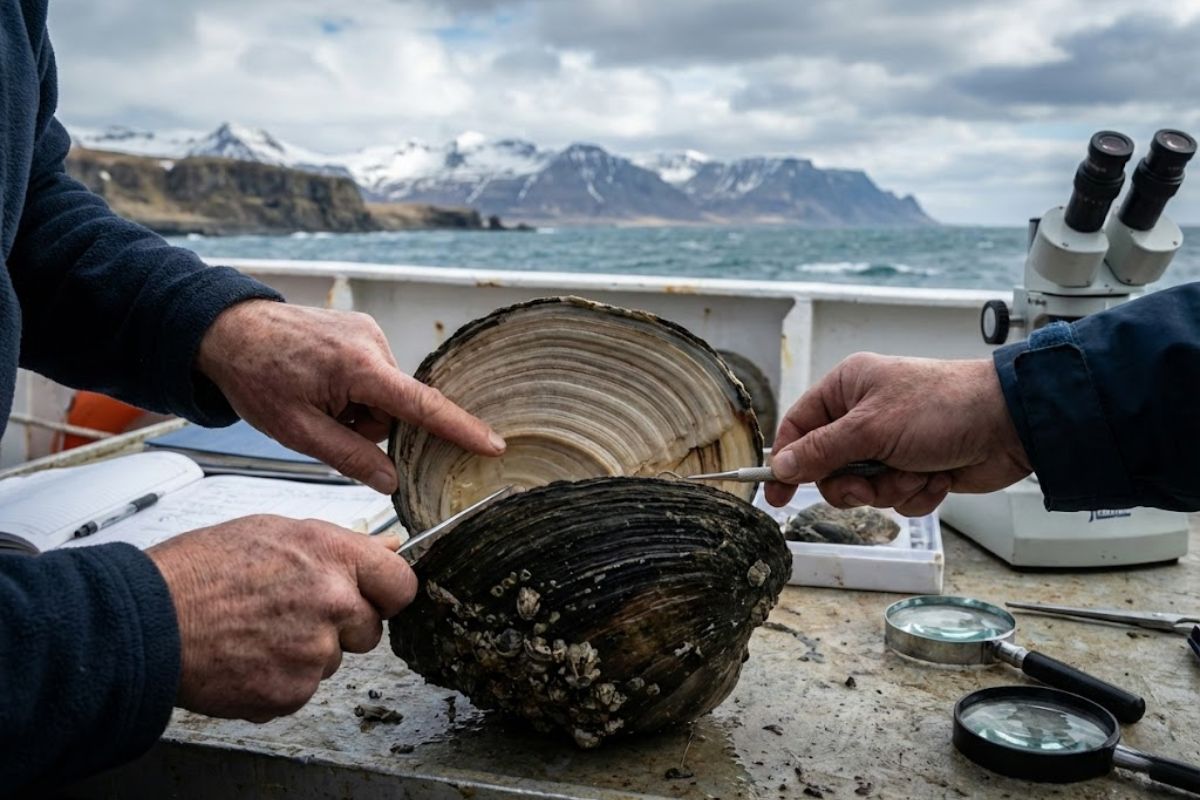
Called the oldest animal ever recorded, the Ming clam, Arctica islandica, had its shell opened in 2006 during an expedition in Iceland. Born in 1499, it was confirmed to be 507 years old. Its death closed a North Atlantic archive that recorded climatic variations for centuries and raised concerns about modern protocols and ethics.
In 2006, researchers on an expedition in Iceland opened Ming’s shell to determine its age and, in the process, killed the… oldest animal ever recordedBorn in 1499, the mollusk entered the scientific and public debate as a rare time marker and as a warning about the limits of research.
The story returned to the debate on January 2, 2026, because it summarizes a recurring dilemma: how far can science go when the object of study is, at the same time, a living individual and a historical record? In Ming’s case, the measurement that confirmed 507 years closed a North Atlantic archive and broadened the discussion about protocol. Risk and responsibility.
What happened in Iceland in 2006?
The episode described in the base is straightforward.
— ARTICLE CONTINUES BELOW —
In 2006, during a scientific expedition, researchers found the mollusk Arctica islandica, nicknamed Ming, and opened its shell to determine its age.
The intervention, carried out to obtain a precise measurement, resulted in instant death of the animal.
This outcome is central to the case because it transforms a research phase into a negative milestone.
The oldest animal ever recorded. The death was not due to the natural causes described in the database, but rather due to human contact in a research setting.
The location mentioned is Iceland, in the cold waters of the North Atlantic, where the species is found and where the incident occurred.
How Ming became a reference for extreme longevity.
Ming is presented as an individual of the species Arctica islandica, known for its unusual longevity.
The evidence suggests that this type of mollusk acts as a natural record of climate change over the centuries, precisely because it has lived for a long time in the North Atlantic.
The historical dimension is reinforced by two dates that structure the case.
The mollusk was born in 1499 and its life was cut short in 2006, surviving human and environmental changes while it remained in the ocean.
The oldest animal ever recorded. It became a symbol because it condensed, in a single organism, a timeline that rarely exists in individuals.
From 405 to 507 years: the adjustment that confirmed the record.
The database indicates that the initial reading suggested an age of 405 years.
That number would already be extraordinary, but subsequent analyses confirmed 507 years, solidifying Ming as the oldest animal ever recorded among the non-colonial animals documented by science.
The review is relevant for two reasons.
First, it shows that age can be underestimated in early readings.
Secondly, it highlights the paradox of the case: the final confirmation, which gave precision to the record, was obtained by a method that eliminated the individual who held the record.
The surname Ming is fundamentally associated with a historical landmark, the Ming Dynasty in China, cited as a temporal reference.
Even when used for comparison purposes, the central point remains: 507 years of life place the animal in an exceptional category.
The seashell as a time capsule of the North Atlantic.
The technical point that underpins Ming’s relevance is the way in which Arctica islandica records its history.
The study describes these mollusks as a time capsule: their shells store information about ancient oceanographic variations and allow researchers to reconstruct environmental signals over many centuries.
When the database states that Ming contained a “living archive of the North Atlantic climate,” it describes a rare combination.
The archive was “alive” because it grew with the animal. And it was a North Atlantic archive because it was anchored in the cold waters of that region, where the mollusk had remained for centuries.
This type of record is valuable for climate research for a simple reason: The larger the time window, the greater the ability to compare changes..
Upon losing the oldest animal ever recordedScience also lost the continuation of this archive, even though some of the data was already in the shell.
What Ming’s death revealed about research and ethics.
The basis explicitly states that the incident raised questions about research practices and that the death highlighted the need for more ethical and careful protocols.
This case is not just a story of longevity, but an example of how data collection can lead to irreversible loss when there is no margin for error.
The discussion is organized in two layers.
The first is technical: research needs reliable measurements to support its conclusions.
The second is ethical: when the object of study is the oldest animal ever recordedThe value of an individual is not only biological, but also historical.
This increases the cost of a poorly calibrated decision. and it changes the pattern of responsibility.
The base also states that, after the incident, other specimens of Arctica islandica have been placed under strict monitoring to prevent similar errors.
The practical lesson is to transform exceptions into priorities for care., reducing the chance of repeat losses with rare individuals.
What do the data mean for the climate of the North Atlantic?
The database describes Ming as a natural record of climate change over the centuries and states that the data collected helps to understand changes in Earth’s climate over the last 500 years.
This excerpt explains why the story doesn’t end with the 2006 incident: it connects to a larger research agenda on climate and the ocean in the North Atlantic.
At the same time, the case exposes a limitation: if the record depends on a living being, the search for information may shorten the record itself.
This tension becomes more pronounced when the object of study is the oldest animal ever recordedBecause the value of continuity is a central part of scientific interest.
The study positions Arctica islandica as a species with a longevity that surpasses many other known animals, such as Greenland whales and Galapagos tortoises.
The comparison places the mollusk in an intuitive ranking and reinforces that it is not just “an old individual,” but a borderline case of biology.
This framing is important because it removes the story from folklore and places it within applied science. When a mollusk from the North Atlantic lives for centuries, it becomes a reference for longevity studies and environmental analysis.
Therefore, the death of oldest animal ever recorded It is treated as the loss of a record that could have continued to grow.
What changes after 2006: monitoring and caution.
The base states that, today, other specimens are under strict monitoring to avoid similar errors. This indicates a change in approach: the focus is not only on collecting, but also on preserving the possibility of careful observation.
In practice, this means recognizing that the oldest animal ever recorded It cannot be treated as a common case.
When there is a chance that an individual may be exceptional, the methodological choice needs to reduce risk and increase guarantees, because the loss is irreversible and the impact extends beyond the laboratory.
Ming’s death in Iceland in 2006, after the shell was opened to determine her age, solidified an emblematic case about science and its limits.
Born in 1499 and confirmed to be 507 years old, the mollusk became known as the oldest animal ever recorded and as an archive of the North Atlantic that recorded climate changes over centuries.
If you follow science and the environment, the most useful step is to demand transparency regarding methods and protocols in research with… exceptional organisms.
Well-informed public debate improves science.Because it pushes for rigor and for choices that minimize irreversible losses.
Do you think measuring the age of the oldest animal ever recorded justifies opening its shell, or should science prioritize methods that don’t put the individual at risk?