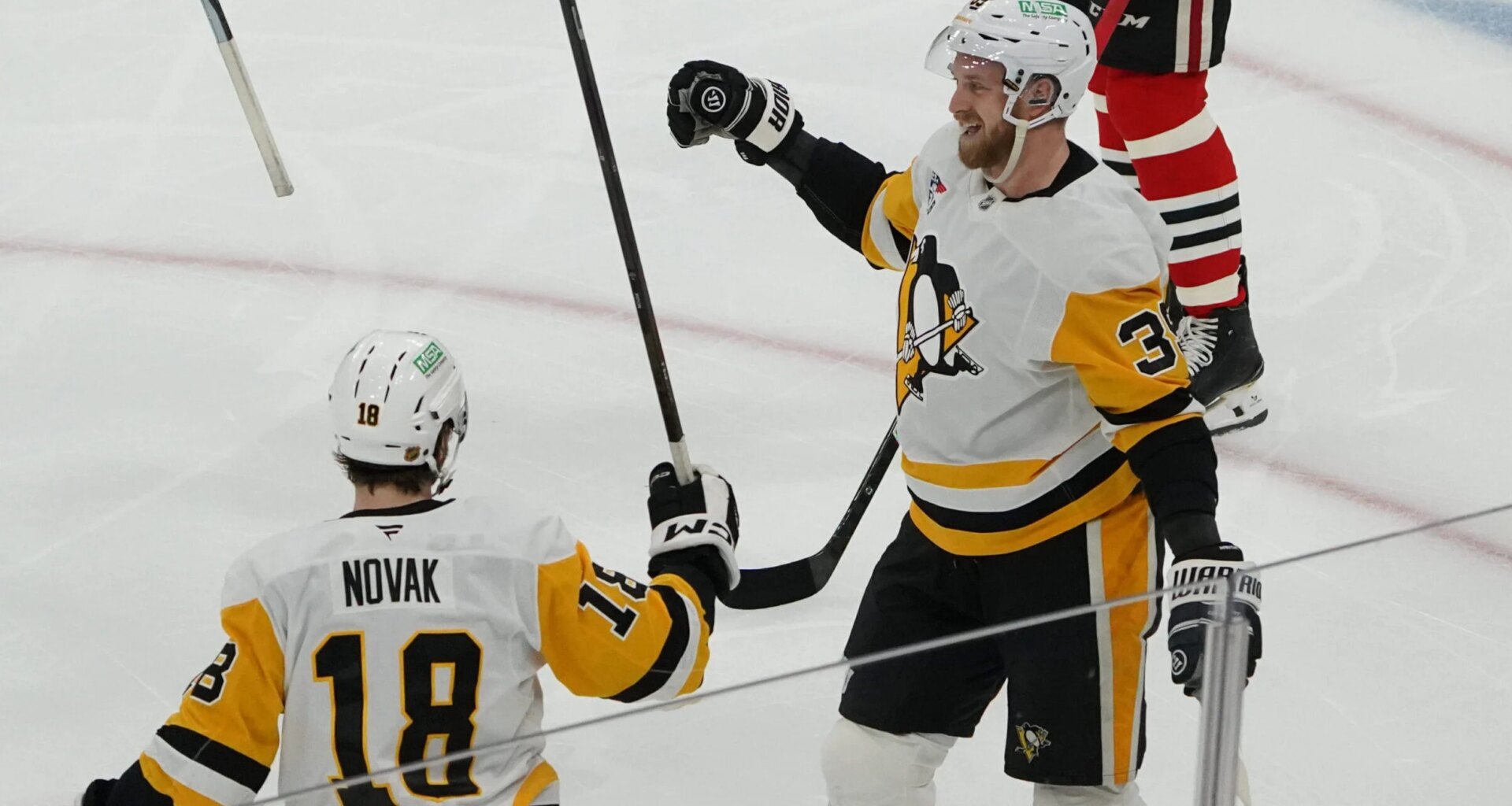
The Pittsburgh Penguins have proven they can beat good teams, but they can also absolutely lose their marbles and self-destruct. What comes next will be a fascinating exposition of players’ will, coaching ability, and a general manager’s grand plan.
Can the Penguins pull their game together and eliminate the catastrophic mistakes that have plagued them for the first 39 games?
Will the team’s performance have any effect on the rebuild?
Answers to the second question appear to be the same unique blend of improving the present by adding to the future. The Penguins made a couple of trades this week, and in those deals is not just a clue but confirmation of what we know of the Penguins’ rebuild path.
There will be trades, and there will be more changes, but they will be for the future, using the present day as an audition for tomorrow.
The first and biggest trade this week was Penguins GM Kyle Dubas and Columbus GM Don Wadell finally consummating a trade for Yegor Chinakhov. Wadell joked on The Sheet podcast with Jeff Marek that he and Dubas at times talked to each other more about this trade than they did to their wives. Discussions had been ongoing since the summer.
Penguins One-Timers
1. Oh, oh, Chinakhov
Yegor Chinakhov, 24, is this season’s version of Philip Tomasino and will get a real chance to prove his NHL bonafides. Dubas paid the healthy but fair price of a likely high 2026 second-round pick and low 2027 third-rounder, which was far more than the fourth-rounder he flipped to Nashville to give Tomasino.
In one sense, the elevated fare indicates Dubas’ progression from low-risk gambles to moves that require more commitment and will have consequences, positive or negative, based on the results.
It was far easier to end the Tomasino test after the winger just didn’t get traction with either former coach Mike Sullivan or current bench boss Dan Muse. Tomasino defaulted to the perimeter and didn’t help when he wasn’t scoring, which was too often.
Thursday’s OT win over Detroit was a terrible game to attempt to judge Chinakhov. Since he is not a penalty killer, like others, he sat for several minutes at a time. The game and non-penalty killers had no rhythm or flow until the third period.
However, this writer/analyst/ne’er-do-well’s first impression of Chinakhov was entirely positive. He was fastidiously above the puck in the offensive zone. His skating is a plus, and possibly elite, and he knows how to play in the defensive zone.
He also had poise with the puck. He wasn’t afraid to hold it and look for space before dishing it elsewhere.
Chinakhov also showed some maturity despite speaking in his second language Thursday morning. When asked why it didn’t work in Columbus, the Russian simply replied that he’d already forgotten about it and this was a new year, a new page.
A perfect answer. It left nowhere to go for us inquiring minds.
2. Anthony Mantha and Justin Brazeau
The pair of cloud-scraping wingers are bringing out the best in each other. Whether it’s beside Evgeni Malkin, Ben Kindel, or Tommy Novak, they are creating offense. This season is the best hockey of Brazeau’s career.
And this is certainly the best version of Mantha, who has had some good years in his 10-year NHL career, but also had long career stretches and seasons of invisibility.
Brazeau could stickhandle in a shoebox. When he’s going to the net and playing stiff on the walls, he’s a force. Brazeau’s contract extends through NEXT year at a ridiculous bargain bin price of $1.5 million per. With 20 points, including 12 goals, he has already exceeded the value of the contract despite playing just 25 games.
Mantha carries a $2.5 million cap hit, but gets a $250,000 bonus for every 10 games played. At 39 games played, he’s already earned a $750,000 bonus, and when he plays Saturday in Detroit, he’ll bump that bonus figure to $1 million.
With 14 goals and 14 assists, Mantha is on pace to earn $4.8 million this season, which is still a team-friendly deal if he gets to 50 points. But…
Penguins Trade Chip
Mantha’s reemergence is the best-case scenario for the Penguins and for Dubas. With each passing season segment, Mantha is both helping the team win and increasing his value in the process.
Since it was the Penguins who took the gamble on Mantha, offering a good contract with big bonuses, Dubas could opt to re-sign him. The guess is that the player would be more than willing to re-sign in this situation.
Further opening Dubas’s options, the Penguins’ big trade deadline acquisition could be simply to keep their big winger if the team is in the playoff hunt, and let Mantha walk via free agency like a trade deadline rental.
All options are on the table, but the Dubas seems to have set himself up well for the next move on the chessboard, and the Chinakhov trade will be a significant factor.
If Chinakhov can prove worthy of more ice time and opportunity, the Penguins will have to clear space somewhere in the lineup for a 24-year-old winger who will be around for a while. Not coincidentally, the Penguins have a pair of left wings available, Rickard Rakell and Mantha.
Trade Chips 2
Since being paired with Kris Letang, Brett Kulak has played significantly better. So, too, has Letang.
Kulak is a free agent at season’s end, and there was talk of Dubas immediately flipping Kulak. That obviously hasn’t happened, but as Kulak stacks performances that are above board, his value increases.
…and increases.
The Penguins still have Ryan Graves and Owen Pickering in Wilkes-Barre/Scranton, ready to fill a spot vacated if or when Dubas gets more value from the Tristan Jarry trade by exchanging Kulak for futures.
Tomasino & Zamula
Tomasino did not pan out for the Penguins, and his hockey future is likely in the AHL for the foreseeable future. He didn’t lack for opportunity, spending long stretches in the Penguins’ top six last season and making the team out of camp this season.
However, Dubas’s choice of trade acquisition certainly raised my eyebrows. Egor Zamula?
The reports from industry contacts on Zamula ranged from scathing to outright dismissive. Lack of quickness and a lack of hustle highlight the beatdowns privately submitted to me after the trade.
Perhaps the Penguins feel they can rework what the Flyers could not. After all, Zamula does have 168 games of NHL experience.
Zamula is a left-handed defenseman, which gives the WBS Penguins FIVE lefties, including Graves, Pickering, Sebastian Aho, Alex Alexeyev, and Zamula.
Disgruntled prospect Emil Pieniniemi is also a lefty. He quietly reported to the Penguins organization last week. He was assigned to Wheeling of the ECHL, as he was originally assigned following training camp, before he pouted and bolted back to Finland without a hockey plan in place.
WBS also has four righties, not counting a potential roster move when Harrison Brunicke returns from Team Canada in several days.
What was the point of acquiring Zamula? The Penguins didn’t need depth, and if they see an NHL future, they would be in a small minority.
Tags: kyle dubas Penguins Trade Pittsburgh Penguins Yegor Chinakhov
Categorized: PHN Blog