In a world increasingly comfortable with opting out, the Lockheed Martin Armed Forces Bowl honors those who opt in — no matter the sacrifice — to see something through.
Like, well, the United States Armed Forces, for example.
Or, perhaps, a full football season – bowl games and all – no matter the potential material sacrifice on the way to your next stop in pursuit of college football’s fortune.
Be the Texas State Bobcats, our new favorite Group of 4 football program, in this upside-down world.
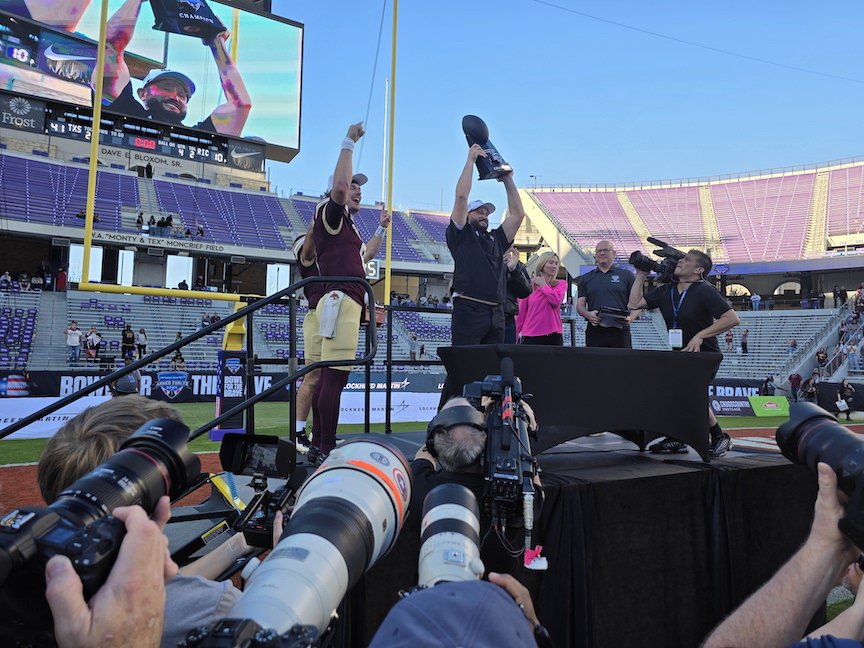
Texas State drove north from the Hill Country for its third consecutive bowl appearance — the third in program history — with something to prove. The Bobcats (7-6) handled their business in a 41–10 victory over Rice (5-8) in Friday’s Armed Forces Bowl, earning the third postseason win the program has ever known.
It all matters to a program still finding its footing at the FBS level, trying to establish an identity in a turbulent era of college football — one defined increasingly by transactions, transfer portals, and mercenaries hired to win on Saturdays.
Texas State football is trending in the right direction. Texas State has achieved three consecutive winning seasons for the first time since the early 1980s days of Jim Wacker, who was next lured to TCU. Next year, they’ll join the new Pac-12. (Friday’s game was its last as a member of the Sun Belt Conference.) Bowl victories are pivotal to programs like Texas State, which needs to keep donors interested. Money for football teams doesn’t grow on trees.
“We still need help,” says Texas State coach GJ Kinne. “We still need resources.”
Anyway, it’s rosters like Texas State’s that many of college football’s fat cat programs come to poach. Kinne says he knows he can’t keep all of his players, though he’s already kept a good nucleus from this year’s team.
“I promise you this: when those kids, if they do decide to leave here, they’re going to regret it because the type of people we have in this building,” Kinne says. “And not everyone has it the way we do.”
Among those guys are people like Lincoln Pare, who won’t be returning next year because he’s exhausted his eligibility.
The Armed Forces Bowl is uniquely fitting for Pare, who wears No. 7 for Texas State’s offense.
“To be able to play in the Armed Forces Bowl after what we’ve done with the Wounded Warrior Project I think is truly a blessing,” Pare says.
Pare and his father this summer created 7 Runs for Warriors, an avenue to use his platform to raise money for Wound Warrior Project. The idea initially stemmed from a desire to honor his U.S. Air Force veteran grandfather, Donald Pare, and Larry Pare, his great-uncle and U.S. Marine who served in Korea.
Every 100-yard game and every touchdown helped raise money to give back to those veterans in need.
“We wanted to honor people in my family but also a cause,” says Pare, who is from Germantown, Tennessee. “A lot of fans and alums got behind that. I ended up with a lot of donations today after the bowl game because I got that last hundred-yard game in.”
Pare had a big day with 106 yards on 11 carries, including a 69-yard touchdown run in the fourth quarter. Quarterback Brad Jackson was the game’s MVP with 244 total yards and four total touchdowns, including three passing. He was 17 for 24 for 173 yards in the air.
Pare says 7 Runs for Warriors hit its $5,000 goal.
Each year, Armed Forces Bowl week immerses players from both teams in the discipline and virtue of service. A luncheon on Wednesday honored veterans from World War II, Vietnam, and Afghanistan and Iraq. Both teams also visited The National Medal of Honor Museum in Arlington.
Fort Worth City Councilman Charlie Lauersdorf, a Marine and veteran of eight deployments, including five in Afghanistan and Iraq, told the players that they were participating in more “than just a football game.”
“They are playing for more than just a title sponsor,” says Lauersdorf, whose wife Amanda is in the Army and was set for deployment until a cancer diagnosis for which she is receiving treatment. “To have Armed Forces Bowl be the one they play in, it’s so much more important than just a single football game. We had a lot of veterans [at the luncheon] that really set the stage for what we’re able to even do here today.”
Kinne said the experience at the luncheon was “emotional.”
“We’re just so fortunate to be able to represent the people that keep us safe and fight for our county is something special,” Kinne says. “We didn’t take that for granted today.”
Pare’s 7 Runs for Warriors isn’t merely work on the field. It requires hours on social media promoting the organization and where to donate, which you can still do on X @Lincdog4, on Instagram at lincoln.pare, or simply go to 7runsforwarriors.com.
The visit to the National Medal of Honor Museum “really hit home,” Pare says.
“Man, I really felt good about doing [fundraising platform] this year,” he says. “It is so worth it. I’m so grateful that me and my dad did that this year. And to be able to play in this bowl game and what it represents means everything. We truly live in the greatest country in the world.”