Sign up for the Slatest to get the most insightful analysis, criticism, and advice out there, delivered to your inbox daily.
It was around noon when I stepped off the train, surfacing into Lower Manhattan’s particular brand of winter blight—when the cold is amplified by tall buildings that block out direct sun and funnel air directly onto your face. It was about 25 degrees, though the temperature felt theoretical once the wind got involved. Within minutes my ears had gone brittle, aching in that sharp kind of way that makes you briefly resent your parents for ever leaving the Middle East.
I followed a small group of South Asian aunties in industrial-grade puffers and bright yellow “Zohran” campaign beanies, which smartly functioned equally as political statements and survival gear. They led me toward the official public “block party,” a kenneled-off stretch of Broadway that I had optimistically imagined would involve warmth-adjacent amenities: food carts, coffee in little paper cups that burn your fingers just a bit, maybe even porta-potties. Instead, it was a wide, empty street hemmed in by police barricades and a few enormous screens. Music blasted. People stood around. That was it.
The aunties seemed genuinely delighted, bopping along to Bruno Mars as if this were the triumph of civic joy they had been waiting for since Election Day. I, meanwhile, realized that joy without circulation was not sustainable for me. I lasted maybe five minutes.
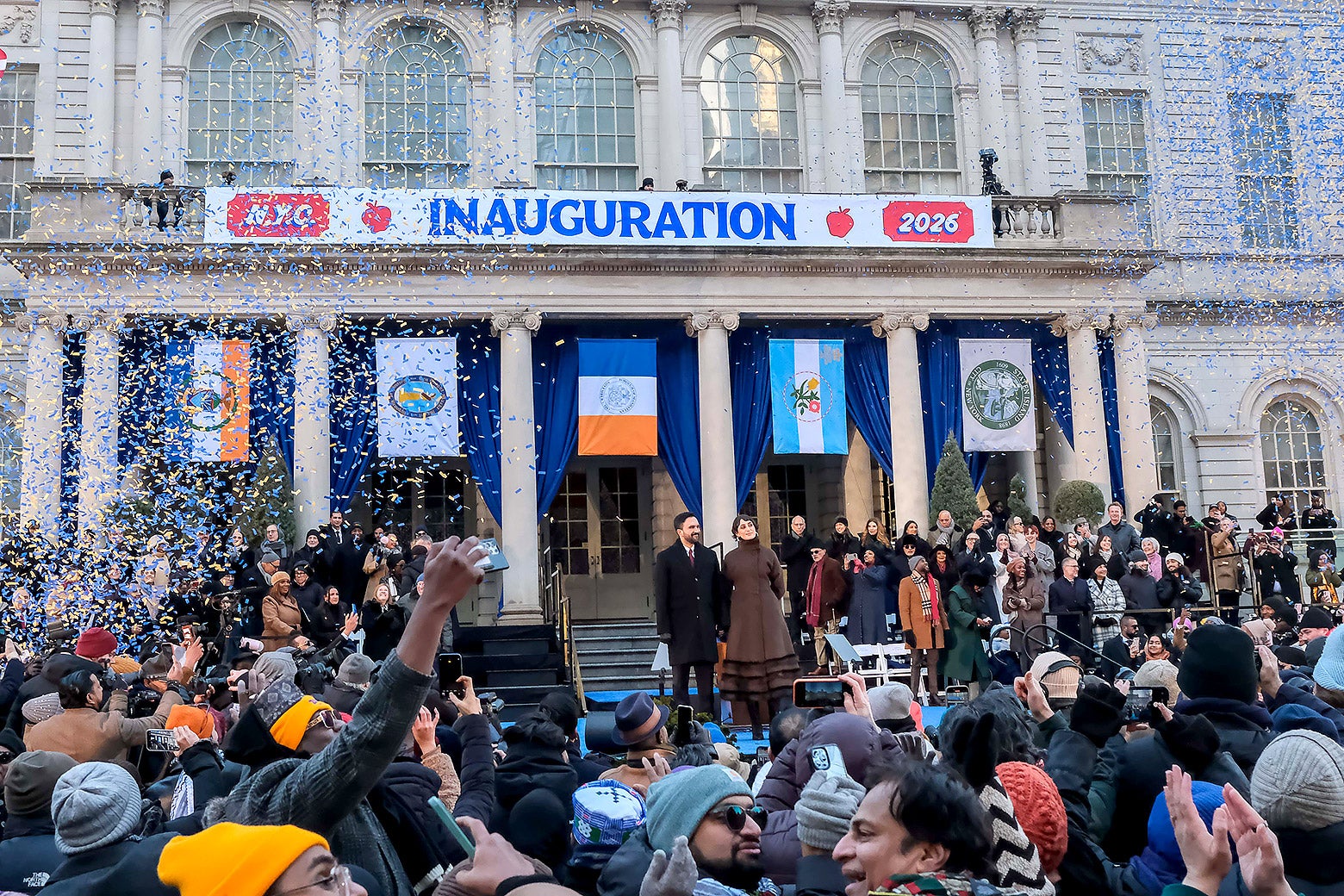
I cut north toward City Hall Plaza, where the actual inauguration was scheduled to take place.
I was expecting a spectacle. Zohran Mamdani is a New York mayor of many firsts: the first Muslim, the first South Asian, the first African-born, the first millennial. In the middle of the Trump era—which has been particularly hostile to every one of those identities—I wanted to see how that collision landed in person. I was curious how ordinary New Yorkers, from the people who powered his rise to City Hall to those who opposed it and everyone in between, would experience a moment that already felt larger than a single election.
What I found instead was something messier and more revealing. New York was working through its feelings in real time. Pride and paranoia crossed paths on the sidewalk. Joy and cynicism hovered in the frozen air. As always, the city was a layered collage best understood through the small encounters and fleeting scenes unfolding at street level as history happened in the background.
Along the barricades, I passed a small group of protesters waving Israeli flags. I approached one woman for a quote. She immediately bristled, waving her hand in my face and telling me to leave, then threatening to call the police—an escalation that felt unnecessary given that we were already surrounded by officers.
Another protester, who declined to provide her name, apologized quietly for the interaction. She told me that some of the others were “kind of crazy.” She stood a few feet away from them, holding her flag politely, not chanting or yelling. She said she was worried about Mamdani’s “background” and wanted to show support for Israel in defiance of a mayor who had broken with New York’s long tradition of unyielding support for the Israeli government. She sounded less angry than anxious, fixated on Mamdani’s outspokenness on what experts have called a genocide, and her nervousness for the future of Zionist New Yorkers.
By the time I reached the security entrance, the program was supposed to start in less than an hour. Volunteers urged attendees to take their seats, but they milled around, greeting old friends, hugging, shouting names across rows of white folding chairs. Unlike the public block party, this felt like a gathering of the campaign’s engine—organizers, supporters, donors, artists, electeds—the people who had powered what many still described as the biggest political upset since Donald Trump’s 2016 win.
Just inside the checkpoint, a woman smiled and said, “Hi, I’m Marisa.” Another chimed in: “Hi, I’m Natasha.” It took me a second to register that they were Marisa Tomei and Natasha Lyonne. Neither was surrounded by handlers or slated to speak. They were simply there, guests like everyone else, bundled up and waiting for things to begin. Both were warm and unfussy, radiating the kind of ease that comes from being completely at home in a crowd like this. The inauguration hadn’t even started, and already it was a vibe.
Hundreds filled the seats. There was music, chatter, the low buzz of anticipation. And yet, nothing about this place was warm. I was uncontrollably shivering.
I started mentally cataloging everything I hadn’t brought with me: a fluffy scarf, a hat that actually covered my ears, maybe even a balaclava, though I doubted that would play well for an Arab at an inauguration, even with the mayor being a Muslim.
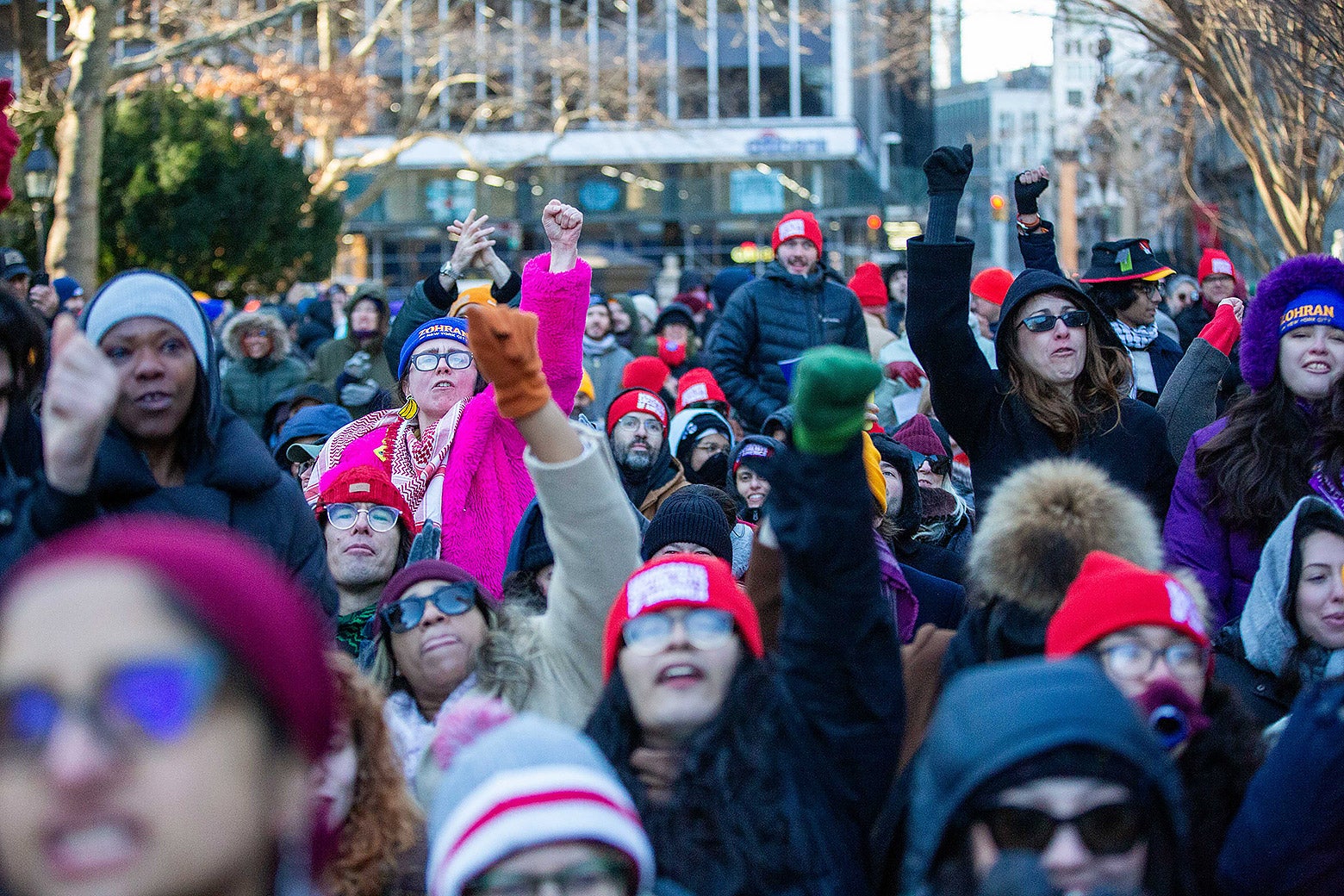
Everywhere I looked were red Democratic Socialists of America beanies, pulled low, doing the quiet but essential work of insulation. I considered asking for one, though I want to be clear: I wanted one because my head was so cold I could feel my thoughts slowing down. Still, there was something remarkable about the destigmatization of a previously dirty word in politics out in force on the lawn of City Hall.
Aymann Ismail
Then I saw him. A Sikh man a few rows from the front unfurled a blanket with the calm confidence of someone who had planned for this exact scenario. He wrapped himself completely and settled into his chair. At regular intervals, he poured himself a cup of steaming hot chai from his thermos. I watched with envy the way the steam rose into the air. I’d have traded my camera for a sip.
The crowd itself felt carefully curated: actors, activists, organizers, journalists, all packed together. Walton Goggins, of HBO’s The White Lotus, hovered nearby, visibly delighted to see Lyonne. Model Waris Ahluwalia looked impeccable, as expected. Kareem Rahma, of Subway Takes fame, fresh off the best year of his career, filmed the scene on his caseless iPhone. Mustafa the Poet was there too, unmistakable and stylish.
Then came the faces I knew from my reporting in 2025: Mohsen Mahdawi and Mahmoud Khalil, Palestinian students of Columbia University with green cards who had been detained by Immigration and Customs Enforcement for their activism. Linda Sarsour, a Brooklyn-born activist, sat near the front in a striking purple hijab. Simone Zimmerman, a Zeteo contributor and a central focus of the film Israelism. Writer Suzy Hansen and I exchanged smiles as we took it all in.
It was brutally cold. Sitting felt impossible. I kept moving, using my camera as an excuse. “If I sit, I’ll miss the moment,” I kept telling people. I ran into familiar faces—Asad Dandia, Husein Yatabarry, Dr. Debbie Almontaser—Muslim New Yorkers I know as part of the civic ecosystem that helped propel Mamdani to success.
As I continued to circle the crowd, ducking between rows of folding chairs, I caught the same refrains over and over. Visitors chatted as they tried to process what they were watching unfold.
“I’ve never seen this much negative coverage of any New York mayor. Fearmongering and what ifs count as journalism now?” one said. Another agreed. “Even if he can’t accomplish everything—because, let’s be honest, they’re going to make his life hell—at least he’s given us a vision of what different could look like,” they noted. “Anyone who has to contort themselves this hard to hate the most likable political figure imaginable clearly has a persecution fetish.”
A Muslim woman in hijab said, “If the Democratic Party had half Mamdani’s integrity, the fascists wouldn’t be winning.” An excited fan waving a handmade Mamdani sign exclaimed, “Zohran delivered Bernie clapping in a beanie—already the best mayor!” Another reveler asked: “Wait. Is that Susan Sarandon? That’s definitely Susan Sarandon. And John Turturro. Right?”
I also overheard some fierce debates between visitors in DSA hats. “This feels like Obama all over again, and that scares me. They’re going to sabotage him at every turn and then blame him when things don’t magically work,” said one. “Can we stop saying ‘free’ transit? We pay for it. Libraries, schools, buses, that’s what taxes are for.” Said another: “Socialists used to hold office in this country. They helped win labor rights we take for granted,” They added: “MAGA keeps saying they hate corrupt billionaire elites—but they’re terrified of a guy who wants to tax the rich? What did you think an ‘everyman’ mayor was supposed to do?”
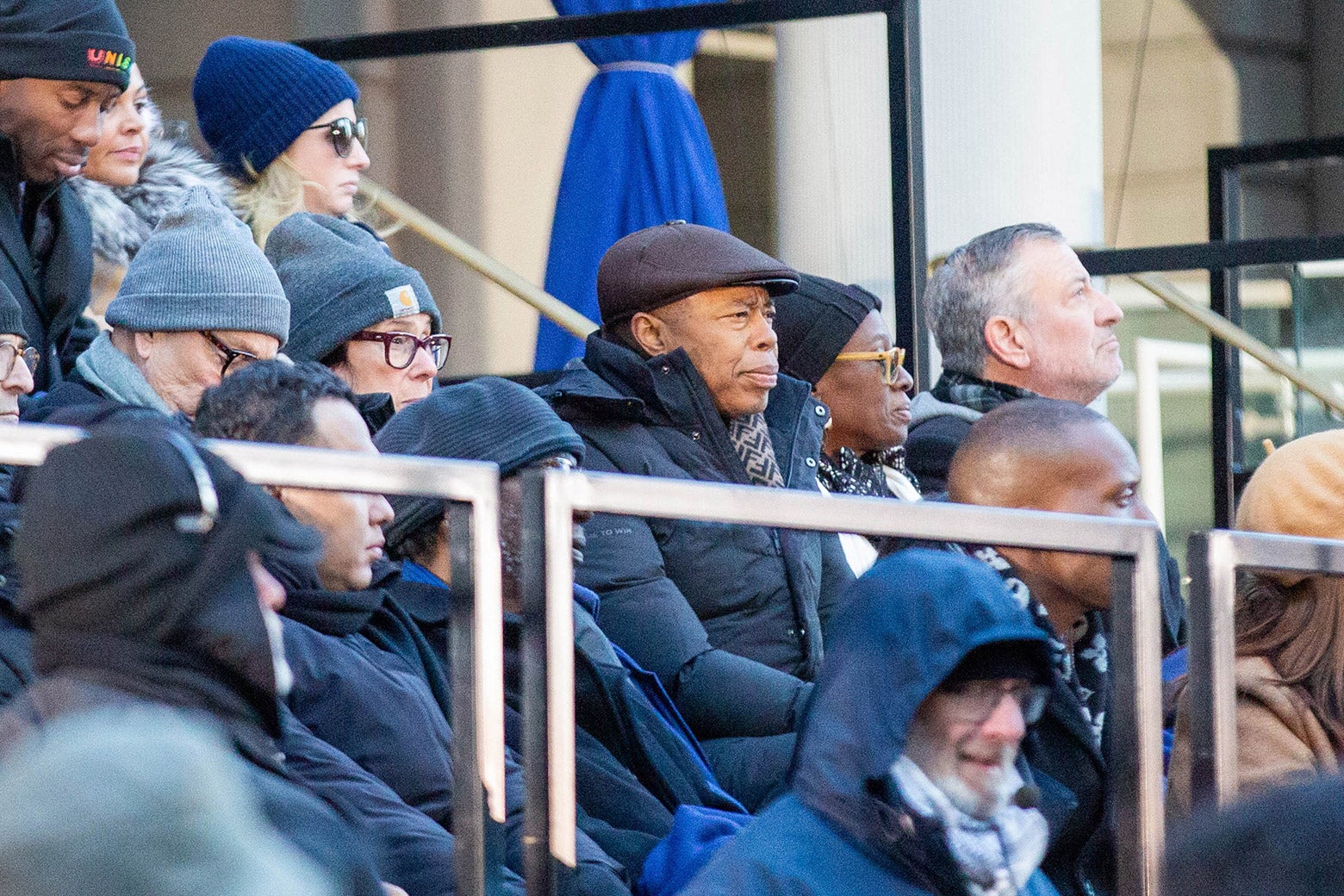
(At one point, people around me began whispering excitedly about outgoing Mayor Eric Adams. Apparently, he looked miserable. Someone said, “He’s having a terrible time.” Someone else replied, “Good.” I had snapped a photo earlier in which he appeared to be pouting. I showed it to them. They leaped with joy. It was petty. It was human.)
Aymann Ismail
The program began with a speech delivered by an excited Alexandria Ocasio Cortez. “New York City has chosen the ambitious pursuit of universal child care, affordable rents and housing, and clean and dignified public transit for all. We have chosen that over the distractions of bigotry and the barbarism of extreme income inequality.”
She and other speakers made several references to the fact that the city was now officially in the care of its first Muslim leader. Imam Khalid Latif was the New York Police Department’s first Muslim chaplain and executive director and chaplain (imam) for the Islamic Center at New York University; he left the latter post last summer to become the co-founder and executive director of the Islamic Center of New York City. As with the many sermons he’s given for Friday prayer, he delivered a moving speech that explicitly tied Mamdani’s faith to his politics.
I came expecting a political coronation. But as I worked my way through the crowd, it felt closer to a collective recalibration—a moment to take stock of how ideas once dismissed as fringe, like openly taxing wealthy citizens, were now being voiced from the steps of City Hall without apology, and to wonder how much further the shift could go.
Aymann Ismail
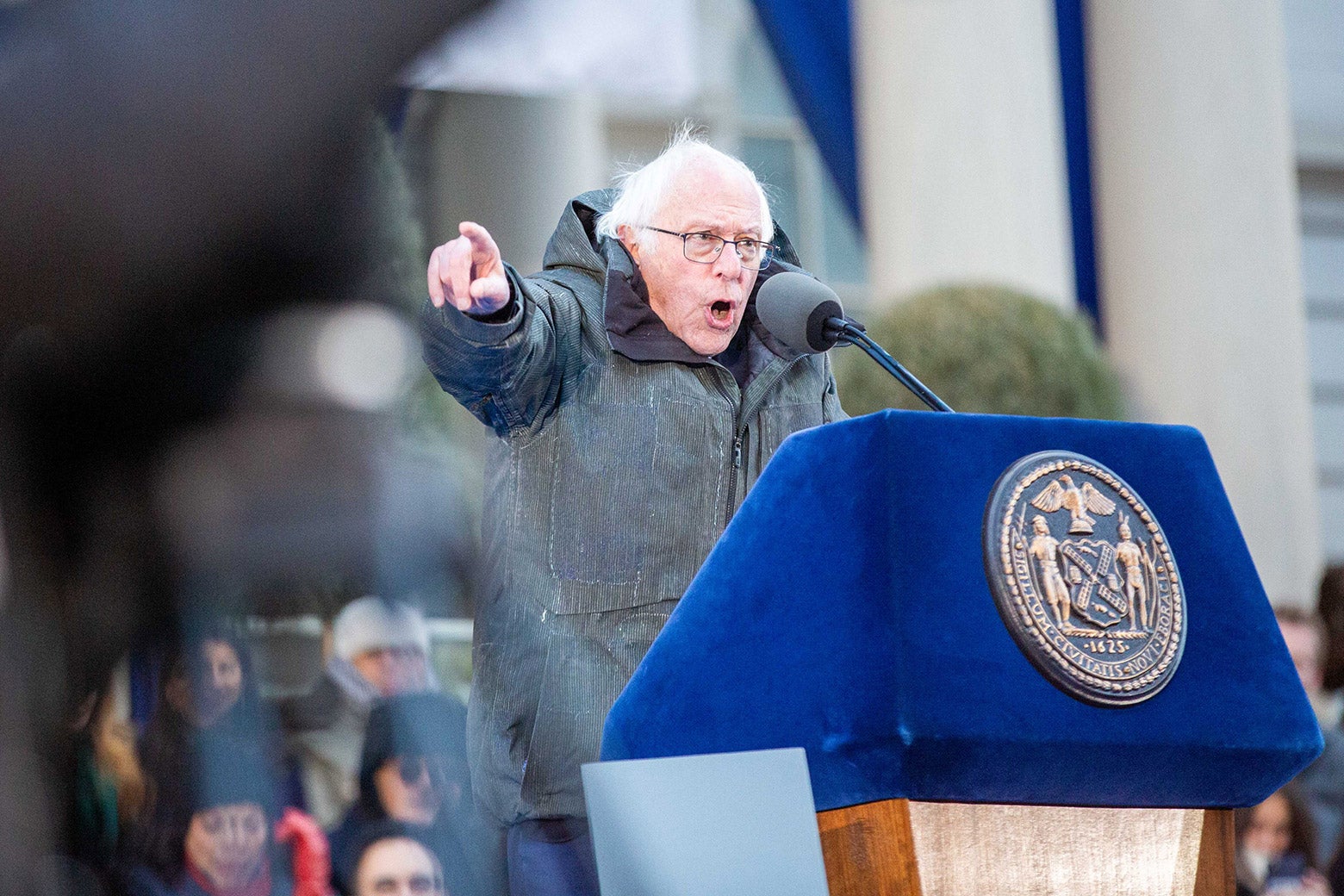
Bernie Sanders delivered an impassioned speech in which he demanded our government put a stop to growing income inequality. The audience collectively broke out into a loud chant: “Tax the rich!” A person next to me remarked, “Let’s start with everyone up there!,” pointing to Mamdani’s political allies who had joined him onstage.
There was still plenty of starry-eyed enthusiasm for the handsome young mayor and the hope he represented. But beneath that was something more measured: a curiosity about how far the boundaries of the possible had moved in just a year.
For Muslim New Yorkers, however, the moment carried an undeniable added weight. It marked a break from the post-9/11 norms of suspicion and overpolicing many had grown accustomed to, even if no one pretended a finish line had been crossed. If the election signaled anything, it was that the city was willing, at least for now, to test what happens when the old guardrails of governance are loosened and we head in a new direction.
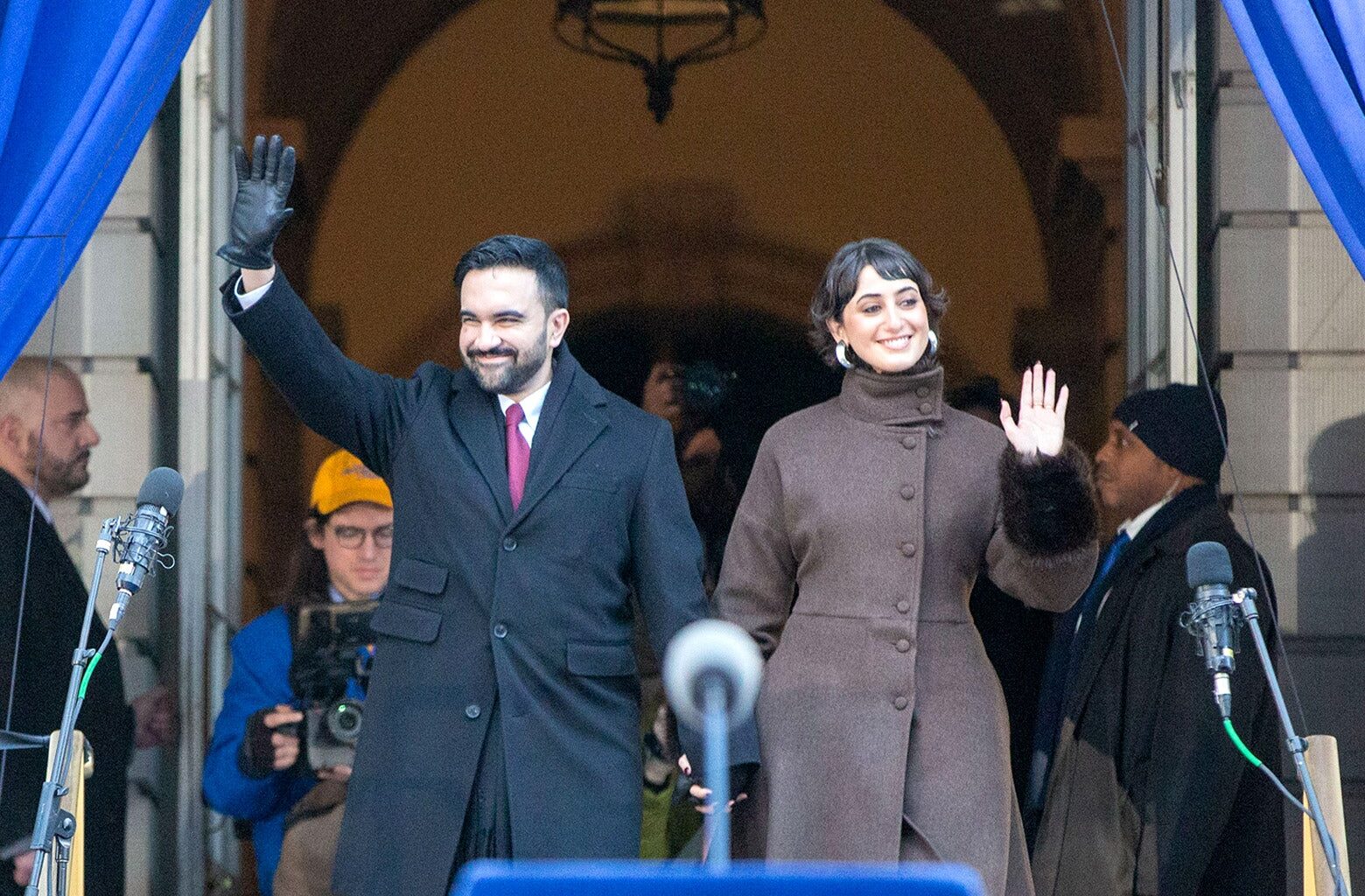
When Mamdani finally took the stage, the energy spiked. At 34, he is the city’s youngest mayor in over a century and, as its first Muslim mayor, the first to take the oath of office on a Quran. Sanders administered the oath, a detail that might have seemed odd given that the senator represents Vermont, but Mamdani cut his political teeth working on Sanders’ campaign, borrowed much of his democratic socialist vocabulary from him, and describes the senator as a political role model. In that sense, it appeared more like an anointing than a procedural formality: the veteran of the American left passing the baton to a younger standard-bearer.
But that raises an obvious question, one that has hovered over Mamdani’s rise from the start: Is he controversial more for his politics or for his religion? The honest answer is that the two are often deliberately collapsed into each other by critics who want to scare Americans with labels, a tactic that would be funny were they not so malignant: think “Islamo-Marxism” and “Islamo-Communism.” Both are shorthand for something foreign.
This is where I should stop and define what democratic socialism is, as it’s been at the center of much of the misinformation about Mamdani. Democratic socialism, as practiced by Zohran Mamdani, is not about abolishing markets or nationalizing everything in sight. It’s about using democratic government to make sure basic needs—housing, transit, health care, education—aren’t treated like luxury goods. New York already runs on plenty of these ideas: public schools, public hospitals, rent regulation, the subway. No one panics when the fire department shows up. We’ve just decided, over time, that some things work better when profit isn’t the point.
There’s also the religion—one that Mamdani and I share. He ran openly as a Muslim in a city still shaped by 9/11, where the backlash that followed turned Muslims in New York and New Jersey into targets of NYPD surveillance and, at times, convenient scapegoats for elected officials. Mamdani made efforts to reassure skeptics, but he didn’t shrink himself to avoid the familiar panic. Claims of divided loyalties will echo, along with other decades-old tropes. Instead, he adopted a posture many of us learned long ago: smiling, appealing to shared humanity and civil rights, refusing to let bad-faith attacks dictate his mood. When you’re held up by a community, the panic stays external.
Then, Mayor Zohran Kwame Mamdani delivered his speech. It was measured, full of gratitude, hope, and defiance, which was the opposite of how Mamdani’s rise has been framed in much of the country. For months, the panic had been building, growing louder and more unhinged the closer he got to actually winning. After he defeated Andrew Cuomo, parts of the right responded with something less like political critique than demographic hallucination. In November, Sen. Tommy Tuberville warned that New York was already lost.
“We just saw what happened in New York,” he said. “We lost New York. It will be completely Muslim in three or four years.” In the senator’s framing, Mamdani is an appendage of a nefarious global force seeking to destroy America. Mamdani’s speech showed he understands New York, and America, possibly better than anyone else, definitely more than Tuberville.
Tuberville, who has described Islam as a “cult” and suggested that Muslims are “here to conquer,” is not fringe. His comments circulated widely, echoed by conservative commentators and algorithmically rewarded for their certainty. “He was just sworn in on the Quran,” wrote right-wing influencer Benny Johnson. “New York, we tried to warn you.”
Warned us of what, exactly? It’s not clear. That a Muslim might govern openly as himself? That a holy book might briefly appear on a municipal stage? That the city where nearly every language and religion on earth already exists in public would somehow collapse under the weight of its own plurality?
Throughout, Zionist protesters across the barricades tried to break the moment with air horns, their blare faint but audible on the official recording. No one onstage flinched. Mamdani didn’t pause. The crowd didn’t turn. The speech carried on, uninterrupted.
When the new mayor turned to the question of who this city is for, he was blunt. “They will be Russian Jewish immigrants in Brighton Beach,” he said. “They will be Palestinian New Yorkers in Bay Ridge who will no longer have to contend with a politics that speaks of universalism and then makes them the exception.” I interpreted it as a rebuke of a Democratic culture long comfortable invoking unity while carving out exclusions.
Standing there in the cold, watching Mamdani rest his hand on the Quran while Sanders administered the oath, I found the disconnect impossible to ignore. There was no takeover, no creeping caliphate. Just a bundled-up mayor promising to govern “audaciously,” speaking to a crowd that looked exactly like New York at its best. What struck me most was how unremarkable it all was, in a good way. He didn’t brandish it as a symbol or treat the moment like a breakthrough to be celebrated. He took the oath. He finished. The ceremony moved on. It was quiet, almost defiant in its normality. It was a welcome change.
And yet I felt something else too—something I hadn’t quite expected. A flicker of satisfaction. A guilty, bracing thrill.
For years, Muslim Americans have been instructed explicitly to keep our heads down. To soften ourselves. To reassure the anxious who are deeply misinformed about the content of the Quran and the nature of its followers. I saw it in my family too. My father, who worked in New York as a taxicab and black car driver for 30 years, told me to be grateful, to be quiet, and to avoid bringing any extra attention to ourselves or our community. That we had enough problems to deal with and didn’t need to give anyone an excuse to train their Islamophobia on us. My mom took a slightly different approach, noting that it was up to us to gently prove we are not the nightmare someone else keeps insisting we are by being nice, being charitable at every opportunity, and making sure everyone knows we’re Muslim if only just to offer them another glimpse of what we are to contrast with what they might assume.

Joshua Shanes
The US’ Self-Appointed Antisemitism Watchdog Is Ignoring the Country’s Biggest Source of Antisemitism
Read More
Watching the panic unfold, I realized that part of what felt so electric about this moment was that, for once, the discomfort and uncertainty had shifted off my shoulders and onto those who hate American Muslims the most.
For just a moment, it wasn’t Muslims being asked to stomach their fear for what the future might hold. It was the people who hate us trying—and failing—to make Mamdani into some Muslim ideologue who moonlights as a jihadist with dual allegiance to a nonexistent global Muslim cabal.
In his speech, Mamdani directly addressed his skeptics, those who “view this administration with distrust or disdain,” and told them plainly: “If you are a New Yorker, I am your mayor.” He invoked what he loved about growing up in the city, the languages, foods, and neighborhoods, the fact that he, a Muslim, can have bagel and lox as one of his weekly rituals. He described a place that looked and sounded exactly like the crowd shivering in front of him. It’s hopeful to see oneself in the top seat. It’s a new experience for us, something others get to experience. Can’t we just have that?
I was cold and extremely ready to go home, more than confident I had seen enough for my story and eager to be out of the cold. And then, outside, like a glitch in the city, I ran into Curtis Sliwa—the 2025 Republican candidate for New York mayor. He was alone, wandering.
He told me he had RSVP’d and “was in line with all the peeps waiting to get in” but had never made it inside. He didn’t even catch Mamdani’s speech. The line was too long. I asked why he hadn’t gone to the front, that surely someone would have recognized him and ushered him inside. He laughed and said he preferred it this way: “Come on. I’m no VIP. I’m just one of the regular people out of the subway into the streets.” He said he had no regrets about his campaign. He smiled when he recalled Mamdani saying he’d rather be trapped in an elevator with Sliwa than Cuomo. He told me he planned to support Mamdani. “He won fair and square. He should be given a chance to put his agenda into place. Even if you disagree with him politically, you got to say: If he is successful, then the city is successful, the state, the country, everyone is successful. But you have haters out there, and that’s what life is about.”
Aymann Ismail
He admitted he felt wanted by neither Republicans nor Democrats. “I’m an outlier,” he said. “I’d rather be with the people.”
Then he vanished into the afternoon just as quickly as he’d appeared.
What stayed with me wasn’t just pride, though there was plenty of that. It was relief. Relief that, for once, a side selling hope instead of fear had won. And it was clear this wasn’t some narrow Muslim celebration. Muslims largely supported Mamdani, but they weren’t automatic votes. They were earned. He campaigned for them, chasing them around at one of the public celebrations that make New York such an exciting place to live.
That’s the complexity of it. The pride of watching a Muslim achieve something historic, paired with the humility of knowing that this victory doesn’t belong to Muslims alone. Zohran Mamdani isn’t a “Muslim mayor” the way his critics insist.
He’s the mayor of New York City.
Sign up for Slate’s evening newsletter.