Do you remember Mother Goose? Are you familiar with the nursery rhyme, “Mary Had a Pretty Bird?” What about “The Cuckoo”?
Thanks to singer-songwriter-artist-activist Natalie Merchant, students from one dozen Chicago Public Schools are experiencing them reimagined.
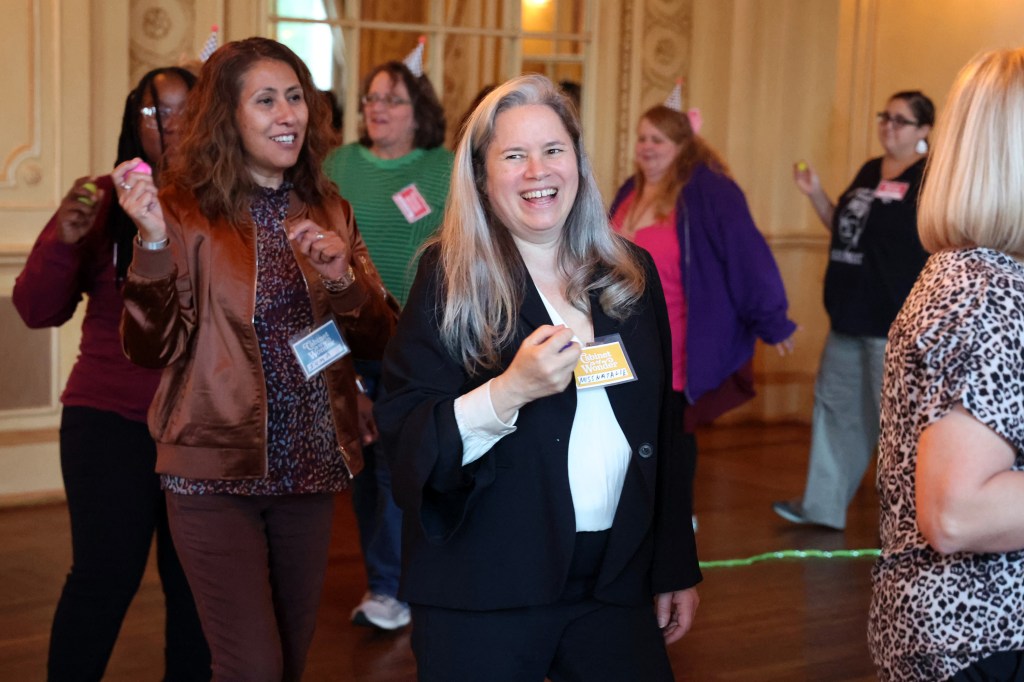
Merchant melds music, play and Mother Goose tales into “Cabinet of Wonder,” a creation from her mind brought to life in collaboration with the Chicago Symphony Orchestra, Chicago Children’s Theatre, Manual Cinema, artists, and early childhood educators.
Designed as an enrichment tool for teachers and parents of children ages 3 to 6, the multimedia project is a web-based collection of professionally produced music recordings, inventive videos and teaching guides.
The nursery rhymes, sheet music and photographs are available to download for use in classrooms and at home. At CPS, “Cabinet of Wonder” is part of a pilot program with the National Head Start Association, providing feedback on students’ responses to the experience.
Merchant is best known for her award-winning career as the lead singer of the band 10,000 Maniacs and for her successful solo career. She told the Tribune she aims for the site to be an experience that nurtures curiosity and critical thinking as she, costumed as the eternal maternal figure Mother Goose, sings 17 nursery rhymes from “Humpty Dumpty” to the “Queen of Hearts” accompanied by the orchestra.
Alongside her, child actors dance and frolic with shadow puppetry in the land of make-believe, where youths go on adventures and learn math, science and reading skills. “The thing that makes it magic is your own imagination,” Merchant told teachers at an assembly with the CSO in October.
For Merchant, imagination is everything.
In a video, she tells the origin story of Mother Goose: She is a poet and writer who uses language to convey her skill of pretending. Children love her because she’s clever and makes them laugh. Every time a child learns one of her rhymes, Mother Goose lives another day.
Mothering origins
Merchant took up the mantle of sharing nursery rhymes with youths eight years ago while living in Troy, New York.
After an intense period of creativity and activism (anti-fracking and domestic violence), Merchant took some time for herself.
She laughed, recalling how that downtime lasted a brief two weeks. A transplant to the town, since her daughter was attending school there, she didn’t know anyone. So she sought community by volunteering.
“I went to the Head Start offices and said I’d like to sing with the kids a couple hours a week,” she said.
That ended up being three days a week for three years and transitioned Merchant to an artist-in-residence for the Head Start program. She hired a guitarist and violinist and took her “sweet little band” to public schools, housing projects and Head Start sites to perform for hundreds of kids.
Merchant’s classroom interactions and dialogue with the children now exist virtually in “Cabinet of Wonder,” a bridge that entertains as well as taps into the building blocks of early education.
For instance, when she would teach “Jack Be Nimble,” students would ask questions like “What does ‘nimble’ mean?” and “Why isn’t Jack afraid of the candle?” When she talked about Jack Sprat, she said it provided an opportunity to talk to the kids about making good food choices and using good table manners.
“I found really lovely ways to talk about many things other than the rhymes. Science, math … the conversations about history would be really fascinating,” Merchant said.
“We’d do ‘Rub-a-dub-dub’ and talk about sea travel. They’re in the ocean. The ocean is full of salt. Some bodies of water don’t have salt. Then we talk about rivers, ponds, lakes, and streams. It was all trying to get them to make connections — form this love of learning for the sake of building knowledge, not because ‘I’m in school and I have to.’”
Topics such as opposites, similes, prepositions, homophones and homonyms are introduced on the free website.
Merchant also incorporated music education into “Cabinet of Wonder.”
Each rhyme showcases a different musical genre, such as Dixieland jazz, calypso, funk, chamber, Celtic and folk, with dance including circle, partner and line. The goal: Expose children to a broad spectrum of music, helping them learn how instruments look and sound.
In doing the work, Merchant learned that few students in her Head Start program were aware of Mother Goose, much less the nursery rhymes associated with her.
“I developed this program of poetry, music, and dance based on Mother Goose rhymes because that was something that I shared with my child,” Merchant said. “People don’t teach Mother Goose so much anymore. One of my missions with this project was to tell people every generation gets to reinvent Mother Goose.”
It only takes one generation to lose culture, Merchant said, citing how Native American children were sent to boarding schools and forbidden to speak their own language. “How many languages died in this country in one generation?” she said.
When working with children in Troy, New York, she noticed that those learning English as a second language were uncomfortable with words and phrases new to them. Merchant discovered that, through play and music, language became more comfortable for them. It gave kids a sense of agency, she said.
“If I repeat these rhymes, I’ll keep this culture, this tradition alive,” Merchant said. “That’s a powerful obligation for a child to feel. It makes them feel important, like the things that I learn matter.”
 Grover Cleveland Elementary students participate in the “Cabinet of Wonder” in-school workshop with flutist Emma Gerstein, of the Chicago Symphony Orchestra on Nov. 5, 2025, in Chicago. The workshop utilized Natalie Merchant’s Mother Goose curriculum. (Stacey Wescott/Chicago Tribune)
The proof was in the pudding at Grover Cleveland Elementary one morning in November.
It was a special day, as the weekly “Cabinet of Wonder” sessions came to life when Emma Gerstein, a CSO flautist, showcased her instrument’s melodic sounds to 4-year-olds sitting cross-legged on a classroom floor. The trill Gerstein produced elicited responses from the crowd like: “That sounds like ballet!” and “That sounds like my dad’s music!”
After the demonstration, the tykes were treated to a “Cabinet of Wonder” video where the nursery rhyme, “Mary Had a Pretty Bird” is performed. In it, children clad in dandelion-hued costumes that resemble said pretty bird, and Mary in a dress. Off-screen, Catherine Councell of Chicago Children’s Theatre engages the students in a call-and-response exercise to the rhyme’s lyrics as they clap to the tempo, move their bodies to the beat, use their hands to mimic the bird’s beak and flap their arms like a bird’s wings.
“What does the color yellow make you feel?” Councell asked. A resounding “happy” comes forth from the crowd.
Three full-day pre-K rooms are implementing Merchant’s vision at Cleveland Elementary in Irving Park, according to teacher Jennifer Cepeda. Before the live performance, she’d introduced “Little Miss Muffet” and “Peter, Peter Pumpkin Eater” to her students.
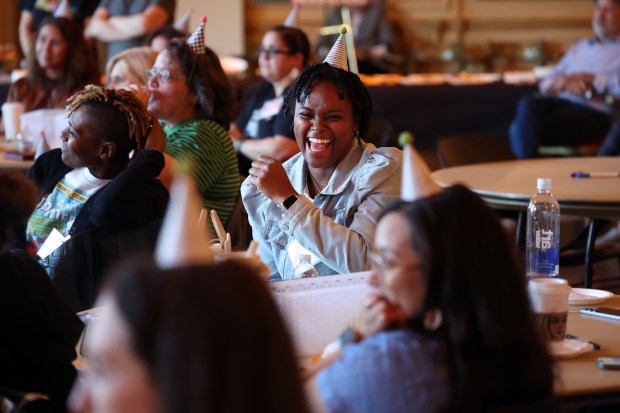 Jonnisha Moore, center, of Walt Disney Fine and Performing ARTS Magnet School, laughs as Natalie Merchant leads a workshop for Chicago Public Schools early educators at Symphony Center on Oct. 8, 2025. (Terrence Antonio James/Chicago Tribune)
Rhymes are powerful
Building “Cabinet of Wonder” was challenging for Merchant.
From fundraising $600,000 to clerical work and outreach to school systems, Merchant utilized all the skills she acquired throughout her career. Combined with her network of creatives — many of whom offered their services for free or at cut rates because they believed in the work — the “Cabinet of Wonder” came to fruition.
Jacqueline Russell, co-founder and artistic director of Chicago Children’s Theatre, is a proponent of “Cabinet of Wonder’s” scale and quality of content. When Russell learned about the project, she offered it a home in Chicago.
“We’re going into this new frontier … and the one thing we all agree on is children deserve the very best quality arts experience. That’s what they’re going to get with this website,” Russell said.
The work Merchant put in over the years didn’t go unnoticed by Head Start. Rachel Hutchison, manager of online instructional design at the National Head Start Association, helped align Cabinet of Wonder material with Head Start standards — such as fine and gross motor control, cognitive development and emotional and behavioral development.
Merchant’s work is supported by a University of Chicago white paper on the benefits of nursery rhymes for children’s neurodevelopment and language. Hutchison considers “Cabinet of Wonder” a world-class resource that’s free.
The work continues to evolve as the pilot gains traction nationwide. “Cabinet of Wonder” will be made available to the National Head Start Association’s 50,000 classrooms serving nearly 750,000 children and families nationwide. Head Start will have a series of virtual events with Merchant and in-person events throughout the school year.
The CSO reached out to its list of teachers last spring to request applications to join “Cabinet of Wonder’s” pilot phase. Chicago schools participating will provide Merchant with feedback on which materials kids responded to and what they liked. By participating, educators will be part of a network where they can communicate with one another through the project’s content, Merchant said.
Mother Goose celebration in Chicago
After Merchant taught students rhymes in New York, she gathered them for an end-of-year pageant titled “Happy Birthday, Mother Goose,” where her band performed a staged production, complete with 150 costumes Merchant designed and made for the children. They are the same costumes we see the youths wearing in the “Cabinet of Wonder” videos.
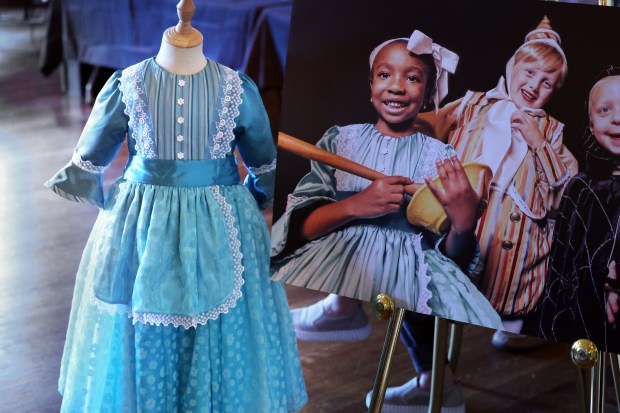 A costume created by Natalie Merchant for a video production of “Little Miss Muffet,” a well-known Mother Goose rhyme, is displayed at Symphony Center in Chicago on Oct. 8, 2025. Merchant created a video series called the “Cabinet of Wonder,” a musical introduction to the traditional nursery rhymes of Mother Goose. (Terrence Antonio James/Chicago Tribune)
“Kids from all over the city would come. They all shared the same knowledge, which was really big for them,” Merchant said. “When I would say, ‘Hey, diddle, diddle,’ all 150 four-year-olds would go, ‘The cat and the fiddle!’ They felt this immense power together. They got to experience sharing culture. They got that feeling you get when you go to a concert and you’re like, ‘I love this song!’ but you’re with 5,000 other people.”
That’s what Chicago’s school-age children will experience May 8-9. Children from schools participating in the “Cabinet of Wonder” pilot will be treated to a concert at Symphony Center featuring Merchant and the orchestra performing Mother Goose rhymes. The Friday concert is free and open to school groups; families can order tickets through cso.org for the Saturday event as part of the CSO for Kids concert series.
As the Chicago cohort progresses, Merchant is in conversation with public schools in New York and Boston to get pilot programs underway there. Her dream for “Cabinet of Wonder” is to secure funding to publish a rhyme book and to have a literacy organization like Reading is Fundamental distribute it to school districts and Head Start locations nationwide.
“Cabinet of Wonder” could be similar to The New York Times’ recipe app, where individuals follow but make the pieces their own, according to Jonathan McCormick, managing director of the Negaunee Music Institute, CSO’s education/community engagement wing.
“I appreciate the website is designed in a way that will be fun for children to explore, but it’s also setting teachers and parents up to utilize the content in a way that is meaningful to them,” he said.