Scientists have identified a promising site on Mars that could serve as the first foothold for human explorers, a pivotal development for long-term colonization plans. The discovery, made using high-resolution imagery from NASA’s HiRISE camera, highlights Amazonis Planitia, a region that balances sunlight access and subsurface ice availability. This finding, published in the Journal of Geophysical Research: Planets, could significantly shape how agencies plan future crewed missions to the Red Planet.
A New Martian Frontier: Amazonis Planitia Emerges as a Landing Hotspot
The area of interest, Amazonis Planitia, is located in the Martian mid-latitudes, offering what researchers describe as a “Goldilocks zone”, not too hot, not too cold, and rich in potential resources. This zone allows for optimal solar energy collection while maintaining temperatures that help preserve subsurface water ice. These conditions, researchers say, make the region especially suitable for human activity, including long-term missions that cannot rely on regular resupply from Earth.
The study, authored by Erica Luzzi and her colleagues, emphasizes the strategic importance of accessible water ice, which would be indispensable for life support systems and in-situ resource utilization. By analyzing data from the High-Resolution Imaging Science Experiment (HiRISE), the team was able to detect features consistent with buried ice deposits, a resource that would allow astronauts to produce both drinking water and oxygen on-site.
In the words of Giacomo Nodjoumi, a postdoctoral researcher at the Space Science Data Center of the Italian Space Agency and co-author of the study published in the Journal of Geophysical Research: Planets, “For the Moon, it would take us one week, more or less, to go back and forth to Earth for resupply. But for Mars, it would take months. So, we have to be prepared for not having resupply from Earth for extended periods of time.” This logistical gap pushes mission planners to identify regions that can offer not only scientific value but also survivability.
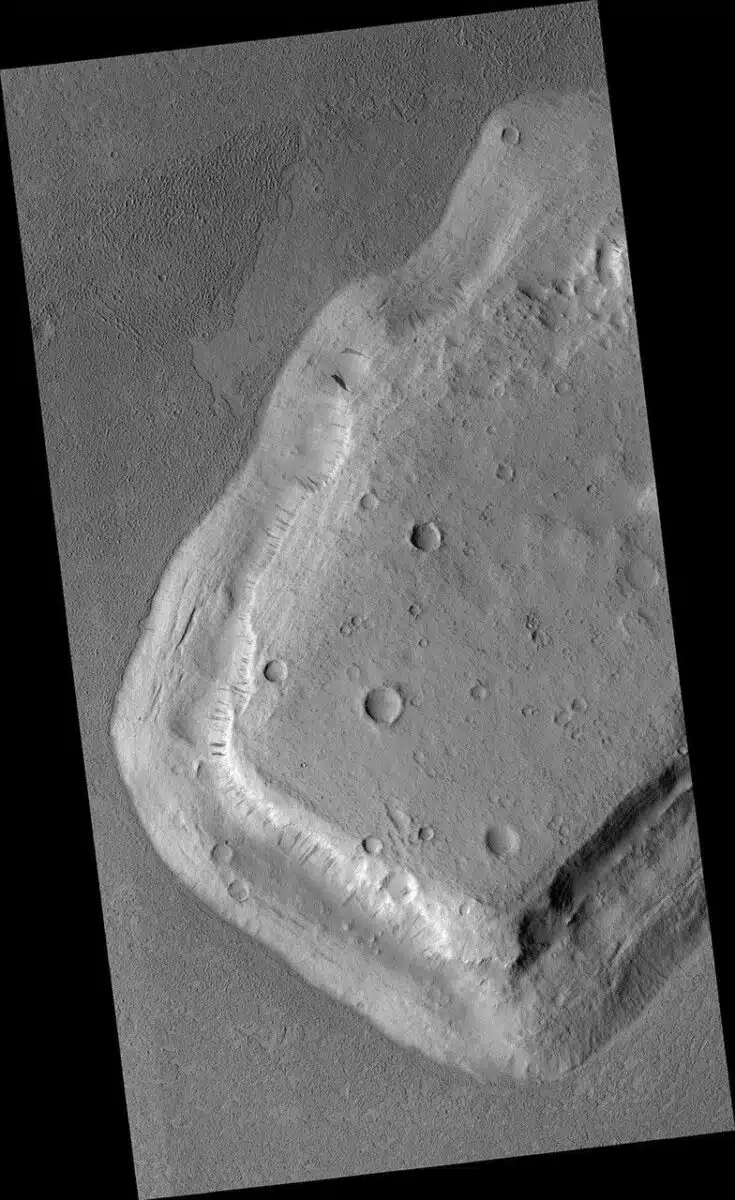 Rising Above It in Amazonis Planitia. Credit: NASA
Why Water Ice Could Make or Break Martian Exploration
Water on Mars is not just a luxury, it’s a mission-critical asset. While the presence of ice on the Red Planet is not new, the accessibility of clean, usable water ice near the surface has long remained uncertain. The Amazonis Planitia site could change that. “The most important resources are oxygen to breathe and water to drink. That’s what makes our candidate landing site really promising,” Nodjoumi said, pointing out the direct link between basic survival and the landing site’s strategic value.
The ability to extract water from the ground would drastically reduce mission costs and increase crew autonomy. It would enable astronauts to manufacture hydrogen-based fuel, oxygen, and even agriculture-supporting systems without relying on Earth-based deliveries. This aligns with NASA’s Artemis-to-Mars vision and international efforts to build self-sustaining outposts on other worlds.
Yet the researchers urge caution. Nodjoumi notes, “We have strong evidence to suggest that this is water ice, but until we go there and measure it, we won’t be 100% sure.” Sending a robotic rover or early crewed mission to conduct direct sampling and geological analysis remains the next step in validating the site’s promise.
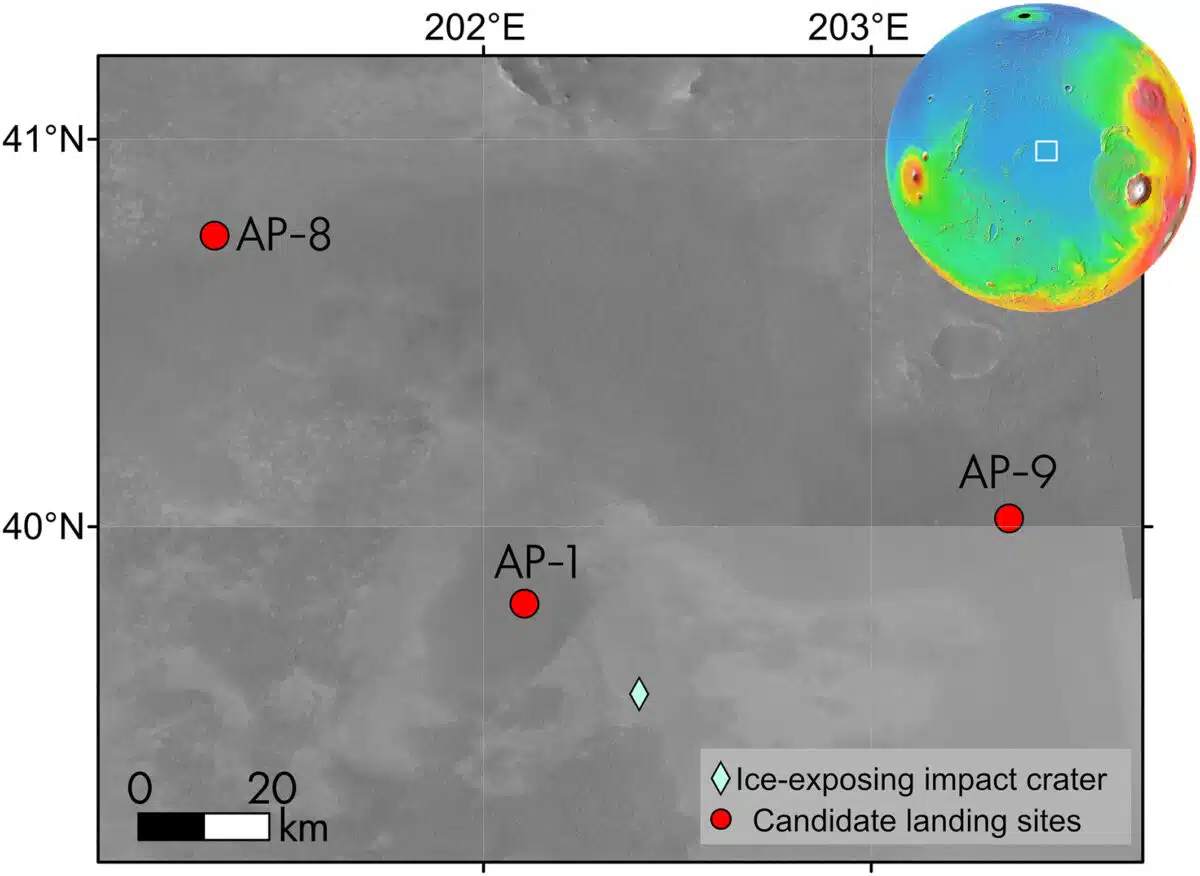 Location of candidate landing sites AP-1, AP-8, and AP-9 (red circles) and ice-exposed impact crater (light blue diamond). Basemap: CTX (Context Camera) mosaic provided by the Murray Lab (Dickson et al., 2018
The Long Journey Ahead: From Orbital Data to Human Footprints
The identification of a viable human landing zone marks only the beginning of what promises to be a multi-decade journey. While the orbital evidence is robust, verifying the composition and quality of the subsurface ice will require on-site exploration. Robotic missions, likely precursors to crewed flights, must be dispatched to collect samples, assess terrain stability, and test in-situ resource technologies.
The significance of this discovery also lies in its implications for mission design. Engineers can now tailor habitat layouts, mobility systems, and energy infrastructure based on known features of Amazonis Planitia. With a confirmed source of water nearby, the dream of setting up a Martian base becomes more than a fantasy, it becomes a feasible objective backed by solid planetary science.
For mission planners and planetary geologists, this is a strategic milestone. The site’s positioning in a relatively flat, low-elevation area also reduces atmospheric entry challenges and facilitates safer landings, another factor that increases its appeal.
How This Shapes the Timeline for Human Presence on Mars
While many timelines for Mars missions remain speculative, this new research provides a concrete target, which helps accelerate planning across agencies like NASA, ESA, and SpaceX. Instead of launching into the unknown, future missions will have a focused destination, backed by data, science, and survivability prospects.
International collaboration will also be key. The involvement of the Italian Space Agency alongside U.S.-based institutions signals a global interest in Mars and increases the odds of multi-national missions, possibly modeled after the International Space Station.
With detailed imagery, scientific validation, and resource mapping, Amazonis Planitia may well become the address of humanity’s first outpost on another planet. As exploration technologies evolve and the urgency for off-world habitation grows, the Red Planet is moving from a distant dream to an actionable frontier.