After more than a decade of planning and negotiation, National City has secured unanimous approval from the California Coastal Commission for a development plan that officials say will finally give residents access to their city’s waterfront.
The commission voted Dec. 10 to certify the Port Master Plan Amendment for the National City Balanced Plan, marking what Mayor Ron Morrison called a milestone for a city facing a unique coastal access problem.
“We’re the only city on the West Coast that either has bayfront or oceanfront that does not have one inch of access to its bayfront,” Morrison said in an interview following the approval.
All three miles of National City’s bayfront are controlled by either the Navy or the Port of San Diego, Morrison said, leaving the public with little access. The Balanced Plan development represents the closest thing to waterfront access the city will have.
What the plan includes
The National City Bayfront encompasses 273 acres of waterfront land and 167 acres of water, according to the Port of San Diego. The Balanced Plan focuses on the Marina District portion of this area.
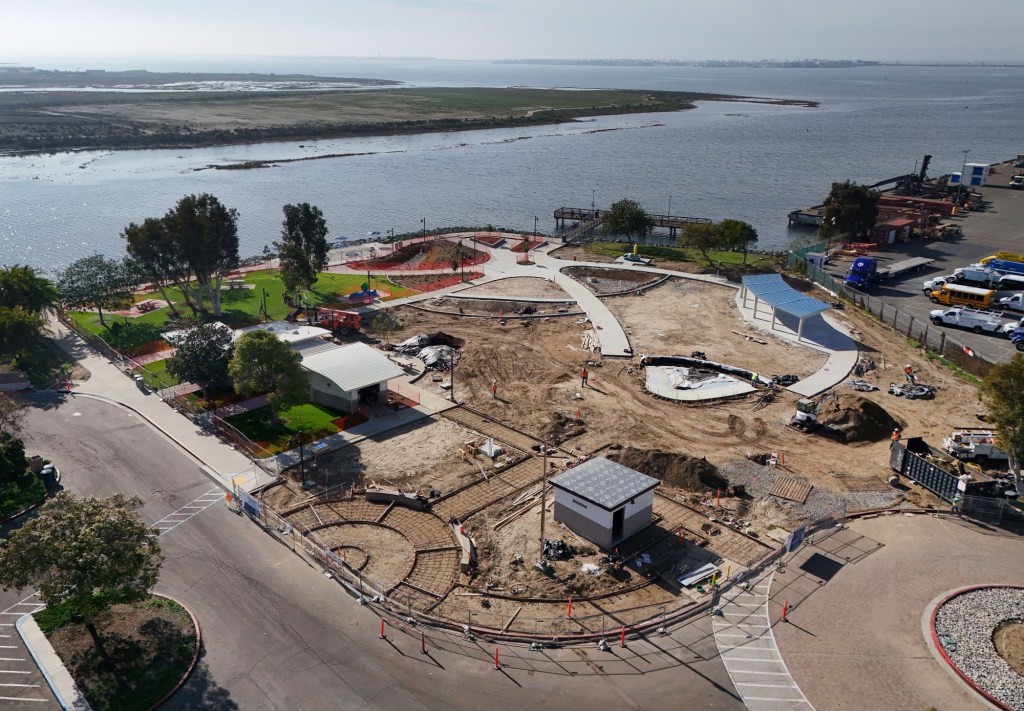
The approved plan expands Pepper Park by 2.5 acres — nearly 50% — from 5.19 acres to 7.69 acres. The expansion will include additional park amenities, picnic areas and a community stage.
 Construction continues on Pepper Park along the San Diego Bay waterfront on December 22, 2025 in National City, CA. (K.C. Alfred / The San Diego Union-Tribune)
The commercial side of development includes a recreational vehicle park with approximately 150 RV sites, 29 tent sites, 25 structured tents and 12 cabins. When economically feasible, up to 65 RV spaces would be replaced with two hotels containing up to 365 rooms.
The plan also includes dry boat storage for up to 200 boats, new dock space accommodating up to 70 vessels, and up to 10 new moorings in the Sweetwater Channel.
Public access features include a 12-foot-wide promenade along the jetty, a 3,600-square-foot public viewing area, and east-west and north-south corridors providing pedestrian and bicycle access.
Maritime industry gains
Maritime interests, which Morrison said are often wary of “gradual encroachment” from commercial and municipal development, secured significant benefits in the plan.
A realigned Marina Way will create a clear buffer between commercial recreation and maritime uses. A new sound wall and rail line will further separate the areas.
Approximately six acres of public streets — including portions of Tidelands Avenue and West 28th Street — will be closed and incorporated into the National City Marine Terminal’s operations. The street closures will allow the terminal to expand its controlled area and eliminate internal fences and drive aisles that currently bifurcate operations.
A new connector rail track will link the terminal’s existing rail infrastructure to additional rail car storage at the Burlington Northern Santa Fe National City Yard, improving efficiency for maritime companies like Pasha Automotive Services.
Reception and timeline
Morrison said he made his fourth appearance before the Coastal Commission for this project on Dec. 10, when the plan was approved.
“When we came before them with this one, they were all excited about it,” Morrison said. “They literally lit up when we went in front of them.”
The commission approved the plan unanimously.
Only two people objected during public comment. One requested waiting for data from recently installed air pollution monitors before proceeding. Another sought additional changes to the plan. The commission rejected both objections, with commissioners noting the project had undergone extensive review and stakeholder coordination.
“We are grateful to the California Coastal Commission for its support of the National City Balanced Plan,” Danielle Moore, chair of the Port of San Diego Board of Port Commissioners, said in a statement. “The progress we have made has been anchored in tireless collaboration with the community, business leaders, and of course the City of National City.”
Commissioner GilAnthony Ungab, who represents National City on the Board of Port Commissioners, said in a statement the plan represents “a lasting legacy for National City, the Port of San Diego, and the entire region.”
Economic impact
Morrison emphasized the plan’s importance for the city’s finances at a time when traditional revenue sources are declining.
“Cities have always depended on sales tax and retail just isn’t what it used to be,” he said. “So to be able to bring these hotels in is going to be a huge boost for our civic economy so that we can continue to provide services within the community.”
The transient occupancy tax — 10% of hotel room rates — goes directly to the city and can fund parks, police protection, fire protection and other services, Morrison said.
“People in National City aren’t going to stay in those hotels exactly,” Morrison said. “That’s going to be people from outside, but the taxes, like 10% of your hotel room, goes right to the city.”
One hotel on 24th Street, approved in an earlier phase, is already operating and “doing phenomenally well,” according to Morrison.
Next steps
The Board of Port Commissioners must accept the Coastal Commission’s certification before implementation can advance.
Morrison said the city is currently working with the port on engineering, permitting and funding for infrastructure, including the road realignment and sound wall.
“We’re hopeful, probably by the end of this next year, to actually see some stuff that’s starting to happen there,” Morrison said, referring to the park expansion and road alignment work.
The journey from the initial proposal in 2014 to final approval took more than a decade.
“It hasn’t been easy because at first we were told, ‘Oh no, this isn’t going to work. You guys can’t do this, can’t do that,’” Morrison said. “And yet we persevered on it and made something that everyone’s happy with. And that’s the exciting thing.”