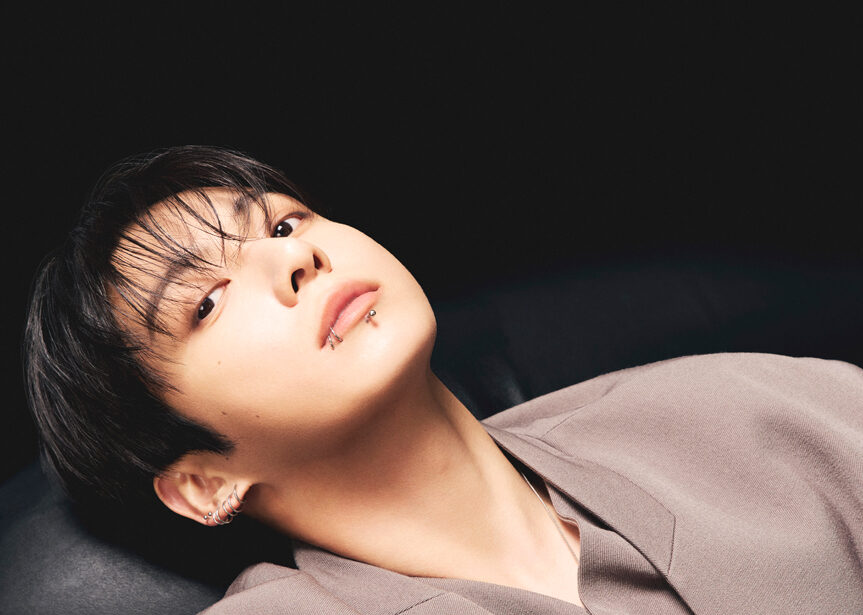
There are many questions surrounding Jung Kook, global pop star and one of the most famous faces on the planet. About the 18 months the BTS member spent in uniform, mostly out of sight and in the kitchen, serving his military conscription as a cook. About what it feels like to step back into the spotlight as a bona fide soloist and part of 21st-century pop icons BTS. About the music being quietly made for the group’s next album in Los Angeles, and what their return might look and sound like. Yet when we meet in a sunlit studio on New York’s West Side for his global cover shoot, Jung Kook is more focused on the everyday details – like what he’ll eat today. And oh, has he been thinking about it. “These days, I’m on a diet and only eat one meal a day,” he shares with a hint of a smile. “So I really look forward to that one meal. I find myself thinking, ‘What should I eat today?’ and waiting with patience. When I finally eat, I feel a sense of achievement.”
Today, that meal is still ahead of him: a dish from a local Korean fusion restaurant that a friend recommended. A late lunch, early dinner – breakfast, technically. With his schedule, there’s no set time for meals; he eats when he can. For now, he’s on autopilot. Jung Kook has been a global ambassador for Calvin Klein since spring 2023 and has just come from a surprise appearance in the label’s Spring/Summer show in lower Manhattan.
Read next
Jung Kook lives in the here and now. He doesn’t like to dwell on the past or philosophise about the future. When he notices a stack of Rolling Stone magazines on the table in front of him, his own face peering from the cover, he winces playfully at his younger, blonder self. “Who is that guy?” he says, laughing. “Why did they choose this as the cover?” Seeing that version of himself sparks no sentimentality. He only shakes his head and laughs again, unwilling to linger too long on someone he no longer is. “I don’t like the past,” he says. “I’m enjoying right now.”
Perhaps such an outlook is inevitable when your teenage years, your twenties, your entire becoming, have been documented and broadcast to millions. The photos, the videos, the performances – they create versions of you that can’t be outgrown. Every iteration of Jeon Jung Kook lives somewhere: on screens, in songs, on the covers of magazines, in the memories of strangers. To some, he’ll always be the baby-faced maknae – K-pop slang for the youngest member of a group – with a toothy smile. To others, he’s a 28-year-old man who is still unfolding in real time, tattooed and assured.
He describes himself as pragmatic, or a “realist”, as he puts it. It sounds more like self-preservation. When so much of you has already been recorded, archived and analysed, the only control left is over this moment.
That may explain his minimal relationship with regular social media networks. In 2023, he deactivated his personal Instagram account – tens of millions of followers gone in an instant – explaining simply that he “didn’t use it much”. He quietly returned in July 2025, launching a new account that, months later, still sits empty. No posts, no captions, just 14 million followers waiting for something that may never come.
In contrast, he regularly updates his dog Bam’s Instagram account, which has nearly eight million followers. It’s a gallery of tender, carefully composed pet portraits. For someone whose own image has been replicated endlessly, photography allows him to look outwards, to observe rather than perform. It gives him another way to exist in the present. To see without being seen.
He shares more intimate glimpses of his life two to three times a month on Weverse, the global superfan platform set up by HYBE, the parent company of BTS record label BIGHIT MUSIC. Even at his most private, Jung Kook’s life unfolds in public. When he opens a livestream on Weverse, millions join instantly – to watch him eat, watch a movie, or just sit in silence. Sometimes he sings; sometimes he says nothing at all. In one now-legendary moment, he accidentally fell asleep mid-broadcast, nearly six million people quietly watching him doze – a pop star at rest, the world holding its breath so as not to wake him.
That paradox, to be seen by everyone yet grounded in himself, is what anchors him now. Jung Kook doesn’t overthink; he moves by feel. It’s there in the way he speaks, deliberate but unguarded, and in the quietly magnetic way he carries himself. Offstage, he’s surprisingly still. “When I’m not onstage, I try to keep my mind empty and avoid overthinking,” he says. “I pour out my inspiration when I’m working on an album or preparing for a performance. But in daily life, I prefer to keep things simple and think in a straightforward way.” On the set of his cover shoot, that ease becomes something almost mechanical, like a rhythm his body knows by heart.
Watching him move through shoot poses with practised dexterity – hand lifted to his jaw, shutter click; chin tilted towards the light, shutter click; jacket slipped off one shoulder, shutter click; eyes narrowing into a smoulder, shutter click; a sudden laugh breaking the spell, shutter click – it’s clear this is all muscle memory, the product of more than a decade spent in front of cameras, trained to maximise every moment.
At 15, he became the youngest member of BTS, the group that would go from underdog rookies to undeniable global phenoms in less than five years. He was still a teenager when the “golden maknae” label stuck, shorthand for a young prodigy who can do it all: sing, dance, rap, even – as time would show – direct. Years later, he’d film ‘Life Goes On’, the group’s 2020 slice-of-life music video that turned a global pause into something quietly human. It wasn’t his first time behind the camera. Under the label G.C.F, short for Golden Closet Film, Jung Kook had been filming and editing his own travel vlogs for years: intimate, handheld glimpses of life in motion – shopping in Tokyo, working out in a hotel gym in Budapest, filming his bandmates on the beaches of Saipan in the Northern Mariana Islands. The clips reveal a director’s eye for rhythm and light, for soft moments and fleeting gestures, and an undeniable instinct for finding truth in transition.
In the early days, time blurred differently. Days were packed with rehearsals, variety show tapings and small showcases that gave way, almost imperceptibly, to world tours and stadium stages. What feels like second nature on today’s set – the nods of understanding, the quick adjustments, the simple efficiency and pleasantries – was forged in those years, when every second of practice was meant to close the gap between BTS and the industry giants they were up against.
 (Picture: Tayo Kuku Jr)
That period has since hardened into legend. The story of BTS has been told and retold: seven young men from a small label, dismissed at debut, fighting for space in an industry dominated by picture-perfect idols from much larger companies. They were not meant to upend the system. They were not supposed to storm the charts in Korea, let alone America. And yet, with relentless dedication and an almost defiant belief in one another, they did. In 2018, LOVE YOURSELF 轉 ‘Tear’ became the first Korean album to debut at number one on the US Billboard 200 chart, paving the way for five more albums that achieved the same feat – among them 2020’s MAP OF THE SOUL: 7, which sold 4.1 million copies in just nine days in South Korea. Six of their singles have likewise hit the top of the US Billboard Hot 100. In 2020 and 2021, they became the first artists ever to top the IFPI Global Recording Artist chart two years in a row. Such milestones cemented the group’s place in the pop pantheon and set the stage for K-pop’s global ascent.
BTS went from performing in cramped broadcast studios and fan-sign halls to selling out stadiums across continents, from variety-show punchlines to Grammy nominees, and from sharing a single bedroom to owning their own luxury homes in Seoul. Their mythology is stitched together from countless hours of choreography drills, late-night livestreams over a pot of jjukkumi (webfoot octopus) and pork belly, and songs that bared their anxieties as openly as their ambitions. For fans, those moments became scripture: the sweat on rehearsal-room floors, the tears at award shows, the victories hard-won.
And at the centre of it all was Jung Kook: the youngest, the maknae, a boy growing into himself under the glare of global attention.
Jung Kook was born in Busan, a port city on South Korea’s southeastern coast, known for its beaches and bustle. The youngest son in a close-knit family, he was a shy kid with a vivid imagination – someone more inclined to sketch, play sports, or lose himself in daydreams than seek the spotlight. That changed the day he saw a K-pop performance on television. He was drawn to the idols’ charisma and energy. For the first time, he could imagine himself in that world. When he was 13, he auditioned for Korean talent show Superstar K and didn’t make it, but his potential was undeniable: several agencies came calling. One of these was BIGHIT MUSIC. Watching a video of fellow BTS member RM rapping sealed the deal for Jung Kook, and he left home for Seoul to train as a singer. It was a decision that would transform both his adolescence and his sense of time. The rhythms of childhood gave way to practice. Life was no longer measured in seasons, but in hours of rehearsal.
Despite being the youngest in the group, he rarely acted like it. Even in the earliest footage – a teenager in oversized hoodies and round cheeks, bowing to the camera with a mix of shyness and determination – there’s a flicker of professionalism, of someone already studying how to be great. The older members teased him for being shy, for practising for too long, for saying little and expressing more through motion. What looked like natural talent was, in reality, a kind of obsession: a hunger to keep up, to prove he could belong.
As BTS grew, so did he. Even if growing up hardly describes what happens when your adolescence unfolds on world tours and livestreams. The rehearsal rooms became his classroom, the stage his only constant. His voice deepened, his movements sharpened, his edges softened. He learned to hold himself with quiet control, to translate emotion into precision. The nickname golden maknae stuck, but the myth hid how hard he had worked to live up to it.
For all of the playful teasing from his bandmates – about how they “raised” him and walked him to and from school in his bright yellow uniform – there’s something bittersweet beneath the image: a boy trying to bridge the gap between youth and adulthood under stage lights.
He’s hinted at that tension in his own work. In his 2020 solo track ‘My Time’, a smooth R&B tune from the BTS album MAP OF THE SOUL: 7, he wrote about being out of sync with the world, chasing a life that seemed to be running ahead of him. “I feel as though I’ve become an adult faster than anyone,” he sings. The song reads like a confession from someone who spent his early years sprinting towards success before he’d even caught up with himself.
Just three years later, Jung Kook made his solo debut with ‘Seven (feat. Latto)’, the most defining moment of his career so far. “Working on the song ‘Seven’ felt like the most important and special moment for me,” he says. “That song is what allowed me to continue working up to now.” Before that, he was stuck in limbo. After years of constant output with BTS, nothing he heard or worked on for his solo debut felt right. “Everything felt like a hassle,” he admits. Then along came the song, and suddenly the spark returned. “‘Seven’ made me want to get back to it,” he says.
 Jung Kook wears Calvin Klein (Picture: Tayo Kuku Jr)
A summer release, ‘Seven (feat. Latto)’ landed like a jolt. Its breezy acoustic strum and UK garage pulse masked something more intimate, even provocative. This was a pop idol shedding the myth of innocence, claiming the fullness of adulthood in his own voice – and doing it in English, for a global audience that had already imagined a thousand versions of him.
The song topped global charts, including the US Billboard Hot 100, and soundtracked thousands of spicy online edits, giving Jung Kook a different kind of self-assurance. “I really loved ‘Seven’ and felt confident performing it, but I was still surprised by how well it was received,” he says. “That reaction gave me even more confidence.”
If ‘My Time’ was Jung Kook looking inward and reckoning with how fast he grew up, then ‘Seven (feat. Latto)’ was him looking outward, rediscovering the joy of performance. The song’s playfulness, its easy sensuality and clean pop polish all pointed to an artist comfortable in his own skin. It felt like he had finally caught up with himself.
If ‘Seven (feat. Latto)’ was Jung Kook opening the door, solo album GOLDEN was him walking through it. Released in winter 2023, the record – which has since racked up more than six billion Spotify streams – demonstrated his newfound confidence. Unlike BTS’s discography, which carries the weight of sentimentality and messaging, GOLDEN was refreshingly unburdened. Jung Kook didn’t write on the album, choosing instead to collaborate with an international roster of songwriters and producers who helped him move freely across genres. It was a deliberate decision, made to let him focus purely on sound, performance and pleasure. Where BTS built sprawling universes out of emotion and meaning, GOLDEN was about instinct: chasing what felt good.
And so, Jung Kook treated GOLDEN like a mood board of pure feeling. Across its 11 tracks, he tried on different skins: the kinetic groove of ‘3D (feat. Jack Harlow)’, the early 2000s nostalgia of ‘Yes or No’, the bright guitar line of ‘Too Sad to Dance’, and the show-stopping swagger of ‘Standing Next to You’ (later remixed with Usher). With shades of pop ranging from shimmering disco and sultry R&B to late-night balladry across its 11 tracks, it was the sound of a pop star testing his edges, finding joy in collaboration rather than authorship.
Sonically, ‘Seven (feat. Latto)’ had already hinted at that shift – light on its feet, deceptively simple, carried by a voice that has aged into velvet. GOLDEN expanded that palette.
For someone long labelled the “golden maknae”, perfection had always been a pursuit and despite the album’s success, he believes there is still room for improvement. “After releasing my solo album GOLDEN, there were things I wished I had done better – both in the songs and the performances,” he admits. “But those regrets are what motivate me to keep working harder and improving.”
The album deepened his hunger to refine his craft. “This is a time where I can evaluate whether I can take another leap forward,” he says of his recent creative output in the studio. “Rather than doing the same kinds of performances or similar songs repeatedly, I’m trying new things and continuing to evolve so I can show different sides of myself.”
 Jung Kook wears Calvin Klein (Picture: Tayo Kuku Jr)
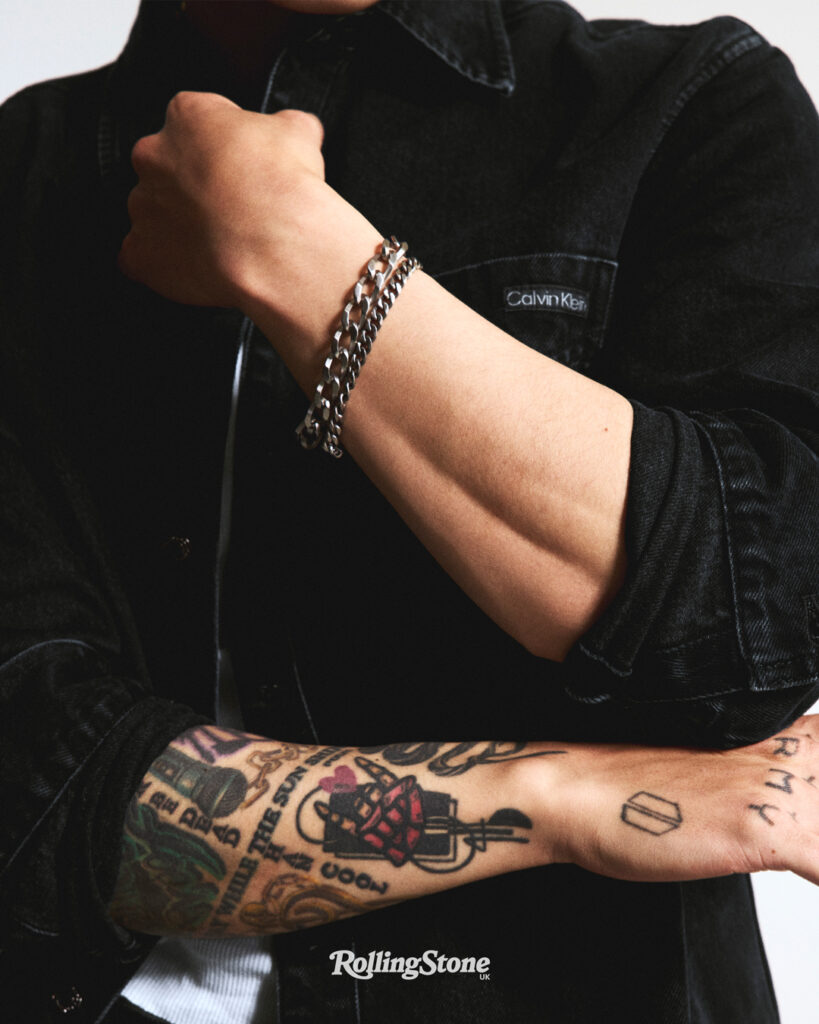
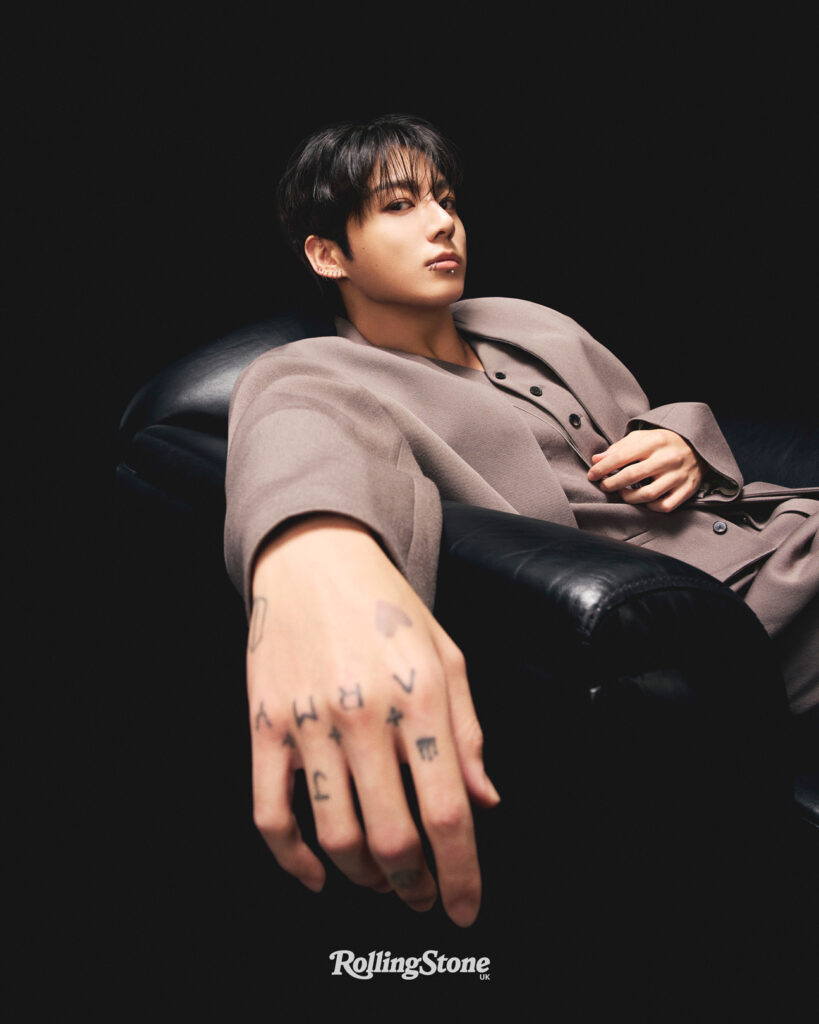
Today, the teenager with wide, wondering eyes is long gone. In his place stands someone sharper, surer, more self-possessed: abs chiselled and arms inked in a burst of colour that climbs from his fingers to his shoulder. A snake coils around his right forearm; beneath it, veins trace the map of years spent in motion, the discipline of performance etched into skin. Each tattoo feels like another mark of ownership.
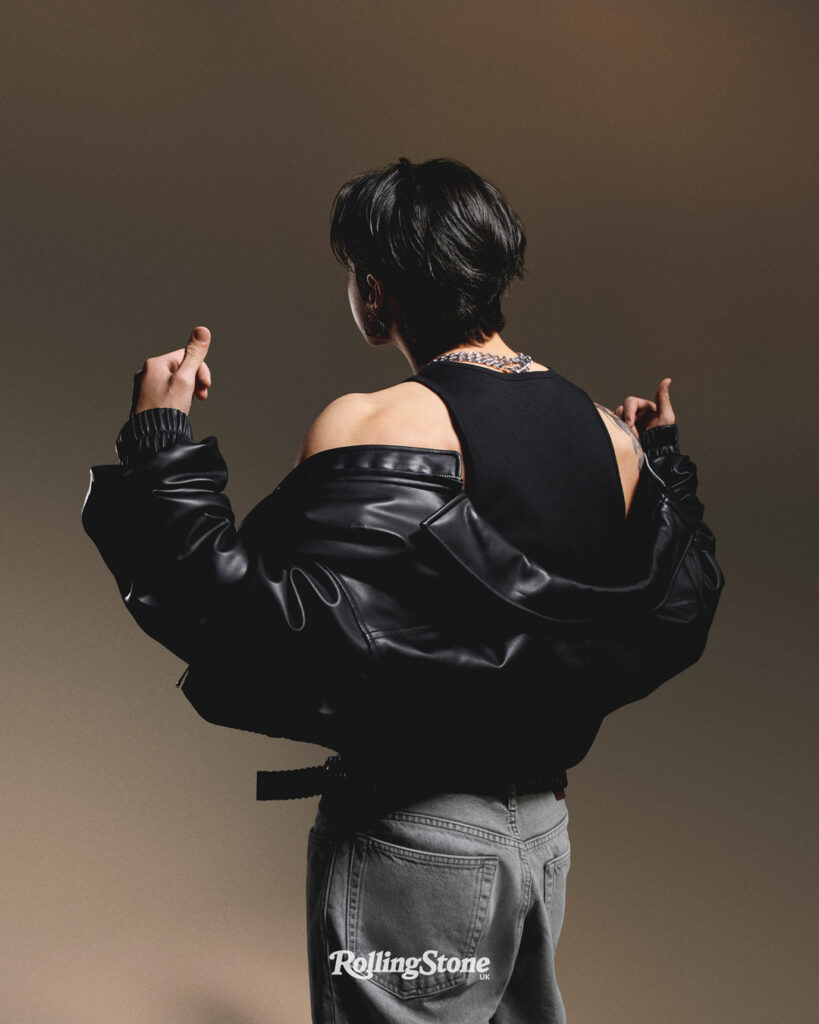
Even here, dressed in a leather jacket, black tank and light-wash jeans by Calvin Klein, Jung Kook commands attention without asking for it. The cameras click, and he hardly needs direction: the years have taught him what the light wants. “We waited 18 months for him,” someone from Calvin Klein says on set. So did the rest of the world.
For a decade, that world watched him grow up in real time. The shift wasn’t sudden, but cumulative: a slow claiming of space, an unlearning of permission. His transformation – the tattoos, the muscle, the unguarded gaze – isn’t rebellion so much as reclamation. It’s the body catching up with the person inside it.
These days, that discipline has turned inwards. “I’ve been trying to focus more on my health,” he says. “I’ve been doing a lot of physical activities like badminton, bowling and jogging.” It sounds almost ordinary until you realise how rare it is for him to speak about the quiet parts of his life. He doesn’t even listen to music while exercising. “I prefer to focus entirely on myself.”
The way he talks about health feels like a philosophy. “Before and after my military service, the depth of my thoughts has changed,” he says. “My attitude towards time has shifted as well. I try to avoid things that are bad for my body. I used to drink [alcohol], but now I’m trying to refrain from it. I want to use my time more meaningfully and cherish it.”
His life now revolves around rhythm and repetition, and the small, steady acts that make him feel anchored. “Doing something consistently, even if it’s small, is more important than making a big effort just once,” he says. “Every morning before I take a shower, I do some cardio, and I do the same thing before bed. That routine changes the way I approach people, the way I approach food. It gives me a sense of accomplishment and confidence because I stuck to my routine for the day.”
Discipline, for Jung Kook, isn’t about control so much as clarity. When asked if he feels closer to himself these days, he pauses. “Honestly, I don’t think I’m that close to myself yet,” he admits, matter-of-factly. “But hearing this question makes me realise I need to love and care for myself more. Exercising and maintaining healthy habits – that’s part of the routine of loving myself.”
Ask Jung Kook what inspires him these days, and he doesn’t hesitate: “I’m not the type to easily find inspiration from just anywhere. When I’m moved by a piece of art, I tend to apply that feeling within the same field rather than translating it into another area,” he says.
He’s drawn to romance, not in a sentimental way, but in how emotion can be expressed simply. “I really enjoy romantic movies like La La Land, Titanic and The Notebook,” he says. “When someone asks, ‘What is art?’ I don’t think it has to be something grand or magnificent. I think art is just something created by someone who wants to make it. It’s the result of that process, something you enjoy.”
After GOLDEN came stillness. In South Korea, all men aged 18 to 28 must complete 18 to 21 months of mandatory military service. Jung Kook’s enlistment in December 2023 forced him to stop – no cameras, no stages, no music to chase. “During my time in the military, I couldn’t work on music even when I wanted to,” he says. “That built up a sense of longing. It made me want to do better and deliver something great.” The discipline was familiar, but the quiet was not. For the first time since he was a teenager, Jung Kook had to live without an audience.
Now, back in motion, he’s rediscovering rhythm, both literally and figuratively. He’s currently in the studio with his bandmates, “preparing for the upcoming BTS album”.
“I’m really looking forward to the next BTS album, the promotions I’ll do with the members, and being able to meet ARMY [BTS’ official fandom] again,” he says. “I’m also excited for the work I’ll do as a solo artist. I want to learn more about dance and improve, especially in street dance.”
Even in the rare pauses between projects, Jung Kook doesn’t idle. He’s rehearsing, recording, chasing new experiences, constantly testing where the next step might lead. “I’ve always pursued change,” he explains. That drive isn’t frantic; it’s focused. He’s learned to move with intention, to create his own rhythm instead of being swept up in someone else’s. “I want to be an artist who doesn’t get dragged by the flow, but creates the flow,” he says. “I don’t want to be confined – I want to be an artist without limits.”
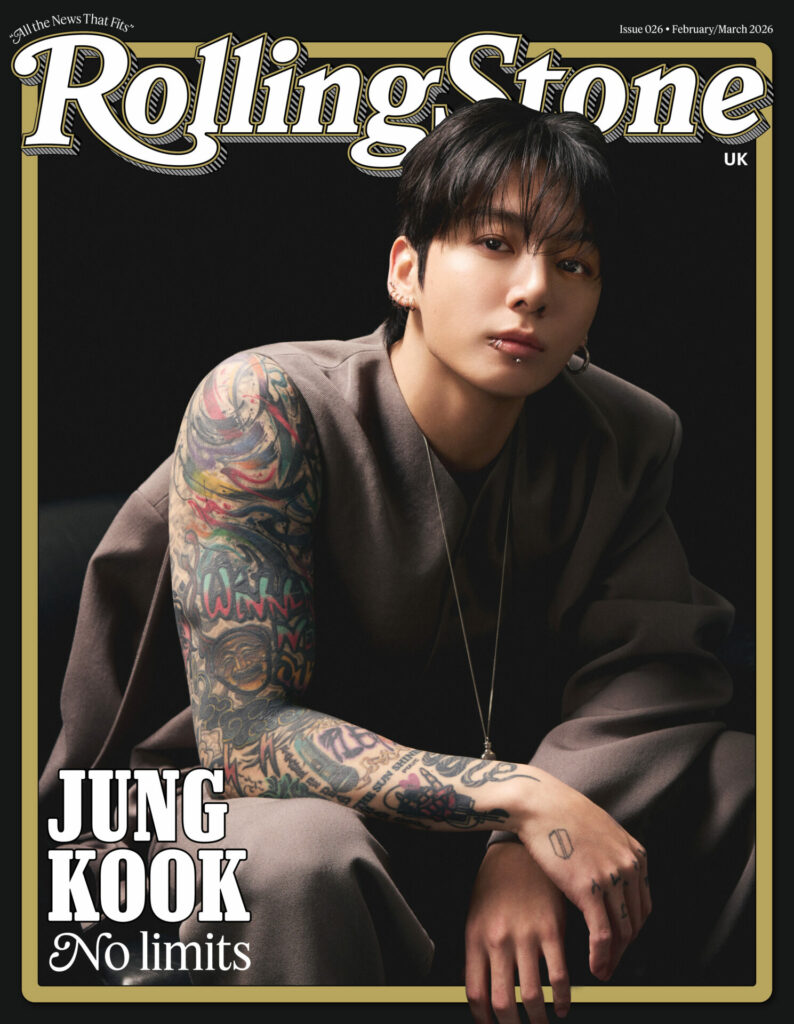
Taken from Issue 026 of Rolling Stone UK. You can buy Jung Kook’s cover here.
Credits: Styling by Kim Youngjin
Makeup by Kim Dareum
Hair by Park Naejoo
Chief producer: Kanako Mori
Production coordinator: Kary H.Rho (Suddenly Pictures)
Post production by Mari Ohara
Interpreter/Interview: Haye Lee
Special thanks: Jacky (Calvin Klein)