To most college football fans, the most surprising turnaround story in recent years is Indiana, which routed Alabama 38-3 in the Rose Bowl to reach the College Football Playoff semifinals.
But a more surprising turnaround might actually have taken place a few hours farther north. University of Wisconsin-River Falls, a program that had posted 19 consecutive losing seasons entering 2021, will play in the Division III national championship Sunday, capping off its first playoff trip since 1996. The conference’s smallest school is led by the fastest and most prolific offense in all of college football.
UW-River Falls averages 564.1 yards of offense per game, the most of any team in any division of NCAA football. Entering November, the Falcons were averaging over 600 yards per game. On Sunday night, they face off against the newest Division III dynasty, North Central (Ill.), which has won three of the past five national championships.
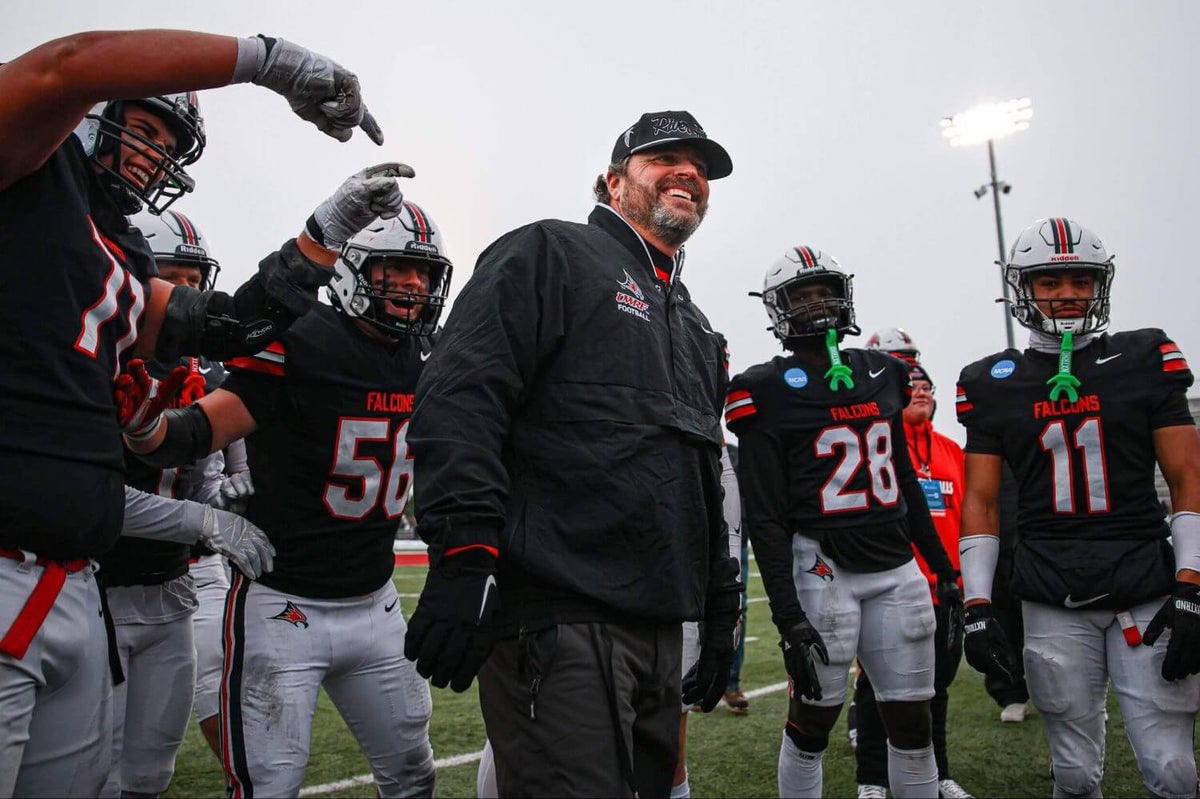
“I can say ‘joke’ now, but I joke I should’ve been fired three times,” head coach Matt Walker said, referring to the nine losing seasons that began his 15-year tenure. “Those were some long, hard nights and years.”
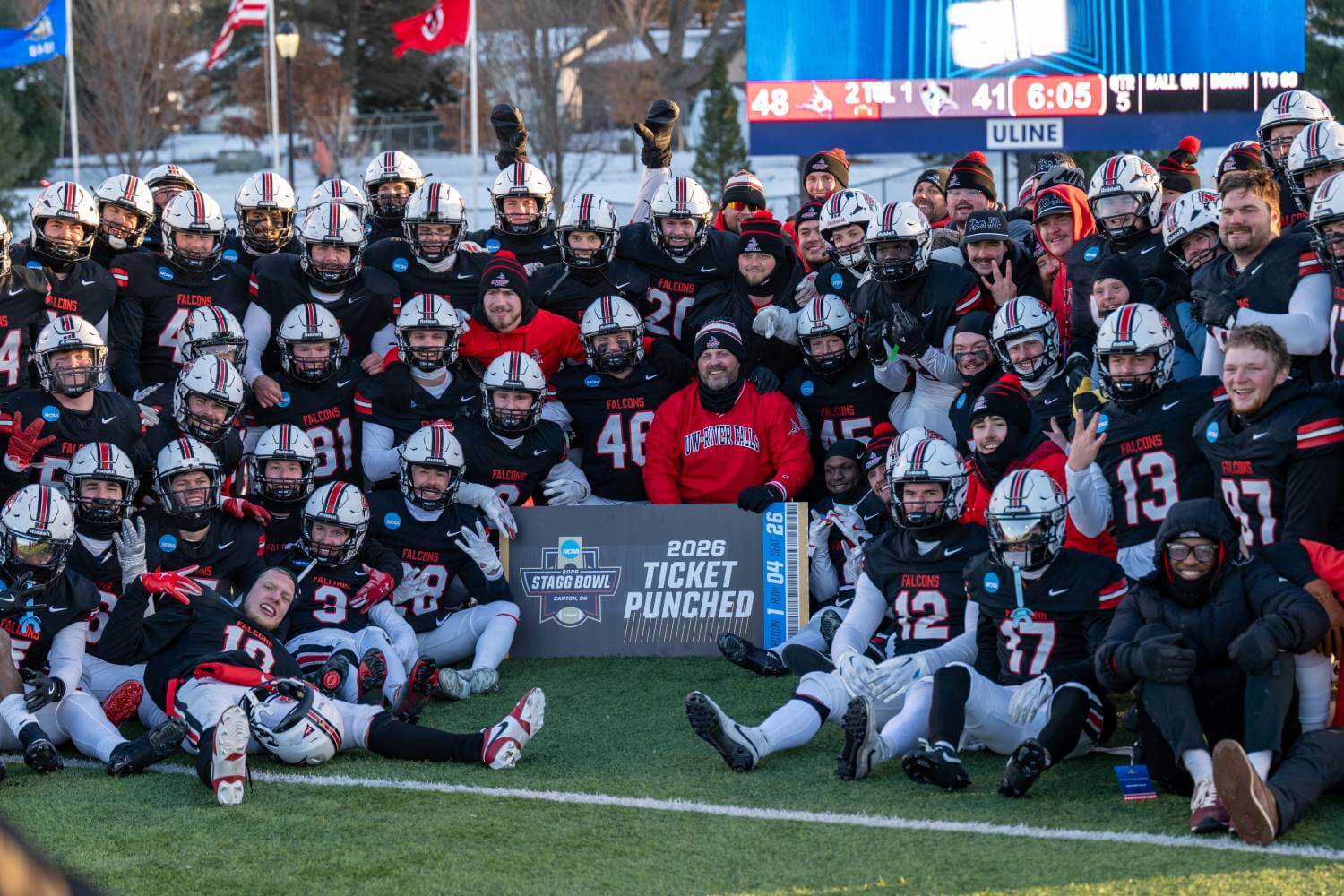
UWRF beat Johns Hopkins 48-41 to earn a trip to the Stagg Bowl, Division III’s national championship game. (Courtesy of UWRF Athletics)
UW-River Falls plays in the Wisconsin Intercollegiate Athletic Conference, the SEC of Division III. It’s where Lance Leipold’s Wisconsin-Whitewater dynasty sprouted more than a decade ago. Walker wanted to coach at the highest level, which is why he left DePauw to take over a downtrodden program at a school with fewer than 5,300 students (Whitewater has more than 12,000). His first 10 years featured a winless season in 2013 and a 2-8 record in 2019. So Walker decided he had to get bold, making a pair of moves that changed everything.
First, he moved his offensive coordinator, Jake Wissing, to defensive coordinator. Wissing is Walker’s most trusted confidant, a longtime assistant and former player for Walker.
Then Walker promoted 26-year-old wide receivers coach Joe Matheson to offensive coordinator. The pandemic-canceled 2020 season proved to be a blessing in disguise. Walker wanted to move to an all-out up-tempo offense, and the lack of a season at the Division III level allowed more time to install and prepare the young Matheson’s “Top Gun” offense — even as Matheson was furloughed for a period.
“I knew early on he was going to be special with a unique mind,” Walker said. “As we talked football, we aligned, and we wanted to truly become the fastest team to ever play.”
UW-River Falls averages 85 offensive snaps per game, the most of any team this season across all NCAA divisions. For comparison, the most at the Football Bowl Subdivision level was 78.1, by Florida Atlantic. Matheson, a former high school center in Green Bay, was a student assistant for Jerry Kill at Minnesota in the mid-2010s. He pulled concepts from Noel Mazzone, Art Briles and others to put together an offense that utilizes run-pass option calls, the quarterback run game, wide splits from receivers, bunch formations, option-choice routes and all kinds of unique formations. With resources and personnel disadvantages compared to their conference rivals, they had to be different.
“It was desperation,” Matheson said. “If you have the personnel to run 12 personnel, that’s what you do. But we had to find ways to get our kids to success. People don’t understand how important it is to have a head coach that is willing to do crazy things.”
That approach has turned quarterback Kaleb Blaha into one of the most prolific players in college football. His 412.1 individual yards per game are second across all NCAA divisions, and he won the Gagliardi Trophy, the Division III version of the Heisman. Blaha played wide receiver at Division II Winona State for his first college season before transferring to UW-River Falls to get back to playing quarterback, not realizing the offense he’d be stepping into at his new school.
“When I first got here, it was tough to get used to because you practice so fast,” Blaha said. “But after a year, I had it down well. It’s an advantage for us because defenses get tired from playing so much.”
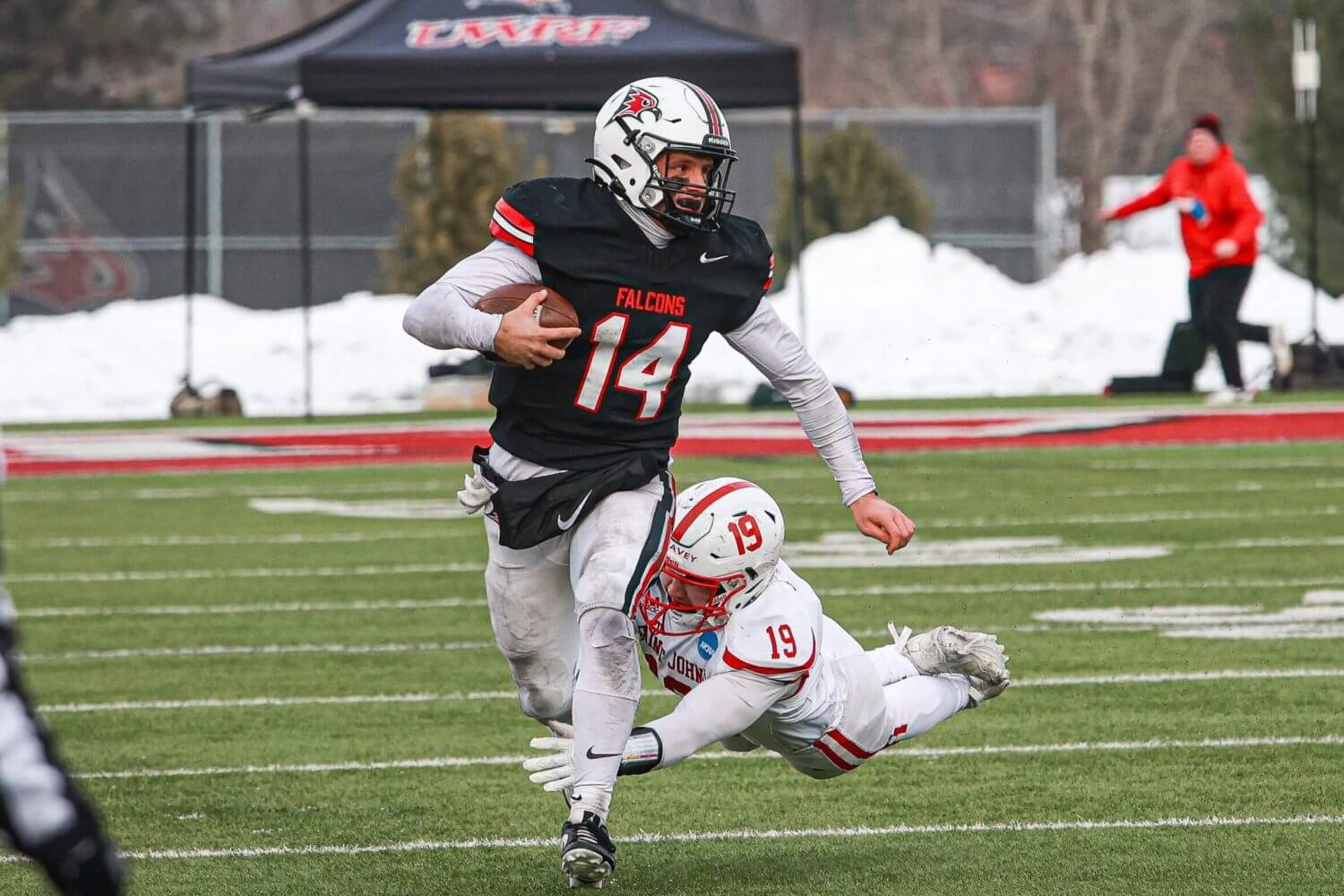
UWRF Kaleb Blaha has thrived at the helm of an offense the Falcons remade during a 2020 season canceled because of the pandemic. (Courtesy of UWRF Athletics)
Walker didn’t just make a scheme change. He found a way to get new players to River Falls. Most schools in the WIAC recruit from Chicago. UW-River Falls, however, sits just 45 minutes outside Minneapolis, across Wisconsin’s other state border. That’s always been a good area for talent, but just as importantly, it has also offered access to an airport.
The Falcons have 38 players from Wisconsin and 67 from Minnesota on their roster. But they also have seven from Arizona, including the team’s Nos. 3 and 4 receivers.
“We’re the only ones in our league with the airport that can truly do it, so let’s try it,” Walker said. “The flights to Arizona were direct and affordable, without Division III there. This became an easy decision to try Arizona.”
Coming out of the COVID-19 pandemic with a new look, UW-River Falls broke its 20-year streak of losing seasons with a 9-2 record in 2021, followed by three consecutive seven-win seasons. The breakthrough came this year. A 52-14 win over Whitewater on Nov. 1 opened the eyes of everyone in Division III.
“That was always the game we couldn’t get over the hump,” athletic director Crystal Lanning said. “We got that win, then the La Crosse win, and you knew something was different about this season.”
UW-River Falls won the WIAC for the first time since 1998, its first outright title since 1985, earning its first Division III playoff appearance since 1996. The momentum has continued in the postseason, as the Falcons have scored at least 42 points in all four playoff wins.
But North Central is a juggernaut, and Division III’s No. 1 scoring offense at 49.4 points per game, only behind Division II champion Ferris State nationally. (UW-River Falls is fifth in D-III in scoring.) Division III has gone through plenty of dynasties in recent decades, like Mount Union, Whitewater, Mary Hardin-Baylor and now North Central, which is in the title game for the sixth year in a row.
The task is tall. But when considering where UW-River Falls has come from, what’s one more mountain to climb?
“We were at rock bottom,” Walker said. “We had to rebuild the sucker up. Now we’ve busted our butts to flip it on its head.”