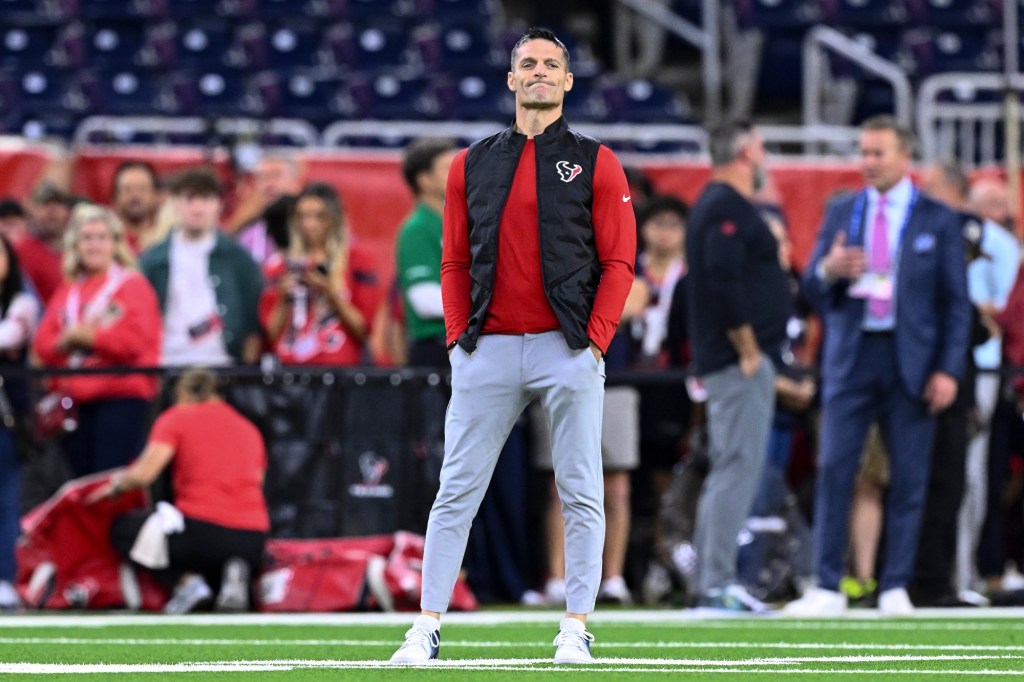
A decade ago, when the owner of an NFL team sized up San Diego City Hall’s ability to get a Chargers stadium built, he threw Texas-sized shade from Houston.
“In San Diego, they’ve been trying for about 15 years,” Texans owner Bob McNair told the Houston Chronicle in December 2015. “They’ve had all kinds of political problems there.”
Getting nasty about it, he mentioned a 2003 scandal involving three City Council members. Never mind that three were long gone.
“At one time, half the council went to jail or something,” said McNair, who was on an NFL stadium panel. “It’s been pretty bad. It’s hard to negotiate when you’ve got to go to the jail to negotiate. So, they haven’t accomplished anything.”
Then McNair canceled a meeting with San Diego Mayor Kevin Faulconer.
Lately, the Texans have again emerged as prominent in the Chargers’ universe, but it’s for a reason unrelated to the NFL’s brass-knuckles stadium politics.
The Texans have become their sharpest at football since McNair led them into the league in 2002.
They’ve won their past eight games as they head toward a third postseason in a row. And their long-term foundation has never been this sturdy. It can’t be lost on the AFC’s other playoff teams, including the now-Los Angeles Chargers, that the Texans are well-positioned to succeed in seasons ahead, too.
They boast three stars at premium spots who are just 24 years old in quarterback C.J. Stroud, cornerback Derek Stingley Jr. and edge rusher Will Anderson. Going into the next NFL draft, they have the best stash of picks among this year’s 14 playoff teams — four in the top 70, six before the fifth round and nine overall.
How did the Texans become so capable?
The key initial move was this one: CEO Cal McNair hired longtime Patriots personnel man Nick Caserio as the general manager in January 2021, two-plus years and a month after McNair’s father died at 81.
The Bill Belichick protege tree hadn’t impressed most NFL observers.
Caserio, 50, has been a shining exception.
Fourteen months into his tenure, Caserio traded scandal-plagued quarterback Deshaun Watson and a fourth-round pick to the Browns.
In return, he got three first-round picks, three other picks between the second and fourth rounds and ample salary-cap freedom.
Caserio took Stroud and Anderson second and third atop the 2023 draft, the latter after trading up, a move many draft analysts deemed too pricey.
Doubling down on Stroud after the Ohio State alum had a great rookie year, Caserio invested in three free-agent defenders who’ve all panned out — end Danielle Hunter, tackle Denico Autry and linebacker Azeez Al-Shaair.
The GM’s hire of DeMeco Ryans as a first-time head coach became another large win.
In the three seasons under Ryans, the Texans’ .620 win rate stands tied for seventh with Sean Payton’s Broncos. Ryans’ first two teams won a wild-card playoff game.
True to Ryans’ reputed defensive expertise, the Texans lead the NFL in fewest points, yards and first downs allowed.
Caserio spent 20 years under Belichick, mostly as a scout or a scouting executive. He was credited with large contributions to three of the Patriots’ six Super Bowl-winning seasons.
Uncommonly versatile, the former quarterback for Ohio’s John Carroll University coached Patriots receivers in 2007 when the offense set several NFL records. The offensive coordinator, Josh McDaniels, was a former teammate.
Brandin Cooks, a former Texans and Patriots receiver, described Caserio as having “no ego,” per ESPN. Patriots executives lauded him as “selfless” and “incredibly driven and intelligent” to NFL.com in 2013.
Belichick, a famously difficult boss to please, told the Boston Herald in 2014 that Caserio “probably does more than any other person in his position in the league in terms of his amount of responsibility, the number of different things he does on the coaching and the scouting level.”
Yet if they are to reach this year’s Super Bowl, the Texans will need to break out of character.
The franchise has never made it past the divisional round.
In the Texans’ two playoff losses under Ryans, to the Ravens and the Chiefs, their offense’s blocking breakdowns overly burdened the team’s defense.
This year’s offensive line is much less expensive.
Caserio’s trade of tackle Laremy Tunsil and a 2025 fourth-round pick to Washington freed up a needed cap space that can help secure Stroud and Anderson, who are first-time eligible for contract extensions this offseason. Because of Washington’s surprising falloff, the Texans got picks that will fall in the top half of the second and fourth rounds on top of two picks they made in March.
Rookie left tackle Aireontae Ersery, a second-round choice out of Minnesota, has panned out.
The blocking remains a concern, but an AFC-best defense can offset a lot. Stroud, whose salary cap charge is $35 million to $45 million less than those of Justin Herbert and Josh Allen this season, has already won two playoff games.
This team went 3-0 behind QB Davis Mills, Caserio’s first-ever Texans draftee, after Stroud was concussed. The Texans are a problem.