The rollout of the National Equipment Identity Register (NEIR) has uncovered the vast scale of mobile handset cloning in Bangladesh, with official data showing that tens of millions of devices have been operating on local networks using fake or duplicated International Mobile Equipment Identity (IMEI) numbers.
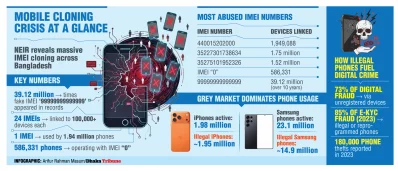
According to data generated after NEIR went live on January 1, a single IMEI, 440015202000, was found to be linked to 1,949,088 devices nationwide.
Several other IMEIs were also repeatedly detected across mobile networks.
One IMEI, 35227301738634, was associated with around 1.75 million devices, while 35275101952326 appeared on 1.52 million handsets.
Even more strikingly, a one-digit IMEI of “0” was found to be linked to 586,331 active devices.
NEIR data covering the past decade further reveal that the blatantly fake IMEI 99999999999999 appeared 39.12 million times across different combinations of document IDs, SIM numbers (MSISDNs) and device records.
The Bangladesh Telecommunication Regulatory Commission (BTRC) has also detected millions of devices operating with placeholder IMEIs such as “0000000000000”, “1111111111111” and “9999999999999” across all four mobile operators.
Despite the scale of the problem, authorities have said these devices will not be blocked immediately to avoid widespread public disruption.
Instead, such handsets will be marked as “grey”.
Faiz Ahmad Taiyeb, special assistant to the chief adviser on posts, telecommunications and ICT, said the government does not intend to take any sudden action that would inconvenience citizens.
“Millions of people are unknowingly using low-quality counterfeit phones,” he said.
“These devices never went through radiation or SAR testing, yet they are active across all networks. We will not shut them down now, only tag them as grey.”
He added that some duplicated IMEIs may belong to Internet of Things (IoT) devices such as CCTV systems, noting that operators historically could not distinguish between SIM-based mobile phones and IoT hardware.
BTRC has now begun separately tagging legally imported IoT devices.
Industrial-scale cloning
Officials said at least 24 fake or duplicate IMEIs have already been identified, each linked to more than 1,00,000 active devices.
Among them are IMEI 3546480200025, associated with 539,648 devices; 35868800000015 with 532,867; 86740002031661 with 463,107; 86740002031662 with 413,814; and 13579024681122 with 276,907 devices.
More than a dozen others fall within the 100,000 to 200,000 range, pointing to what officials describe as industrial-scale cloning.
“We knew clone phones were widespread, but we did not realize the depth of this crisis,” Taiyeb said.
“Selling counterfeit phones as ‘official new’ devices is an unimaginable and unprecedented deception. This network must be dismantled.”
The findings reinforce long-standing links between illegal handsets and crime.
A Bangladesh Bank report from 2024 shows that 73% of digital fraud occurs through unregistered devices, while joint BTRC–mobile financial service data indicate that 85% of e-KYC fraud in 2023 involved illegal or reprogrammed phones.
That year, some 180,000 phone thefts were officially reported, with most devices never recovered.
Sources said that of nearly 1.98 million iPhones active on local networks, around 1.95 million were not imported legally.
Similarly, of the 23.1 million Samsung phones in use, about 14.9 million are believed to have entered the market without paying taxes.
Analysts estimate that just 10 IMEIs account for nearly five million phones, highlighting the extent to which grey-market imports dominate the handset ecosystem.
The NEIR findings have also added context to the violent protests at the BTRC headquarters on January 1, when opponents of the system vandalized the regulator’s offices, arguing that high taxes, ranging from 35% to over 60%, push traders into the grey market.