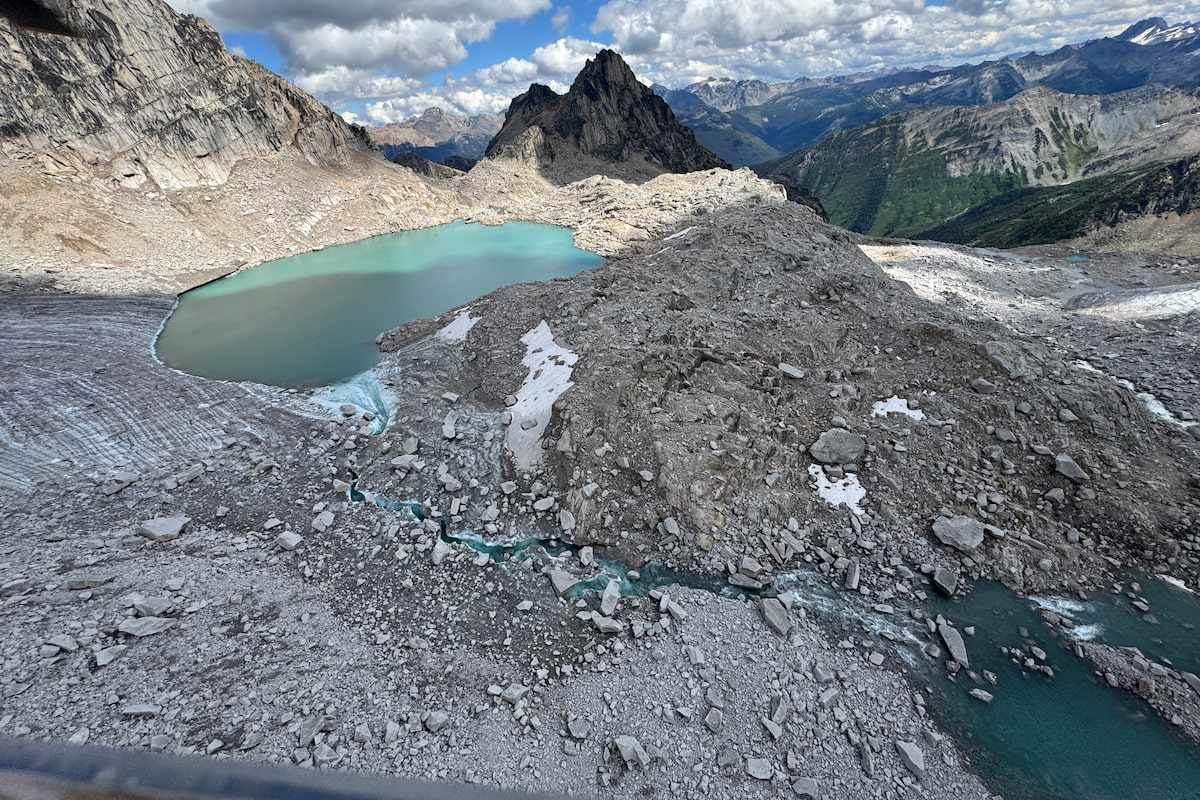
Helicopters rescued more than 60 hikers from Bugaboo Provincial Park after a glacial ice dam burst triggered a flash flood, destroying their only route out of the southeastern B.C. mountains, Aug. 17.Jordy Shepherd/Jordy Shepherd/ Columbia Valley SAR
More than 60 hikers and climbers were rescued by helicopter from Bugaboo Provincial Park in August after the glacial ice dam that held a lake gave way, unleashing a flash flood that destroyed their only path out of the mountains in southeastern B.C.
The dramatic ice-sculpted granite spires of the Bugaboos, with many peaks of more than 3,000 metres, draw climbers from around the world. However, the province’s shrinking glaciers mean increasing geohazards here, and elsewhere.
In 2025, glaciologists charted one of the worst years on record for shrinking glaciers in Western Canada, with an estimated 2.5 metres of water loss over the surface. That’s about 30 gigatonnes of mass, washed away.
It was the second worst year, after 2023, said Brian Menounos, a professor of Earth sciences at the University of Northern B.C. He was part of a research team that studied glacier mass in Western Canada, the U.S. and Switzerland over 2021-24.
With 2025 coming on the heels of all the other very bad years, it’s an alarming trend, he said.
It was also the United Nation’s ‘international year of glaciers preservation,’ and the year that scientists say is on track to be one of the warmest on record, resulting in climate disasters from wildfires in California to deadly floods in Asia.
“We are not preserving glaciers. In fact, we’re accelerating the loss,” said Menounos, who is also a chief scientist with the Hakai Institute, a non-profit research organization in the province.
Those findings dovetail with the U.S. National Oceanic and Atmospheric Administration’s latest Arctic Report Card, which confirms that the region has just logged its warmest year since 1900, bringing with it irreversible changes to Canada’s North.
Western Canada is home to more than 18,0000 individual glaciers, which are an integral part of aquatic ecosystems for marine life and human communities alike. Their loss is reshaping the landscape too.
In Bugaboo Provincial Park, which features several major glaciers, the government has hired a geotechnical consultant to assess the August flood. A similar incident in the park occurred in 2017, when the natural dam holding the side of a lake created by the fast-retreating Vowell Glacier suddenly failed, triggering a flood. The park declared an emergency, but no hikers were trapped.
Shrinking glaciers are also contributing to droughts, which are threatening fresh water supply in communities from Merritt, B.C. to Cowley, Alberta. When glaciers melt faster than they are replenished, the hydrologic cycles that reliably replenish fresh water supplies are disrupted.
British Columbia’s coastal range is home to significant glaciers, but scientists are measuring rapid loss of ice mass since the 1980s.Grant Callegari/Hakai Institute/Supplied
Scientists have warned mountain glaciers around the world are on track to lose half of their mass by the year 2100, threatening a critical water resource for nearly two-billion people around the globe.
Prof. Menounos says those estimates are starting to look optimistic, as recent trends point to acceleration.
His research team found a twofold increase in mass loss compared to the entire decade prior – making those four years their worst decline on record.
“We’re no longer on the gentle part of the hill. We’re on a much, much steeper portion of that hill. So we think that the projections perhaps are a bit too conservative, and that we will see disappearance of ice much, much quicker.”
In the meantime, emissions reduction efforts globally have stalled, with new climate plans delivering less than 15 per cent of the cuts needed to hold warming to 1.5 C. Fossil fuel emissions are the main drivers of climate change, but Alberta and British Columbia have embraced new fossil fuel development as seen in a number of initiatives this year.
British Columbia, home of North America’s first broad-based carbon tax, eliminated its consumer carbon tax effective April 1, ending 18 years of global leadership in the fight against climate change. This followed the federal Liberal government’s move to drop the national consumer carbon price, to ease financial strain on households.
Wildfire ash is accelerating glacier melt in the Canadian Rockies
Record Arctic warmth meets retreating climate action, leaving the North exposed
In June, tankers filled with liquified natural gas began travelling nearly 300 kilometres out of Douglas Channel, in B.C.’s central coast, to the ocean and towards Asia, marking the launch of the province’s LNG industry.
And in early December, Canada negotiated a framework with Alberta with a goal of building a new oil pipeline across northern B.C.
These developments didn’t change the weather, but they demonstrate a set of priorities that don’t fit with what climate scientists say is needed to slow global warming.
The Union of British Columbia Indian Chiefs, a political advocacy group for First Nations, is calling for greater investments in planning and monitoring, as the risk of geohazards and the potential disruption of aquatic ecosystems are keenly felt in Indigenous communities.
“It’s a call for collective action,” said Chief Marilyn Slett, UBCIC secretary-treasurer. “Governments must step up to ensure that glaciers, which are sacred to so many of our peoples, are studied, protected, and respected as part of our shared responsibility to future generations.”
Prof. Menounos said additional research is needed to look for opportunities to retain water for future needs, such as deepening lakes forming underneath glaciers. Geophysical surveys or modelling can help identify those potential sources.
“How are we going to actually come up with a strategy to deal with this loss, not just watch it disappear?”