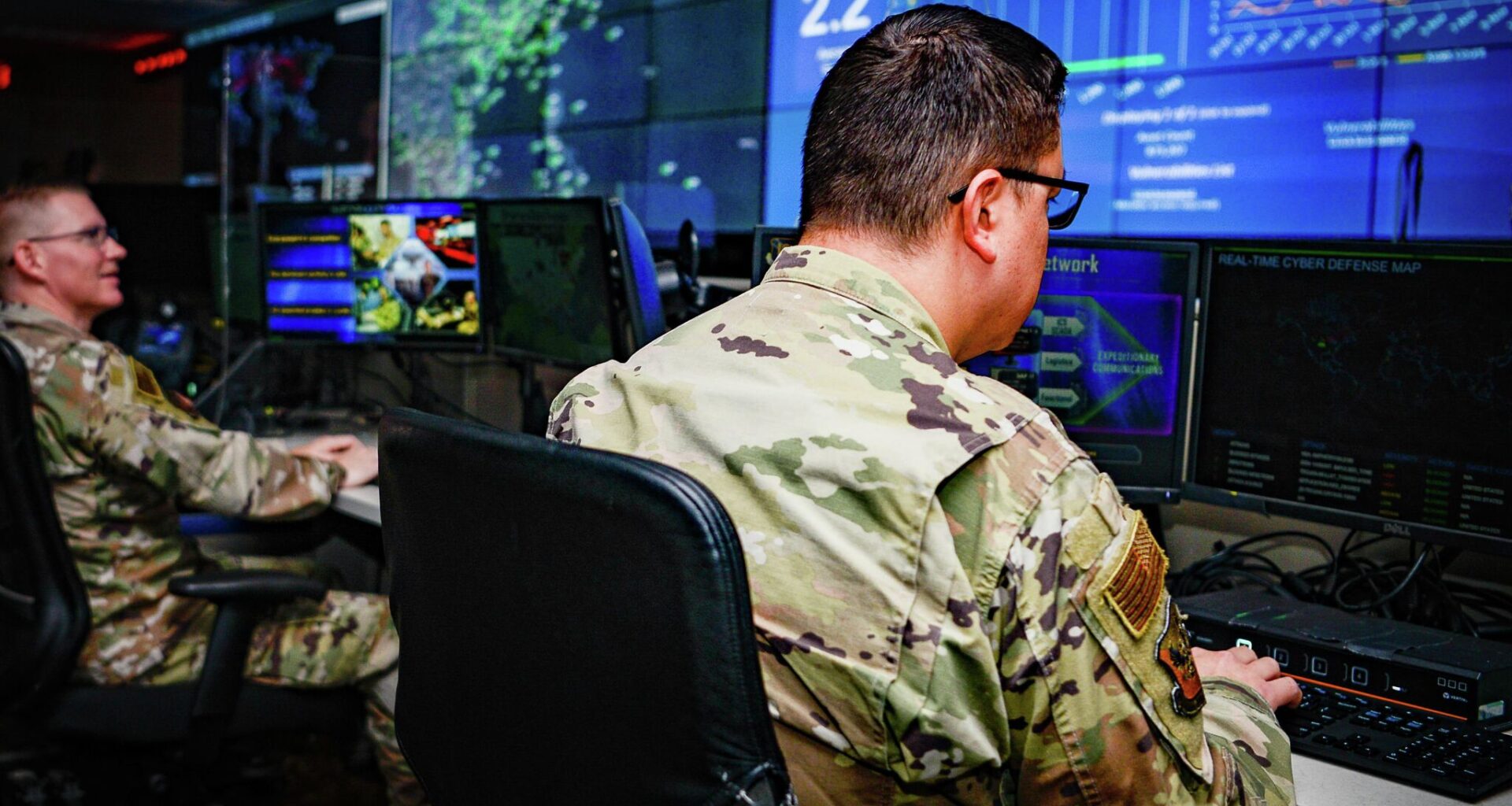
16th Air Force airmen in the 616th Operations Center at Joint Base San Antonio-Lackland. The operations center is 16th Air Force’s Information Warfare Command and Control unit consisting of experts in intelligence, surveillance and reconnaissance, electromagnetic spectrum, cyber and information operations.
Sharon Singleton/16th Air Force
Defense Secretary Pete Hegseth’s Pentagon shakeup, which has already gutted two Army headquarters in San Antonio, has led the Air Force to scuttle a plan to elevate the status of its cyber and intelligence hub on Lackland Air Force Base.

A pending decision on the plan had been cited as a reason for delaying consideration of Port San Antonio’s proposal to build the unit a new $1 billion-plus facility to replace its crumbling 71-year-old headquarters.
Article continues below this ad
While no missions or people will leave San Antonio because of the decision against elevating Air Forces Cyber into a so-called component command, it leaves the information warfare hub — and its 4,850 local workers — wondering if it will get new facilities for work that’s important to national security. The current headquarters is plagued with troubled heating, ventilation and air conditioning systems, shifting floors and cracked walls.
The move could have brought a more senior commander, additional jobs and cut out a layer of bureaucracy between its leaders and the service’s top brass.
RELATED:Air Force grapples with future of its San Antonio-based cyber war headquarters
Despite the delays and policy questions, the head of Port San Antonio remains undeterred in his vision to create a new home for Air Forces Cyber, also known as 16th Air Force, on the Southwest Side tech campus.
Article continues below this ad
A conceptual rendering of a 16th Air Force campus proposed at Port San Antonio. At far left, the existing Boeing Center at Tech Port can be seen. At center right in white is what the Port is now calling Innovation Tower, a new office building it’s working to develop.
Port San Antonio
“These things will eventually work themselves out,” Jim Perschbach, Port San Antonio’s president and CEO, said last month. “From our perspective, it doesn’t really impact us.”
The port, he said, is ready to build a new cyber campus for the military in whichever form it may take. But the back and forth has only slowed the notoriously slow processes to get new military infrastructure.
READ MORE:Port San Antonio snubbed: Abbott vetoes $50M for military cyber campus
Article continues below this ad
The shift is another effect of Trump administration policy changes under Hegseth’s defense department that are impacting Texas.
Last month, the Army said most of its soldiers and civilians working at Army North and Army South on Joint Base San Antonio-Fort Sam Houston would be leaving for Fort Bragg, North Carolina, as part of a reorganization creating a new Western Hemisphere Command.
22 months
Since at least February 2024, Perschbach has been pitching the idea to use a public-private partnership with the Pentagon to build a campus for Air Forces Cyber and its partner agencies on the site formerly known as Kelly Air Force Base.
Article continues below this ad
He’s said, and Texas elected officials have appeared to agree, that the plan to use an intergovernmental support agreement to fund and construct the facility could save taxpayers as much as $1.4 billion on a new headquarters.
Jim Perschbach, president and CEO of Port San Antonio, speaks during a panel discussion about the future of mobility.
Jessica Phelps/Staff photographer
The Air Force was interested, discussing the matter at meetings in Washington and responding in writing to Texas congressmen last August that it expected to complete its review that November.
CYBERCITY USA:Texas Cyber Command setting up temporarily at UT San Antonio’s downtown campus
Article continues below this ad
At the time, U.S. Rep. Tony Gonzalez warned the Air Force to decide quickly, saying “the time for waiting is over,” likely an effort to get it done before the Trump administration would shakeup policies from the Biden era.
“The men and women performing one of the nation’s most important missions deserve an updated work environment and time is of the essence,” the San Antonio Republican said at the time. “I … worry the Air Force’s ongoing organization restructure will delay their strategic plan for future installations, thus leaving the decision in limbo for years to come.”
But November 2024 came and went with discussions halted amid the decision-making doldrums before a new administration took over.
The Air Force had remained mum on a new Air Forces Cyber campus since President Donald Trump took office a year ago.
Article continues below this ad
Earlier last year, Texas lawmakers tried to sweeten the deal with the promise of $50 million to help fund construction of the campus if the military agreed to move it to the port. Gov. Greg Abbott vetoed that proposal.
Caught in the middle
Looming in the background of discussions over the future of the 16th Air Force is a larger debate on the future of how the military organizes its cyber forces.
U.S. Secretary of War Pete Hegseth speaks to senior military leaders in September at Marine Corps Base Quantico.
Andrew Harnik/Getty Images
Congress has mandated a study into creating a new military branch focused on cyber but at least two former leaders of U.S. Cyber Command have argued that would take too long, create unnecessary bureaucracy and confusion.
Article continues below this ad
Former spy agency chief retired Air Force Gen. Timothy Haugh, said reforms to the military’s cyber forces rolled out by Hegseth last year need more time. He was sacked from his job as head of the National Security Agency and U.S. Cyber Command in April after far-right conspiracy theorist Laura Loomer recommended his ouster to Trump.
CYBER DRAMA:Trump fires spy chief with San Antonio ties after Laura Loomer meeting
“We should start with the steps that can be done aggressively with the least cost and the most rapid return,” he said in testimony to the National Academies’ committee conducting the study, according to Air & Space Forces Magazine. “We want to be focused on producing more tooth and not focused on growing bureaucracy.”
Hegseth’s rejiggering of Pentagon policies also led the Air Force to abandon much of its Biden-era plan to reorganize the force to be better prepared for war against Russia or China. Some of the decisions were implemented but many remained to be carried out.
Article continues below this ad
US Air Force Gen. Timothy Haugh testifies during a 2024 Senate Select Committee on Intelligence hearing in Washington.
MANDEL NGAN/AFP via Getty Images
Last month, the service updated the status of its so-called “reoptimization,” laying out which measures would be continued or “terminated.” It said that since the program’s announcement in March 2024, “fluctuations in priorities, resources, and methods have led to significant changes.”
Among those terminated were several moves to elevate other commands, but Air Forces Cyber was missing from the list.
But the service has since confirmed it will maintain its status as what’s known as a numbered Air Force.
Article continues below this ad
For his part, a hopeful Perschbach said his conversations with the Air Force continue. He’s looking forward to working with Michael Borders, the nominated Assistant Secretary of the Air Force for Energy Installations and Environment, who is awaiting Senate confirmation.
“We’re optimistic that we’ll have a relatively early conversation with him,” Perschbach said. “He is the the owner of a lot of these decisions.”
A look at the 16th Air Force complex from the air. The building sits on a slightly elevated part of Joint base San Antonio-Lackland that is often called Security Hill. The 16th is in the building on the lower left hand side of the photo.
U.S. Air Force