On Saturday, the United States captured the Venezuelan president, Nicolás Maduro, and took him to New York to face criminal charges. American special operations forces seized Mr. Maduro with the help of a C.I.A. source within the Venezuelan government who had monitored his location in recent days, according to people briefed on the operation.
Initial strikes
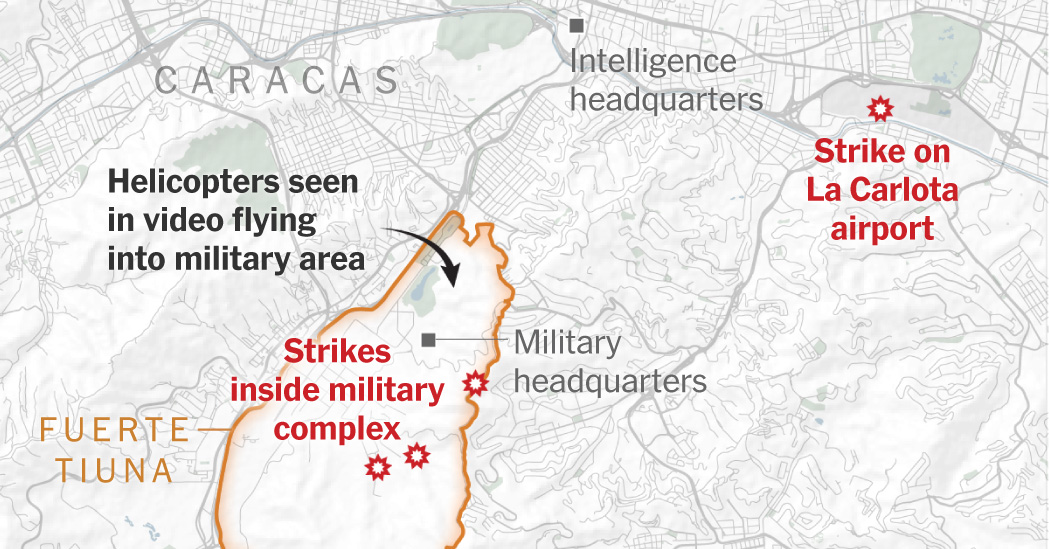
Early Saturday, around 2 a.m. local time, U.S. forces struck multiple locations in northern Venezuela, including in the country’s capital, Caracas, to suppress air defenses and clear a pathway for the U.S. helicopters to reach Mr. Maduro. The Venezuelan government declared a national state of emergency in response to the attacks.
Locations of known strikes
Eyewitnesses reported hearing explosions in Fuerte Tiuna, a sprawling military base in the center of Caracas that is home to Venezuela’s top brass and many senior government officials, and where Mr. Maduro was suspected to be located. A photo shows the military site burning early on Saturday morning, after multiple locations nearby were targeted.
A video verified by The New York Times shows smoke billowing near La Carlota Airport in Caracas as explosions ring out.
Other witness reports and verified videos indicate that the La Guaira port and the Higuerote Airport were also struck.
At least 40 people, including civilians and soldiers, were killed in the attack, according to a senior Venezuelan official, who spoke on the condition of anonymity to describe preliminary reports.
Capturing Maduro
Gen. Dan Caine, the chairman of the Joint Chiefs of Staff, said forces arrived at Maduro’s compound at 2:01 a.m. local time and were back “over the water” at 4:29 a.m. “with indicted persons on board.”
Locations of known strikes
A video verified by The Times shows fires burning in Caracas and helicopters descending towards Fuerte Tiuna, said to be taken at 1:58 a.m.
In a press conference late Saturday morning, President Trump said that no American troops had been killed and that no military equipment had been lost during the operation. Separately, two military sources said that six U.S. forces had been injured in the operation.
Mr. Trump said that Mr. Maduro and Ms. Flores had been taken to the U.S.S. Iwo Jima, one of the American warships that have been prowling the Caribbean, and would be taken to New York.
The Iwo Jima was sailing about 100 miles off the coast of Venezuela at 11 a.m., according to a satellite image taken by the European Space Agency’s Sentinel-2 satellite.
The ship was accompanied by at least seven other Navy vessels, including the MV Ocean Trader, which can act as a special operations mothership capable of deploying helicopters, small boats, and drones. Four other vessels were equipped with long-range missiles.
The couple was then transferred to the United States via the U.S. Navy base at Guantánamo Bay, where the F.B.I. had a 757 government plane waiting on the airstrip to bring them to Stewart Air National Guard Base, north of New York City.
Transferring Maduro to detention
After Mr. Maduro landed in New York on Saturday afternoon, a law enforcement official with knowledge of his movements but who was not authorized to speak about the matter, said he arrived in Manhattan by helicopter just before 7 p.m. and was driven to the U.S. Drug Enforcement Administration’s New York City headquarters.
Mr. Maduro was then flown by helicopter from Manhattan to Brooklyn and driven to the Metropolitan Detention Center, where he is expected to be held.
Mr. Maduro faces a new indictment in the Southern District of New York that charges him with narco-terrorism and conspiracy to import cocaine. He was first indicted in 2020 during Mr. Trump’s first administration on similar charges. It is not yet known when he might make his first court appearance.