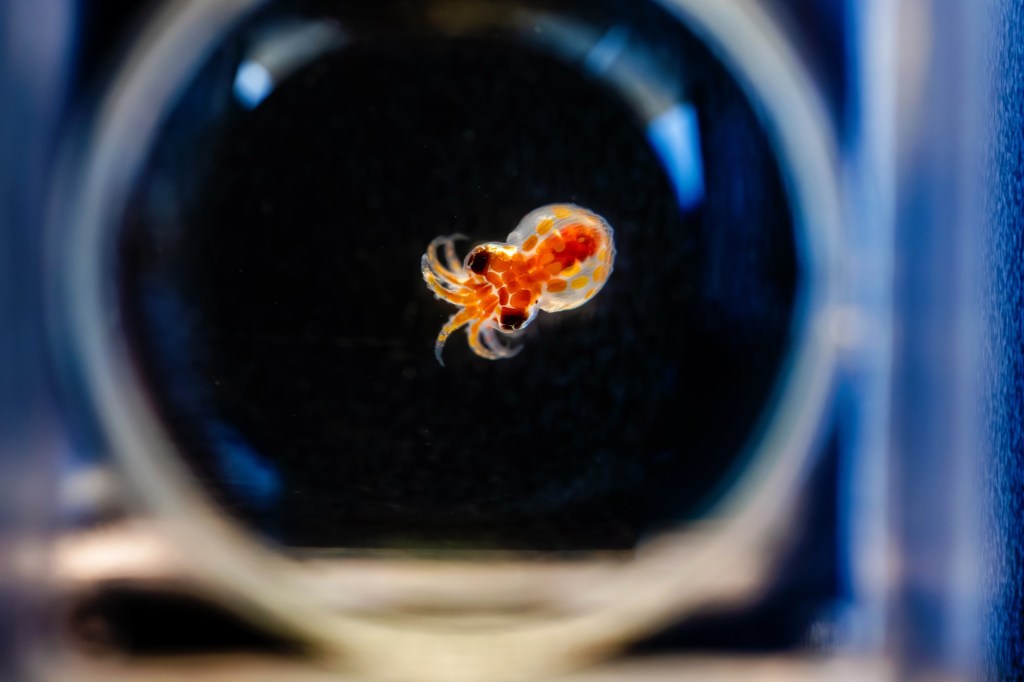
A surprise discovery at Birch Aquarium in La Jolla is shedding new light and providing first-of-its-kind information about what researchers call a mysterious octopus species that typically is in deeper waters away from human eyes.
Last year, the aquarium celebrated the hatching of more than 3,000 red octopuses after discovering eggs hidden in a tank out of public view. The mother octopus laid her eggs June 7, and they completed hatching Oct. 16.
“The discovery of the eggs was a complete surprise,” said Maddy Tracewell, senior aquarist for animal health at Birch Aquarium. “One day I looked in [the octopus’s] habitat and saw a cluster of eggs attached to the side of the acrylic [tank]. There were thousands upon thousands of tiny eggs. I was super impressed that she was able to attach the egg chains [also known as festoons] to the smooth acrylic. I’ve only ever seen festoons attached to rocky surfaces deep inside of a den. … Never in a million years did I think the eggs were fertilized, but I left them with her just in case.”
Soon after, Tracewell saw what is known as “eye spots” in the eggs, indicating that not only were they fertilized, they were developing. The team now believes a male fertilized the eggs before the octopus arrived at the aquarium.
With little information about how to raise red octopuses, Tracewell began researching how to care for them. In doing so, she learned the red octopus is what is known as a “small-egged” species.
“This means they lay thousands of small-size eggs,” Tracewell said. Each one is slightly smaller than a grain of rice.
“Once the eggs hatch, the octopus babies are known as paralarvae and they spend the first stage of their life suspended in the water column drifting with the ocean currents. After a few months, they morph into what we recognize to be an octopus and settle to the bottom.
“This varies drastically from ‘large-egged’ species, which lay large-size eggs and far less of them. When these large-size eggs hatch, the babies already look like miniature adult octopuses and immediately settle to the bottom. It is much easier to raise large-egged species because it is more or less like taking care of a very small octopus.”
Tracewell also realized how little information there was — “almost zero literature,” she said — on how to raise the paralarvae.
“I reached out to many different colleagues and they echoed the same sentiment,” she said. “So although I was very excited to have fertilized eggs, realizing that no one has reared them before felt very daunting.”
The egg hatch success rate is usually dependent on the mom, so the team set out to regulate the water temperature and make the area as suitable as possible for her.
“During the incubation, the mom will sit on the eggs to protect them from predators and aerate them to keep them clean,” Tracewell said. “During incubation, the moms devote all their energy and resources into guarding their eggs.”
Soon, Tracewell started to notice changes in the eggs as they developed, indicating the process was working.
A red octopus has three hearts — one that pumps blood through the body and two that pump blood through the gills. It also can change colors quickly to yellow, brown, white or a variety.
“Some of the coolest moments of watching the eggs develop were seeing all three individual hearts beating and then seeing the color-changing cells fire for the first time,” she said. “I definitely nerded out with every step of the transformation. Seeing the ink sac develop, seeing their eyes move for the first time were all exciting.”
With the eggs hatched, the baby octopuses will remain behind the scenes as they continue to grow. The species can reach up to about 20 inches long.
Now the next phase of waiting and observation begins.
“The red octopus paralarvae are 3 months old now, which is very exciting and a huge milestone. However, the true celebration will be when the paralarvae successfully morph into bottom-dwelling octopuses,” Tracewell said. “I’m currently seeing some behavior that suggests they are beginning that transformation, but I think we are still one to two months away from a complete settlement. That will be when the real party happens.”
“There are other species of small-egged octopuses that have been successfully reared … but as far as I know, it would be a first for the red octopus,” Tracewell added. “It’s not a species that humans encounter frequently. By creating a red octopus rearing program, this could be an exciting opportunity to learn more about this mysterious species.” ♦