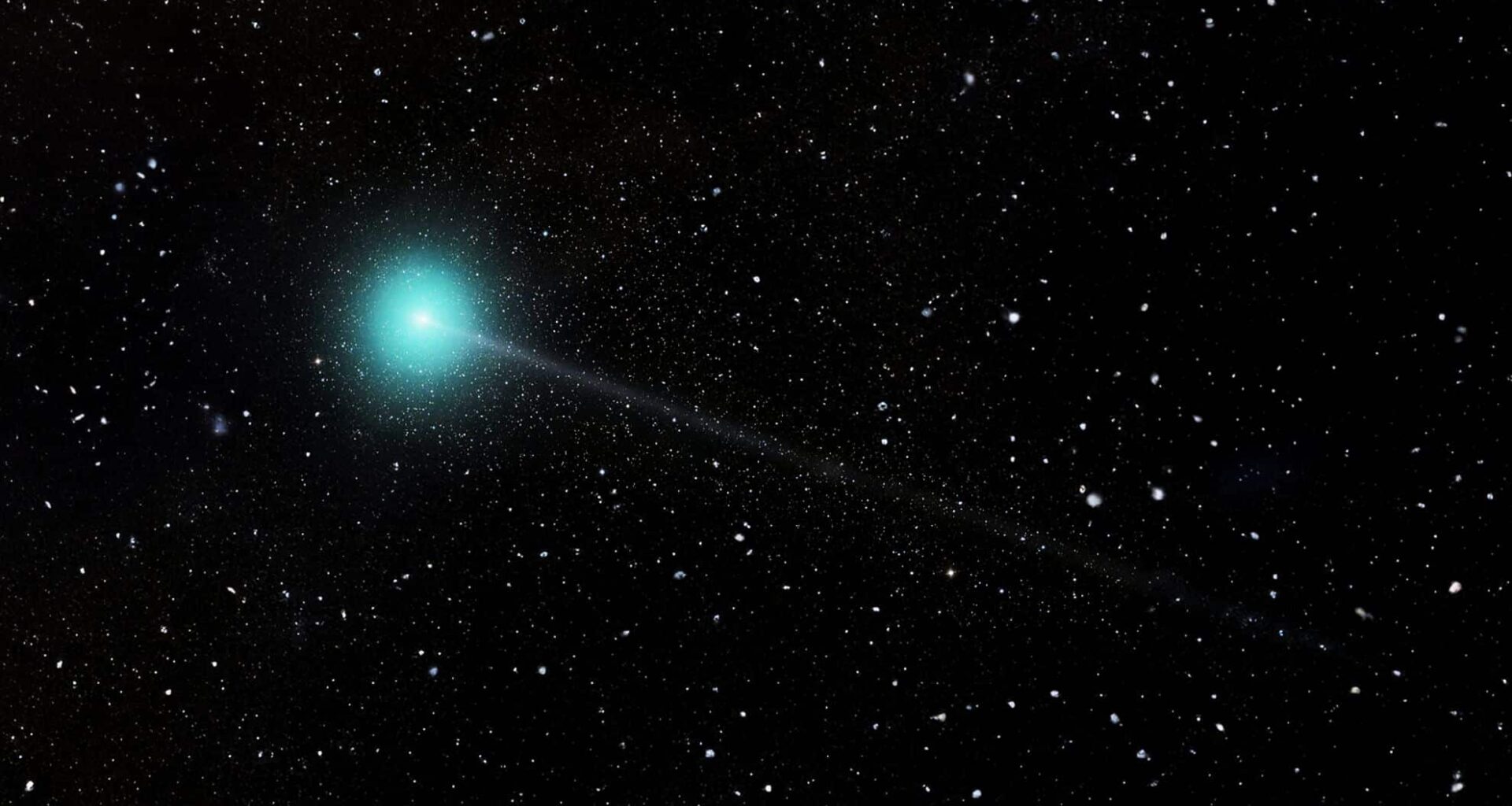
While its fate remains uncertain, this long-period comet’s trajectory and brightness are generating significant interest among astronomers and space enthusiasts alike. After a flurry of bright comets in 2024 and 2025, the arrival of C/2025 R3 could continue the streak of noteworthy cosmic events that have captivated observers across the globe.
The comet was first spotted on September 8, 2025, by Pan-STARRS, a sky-surveying project based atop Haleakalā volcano in Hawaii. Shortly after its discovery, astronomers at Mauna Kea confirmed its orbit using the Canada-France-Hawaii Telescope, giving researchers a clearer idea of its upcoming path through the inner solar system. With its perihelion (the closest point to the sun) falling in mid-April, anticipation is growing for how visible and impressive the comet may become during its journey.
A Promising Approach Between Earth and Sun
Comet C/2025 R3 will pass 47.4 million miles (76.3 million kilometers) from the sun at its closest point on April 20, according to observations reported by Space. Its closest approach to Earth occurs a week later, on April 27, when it will be within 44 million miles (70.8 million kilometers) of the planet. These distances place the comet between the orbits of Mercury and Venus, providing potentially favorable geometry for skywatchers.
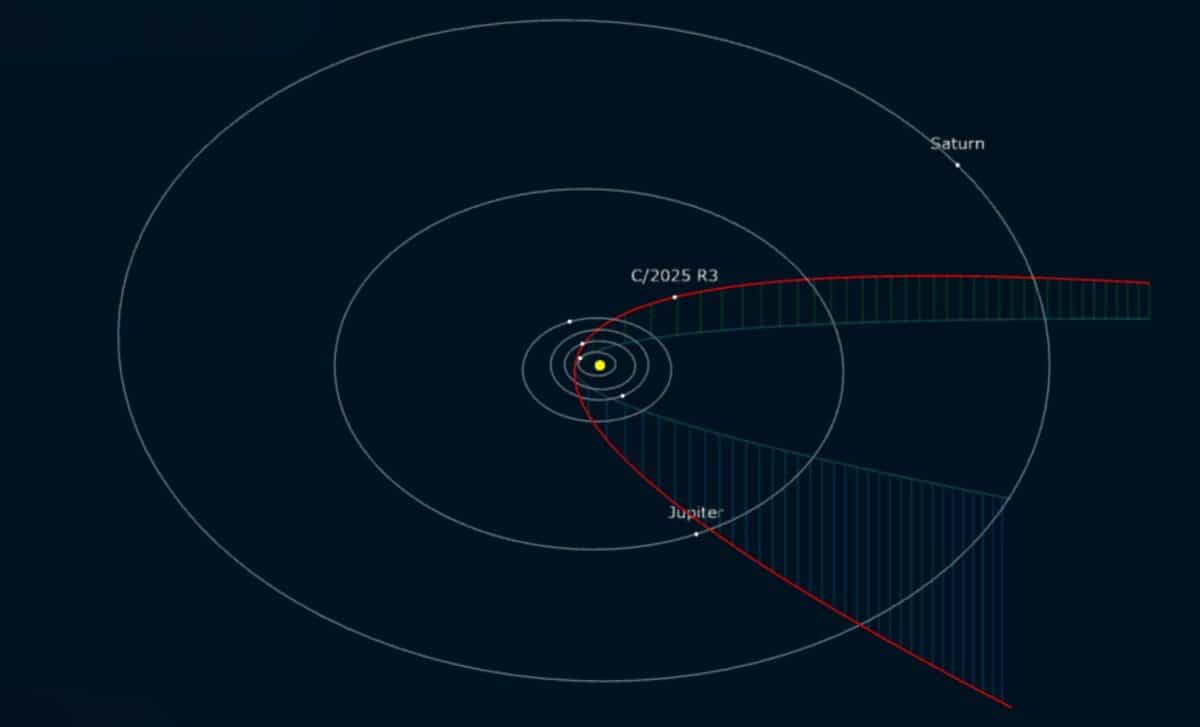 The comet’s path through the solar system and its position at the given date ©astro.vanbuitenen.nl
The comet’s orbit is highly inclined, with an inclination of 124.7°, and it follows a nearly parabolic trajectory, suggesting it is a new comet from the outer Oort Cloud, as stated in MPEC 2025-YF1. This first-time journey through the inner solar system increases both the excitement and the unpredictability of its brightness. During its closest approach, C/2025 R3 is projected to reach magnitude 3.3, comparable to some of the brighter stars in the night sky, though not necessarily visible in urban conditions.
Visibility Depends on Timing and Scattering
Whether this comet becomes a naked-eye object or remains a binocular target will largely depend on a phenomenon known as forward scattering. Because the comet passes between Earth and the sun in late April, sunlight reflecting off dust particles in its tail could intensify its apparent brightness. This effect has helped brighten other comets in the past, making them more visible than expected.
Another factor aiding visibility is the new moon on April 17, 2026, just days before perihelion. This phase ensures darker skies, improving the chance of spotting the comet in the pre-dawn hours from the Northern Hemisphere, particularly as it passes through the constellation Pisces, near the Great Square of Pegasus. By mid-April, observers can expect the comet to appear about 15 degrees above the eastern horizon an hour before sunrise, with only a waning crescent moon present in the sky.
Building Momentum After a Wave of Recent Comets
C/2025 R3 follows a sequence of notable comets that have rekindled interest in comet watching. According to Space, 2024 and 2025 featured six bright comets, including the “Devil Comet” 12P/Pons-Brooks and C/2024 G3 (ATLAS), dubbed the “New Year comet”, which impressed Southern Hemisphere viewers in January 2025. Later in the same year, C/2025 A6 (Lemmon) and C/2025 R2 (SWAN) made appearances in October, though only one came close to naked-eye visibility.
Adding to the recent excitement, 3I/ATLAS, the third interstellar object detected in our solar system, made headlines after its October 29 perihelion, when it unexpectedly brightened. Against this backdrop, C/2025 R3 emerges as a new potential highlight in a recent resurgence of comet activity.
Whether C/2025 R3 becomes a standout of 2026 or quietly fades from public view, its approach is one more chance for amateur astronomers and stargazers to look up and connect with the dynamics of our solar system. For now, anticipation builds with each passing night as the comet brightens slowly on its way toward the sun.